
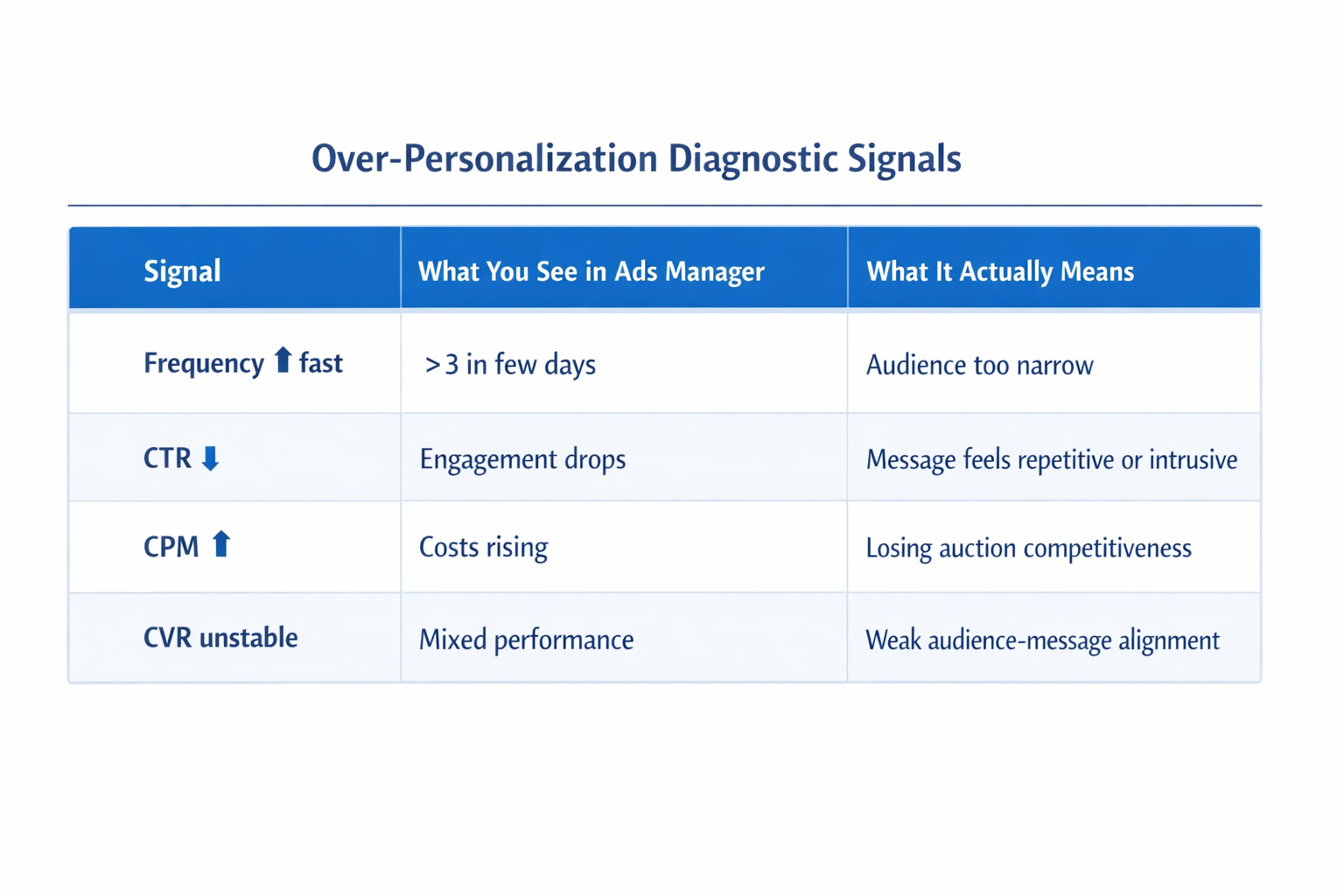
Personalization stops working the moment users feel watched. You can usually see this in campaign data before anybody on the legal or brand side raises the issue. CTR starts slipping, CPM rises without a clear targeting change, and frequency climbs faster than conversions. That pattern often means the platform is still finding relevant users, but the ad experience has started to feel too specific.
This is not just a compliance discussion. It is a performance problem. The more aggressively you personalize, the more carefully you need to manage trust, repetition, and signal quality.
Why Personalization Often Fails Before Privacy Becomes a Formal Problem
In most ad accounts, the first warning sign is not a policy notice. It is performance decay that feels hard to explain if you only look at surface metrics.
A familiar pattern looks like this:
-
Frequency rises too quickly inside a small audience.
This usually happens in tight retargeting pools or highly filtered custom audiences. The platform keeps serving impressions to the same people because there are not enough fresh users entering the segment. At first, that can look efficient. Then engagement softens, and the same budget starts buying weaker attention. -
CTR declines while CPM increases.
That combination matters because it suggests the ad is losing auction strength at the same time that user response is weakening. In practical terms, the platform has to pay more to keep showing an ad that fewer people want to engage with. -
Conversion quality becomes uneven.
You may still get results, but they come from a thinner slice of the audience. One placement or one pocket of users keeps converting while the rest of the segment becomes expensive and unreliable. That is often a sign that the message is too narrow, too repetitive, or too obviously behavior-driven.
This is where over-personalization starts to hurt. The campaign has not necessarily become non-compliant, but it has become less comfortable and less efficient.
How Platforms Actually Use Personal Data
Most advertisers still talk about personalization as if the platform is simply “tracking users.” In reality, delivery systems work more like behavioral prediction engines. They assemble patterns, score actions, and keep adjusting the audience model as new signals arrive.
That process usually works in three layers:
-
The platform groups behaviors, not just identities.
A user who compares product pages, pauses on pricing, and returns within two days may be clustered with other users showing similar intent patterns. The platform does not need perfect identity resolution to make that decision. It only needs enough behavioral consistency. -
Recent signals usually outweigh old ones.
A purchase yesterday, a strong engagement event this morning, or a cluster of recent visits can reshape delivery faster than advertisers expect. That is one reason campaigns sometimes “change behavior” without any manual edits. -
Expansion mechanisms push beyond your original inputs.
This is especially visible with lookalikes and broader algorithmic targeting. Once the system exhausts the most obvious matches, it starts testing adjacent patterns that resemble the seed audience closely enough to justify spend.
The important takeaway is simple: personalization is not static. You are not targeting a frozen group of users. You are shaping a moving system that keeps reinterpreting intent.
Where Privacy Pressure Actually Comes From
Privacy pressure does not only come from regulation or browser-level restrictions. In campaign management, it usually appears through operational friction.
Platform-level signal loss
When tracking becomes less deterministic, the impact is immediate:
-
Conversion events become delayed, aggregated, or modeled.
That weakens the feedback loop the platform uses for optimization. You are still getting signals, but they are less precise and often less timely. -
Retargeting pools become thinner or less stable.
Match rates fall, audience freshness decays faster, and segments that used to perform consistently start to swing. -
Optimization leans on broader signals.
Instead of learning from detailed micro-actions, the system begins relying more heavily on larger outcome patterns. That shifts power away from hyper-specific audience construction.
If you want a companion piece focused on this exact environment, Combating iOS Privacy Changes: Smart Ad Targeting Strategies for Facebook fits naturally here.
User behavior adaptation
Users do not think in terms of attribution frameworks, but they absolutely react to how ads feel.
You can usually spot that adaptation in a few ways:
-
Repeated ads start getting ignored faster.
The audience does not need to hate the ad. It just needs to recognize it too quickly and stop paying attention. -
Behavior-specific language starts feeling invasive.
Messaging like “you viewed this” or “still thinking about it?” can work in some accounts, but it also raises friction fast when frequency is already high. -
Contextual relevance outperforms explicit surveillance cues.
Ads that speak to the user’s likely problem often outperform ads that signal exactly what the platform knows about them. That difference matters more in privacy-sensitive environments.
Auction competition
Highly personalized campaigns often push you into the most expensive part of the auction.
That creates three practical problems:
-
The same high-intent users attract many advertisers.
So precision does not just improve relevance. It also concentrates competition. -
Spend distribution becomes less stable.
You may see patches of strong delivery and then long stretches where the campaign struggles to win enough impressions efficiently. -
Small engagement gaps become expensive.
In crowded auctions, even a modest decline in relevance or creative freshness can have a visible cost effect.
The Real Tradeoff: Precision vs. Scalability
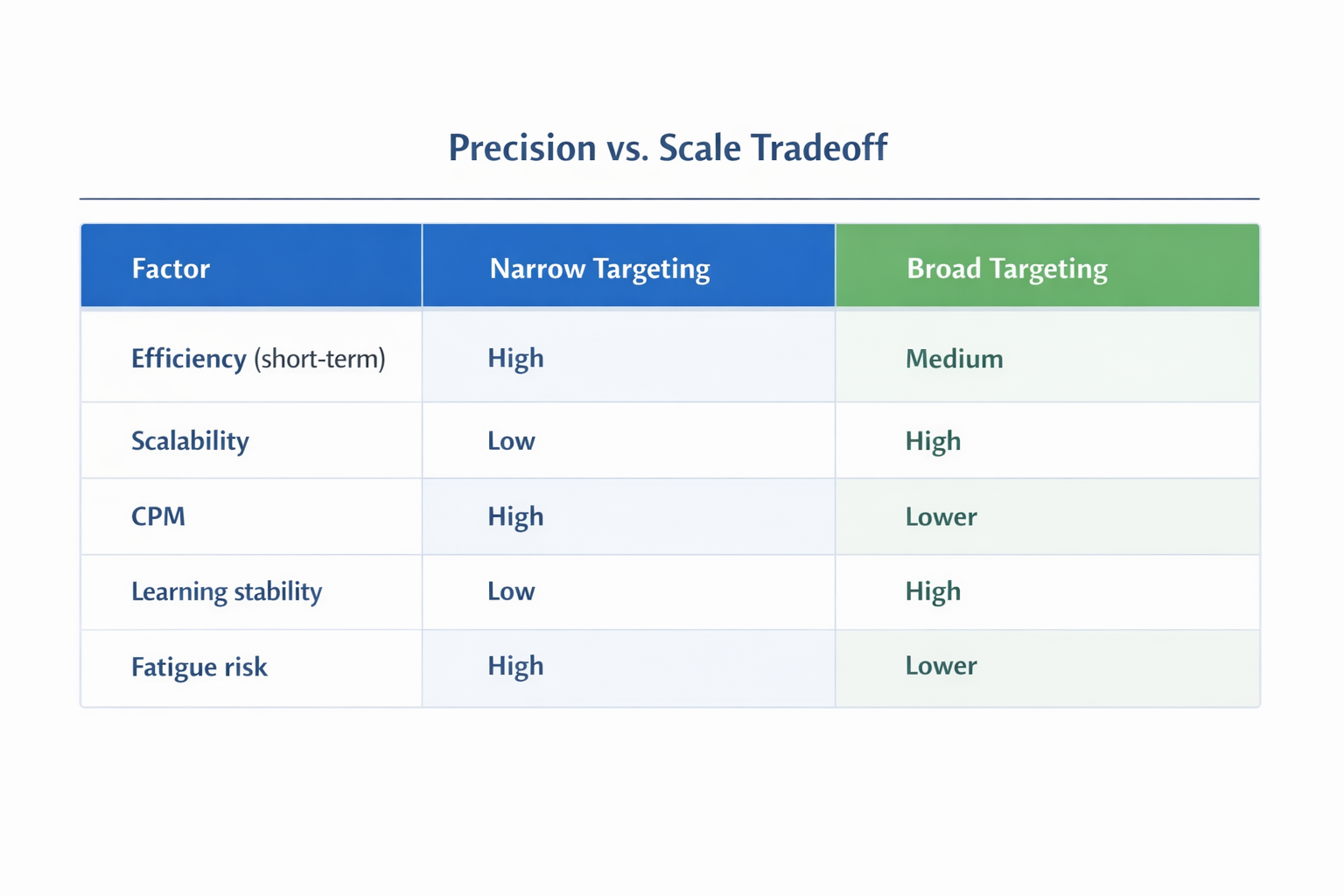
Highly personalized targeting often looks excellent at low spend because it captures the obvious opportunities first. The problem starts when you try to scale.
That usually happens for a few reasons:
-
Narrow audiences saturate fast.
Once you have reached the most responsive users, incremental impressions go to people with weaker intent or to the same people again. Performance looks fine until it suddenly does not. -
Creative options become too constrained.
The tighter the segment, the more marketers feel pushed to write narrowly tailored ads. That reduces flexibility and makes fatigue arrive faster. -
Learning becomes unstable when conversion volume is thin.
A small segment may produce enough conversions to look promising, but not enough for the system to generalize reliably as spend increases.
This is why broader models often age better. They give the platform more room to learn, more room to recover from weak pockets, and more space to find adjacent demand. If you want a side-by-side view of that decision, Retargeting vs. Broad Targeting: Which Strategy Drives Better Results? is a useful related article.
Practical Ways to Balance Personalization and Privacy
The best balance usually does not come from eliminating personalization. It comes from controlling where and how you use it.
1. Widen the audience logic before you widen the message
Advertisers often do the opposite. They write broader copy but keep very narrow audience rules. That can backfire because the delivery system has no room to stabilize.
A better approach is to:
-
Combine related actions into wider intent clusters.
For example, group engaged site visitors, pricing viewers, and high-attention content readers into a broader audience rather than isolating each signal into its own tiny segment. -
Use recency more than excessive filtering.
A clean 7-day or 14-day engaged audience often works better than a complicated audience with five stacked rules and low volume. -
Let expansion happen under control.
Once you see stable quality, giving the platform more room can reduce cost pressure without immediately sacrificing relevance.
2. Make the creative feel relevant, not invasive
Most privacy tension shows up in the message before it shows up in the targeting settings.
A healthier creative approach usually includes:
-
Problem-based framing instead of action-based framing.
Rather than saying “you checked our pricing,” say something that speaks to hesitation, evaluation, or comparison. The ad still feels relevant, but not intrusive. -
Rotation before fatigue becomes obvious.
Do not wait for CTR to collapse. When frequency rises and response begins to flatten, rotate sooner. -
Segment by intent stage, not by every observable behavior.
A message for “evaluating options” is often more durable than a message for “viewed feature page but not demo page.”
3. Watch the metrics that reveal discomfort early
You do not need direct user feedback to know when the balance is off. Performance patterns tell you a lot.
The most useful diagnostic signals are:
-
CTR falling while frequency rises.
That often means recognition is increasing faster than interest. -
CPM rising without a structural campaign change.
When the platform pays more for the same audience, it often reflects weaker relevance or stronger competition. -
Uneven conversion behavior across placements or segments.
That can reveal that only part of your audience still finds the personalization helpful. -
Lead quality or downstream acceptance rate slipping while top-line conversion volume holds.
This is especially common when the campaign keeps finding easy clicks but not durable intent.
4. Depend less on fragile signals
Some inputs are simply less reliable in privacy-constrained environments.
That means you should usually be more careful with:
-
Tiny micro-conversion audiences.
They can look precise, but they often decay quickly and create unstable optimization. -
Extremely narrow retargeting windows.
These can work in high-volume ecommerce, but in many accounts they become too small to scale without repetition problems. -
Heavy over-segmentation.
Splitting every behavior into its own audience can make the whole account harder to learn from and harder to manage.
More resilient campaigns usually lean on broader conversion signals, stronger first-party inputs, and cleaner audience structures.
A More Durable Model of Personalization
The best long-term approach is not “less personalization.” It is smarter personalization.
That means:
-
Using first-party data and behavioral insight to guide direction, not to over-script every ad impression.
-
Allowing the platform to infer patterns where that improves stability.
-
Writing creatives that feel useful and timely without sounding like they were generated from a surveillance log.
-
Treating trust as part of performance, not as a separate brand concern.
In other words, personalization should help the system find the right people, but it should not make the ad feel too knowing.
Final takeaway
If your campaigns only work when the platform has extremely specific user data, they will probably become more fragile over time. Privacy changes, signal loss, rising competition, and user fatigue all push against that model.
The stronger alternative is to build campaigns that can still perform when the data is less precise. Broader but cleaner audience logic, more human creative framing, and better diagnostic discipline usually create a healthier balance between relevance and trust.
Personalization should guide the system — not corner it.
