Funnels rarely break everywhere at once. Performance usually degrades at a single stage while the rest continues to function, which makes the issue easy to misread.
You might see stable CTR and consistent traffic, yet pipeline or revenue stalls. That’s not a top-level failure — it’s a bottleneck inside the funnel.
If you’ve ever faced a situation where everything “looks fine” but results don’t move, it’s the same pattern described in Ad Metrics That Lie: When Good Numbers Hide Bad Performance.
Why Bottlenecks Get Missed
Blended metrics hide where friction appears.
-
CPL can stay stable while lead quality drops.
-
CTR can remain strong while landing page engagement declines.
-
Spend can scale without increasing revenue.
Each of these situations creates a false sense of stability. The system looks healthy at the surface level, but the efficiency loss is pushed downstream, where it becomes harder to attribute.
This is why many advertisers misread performance and keep optimizing the wrong stage.
First Step: Locate the Break Point
Don’t look at isolated metrics.
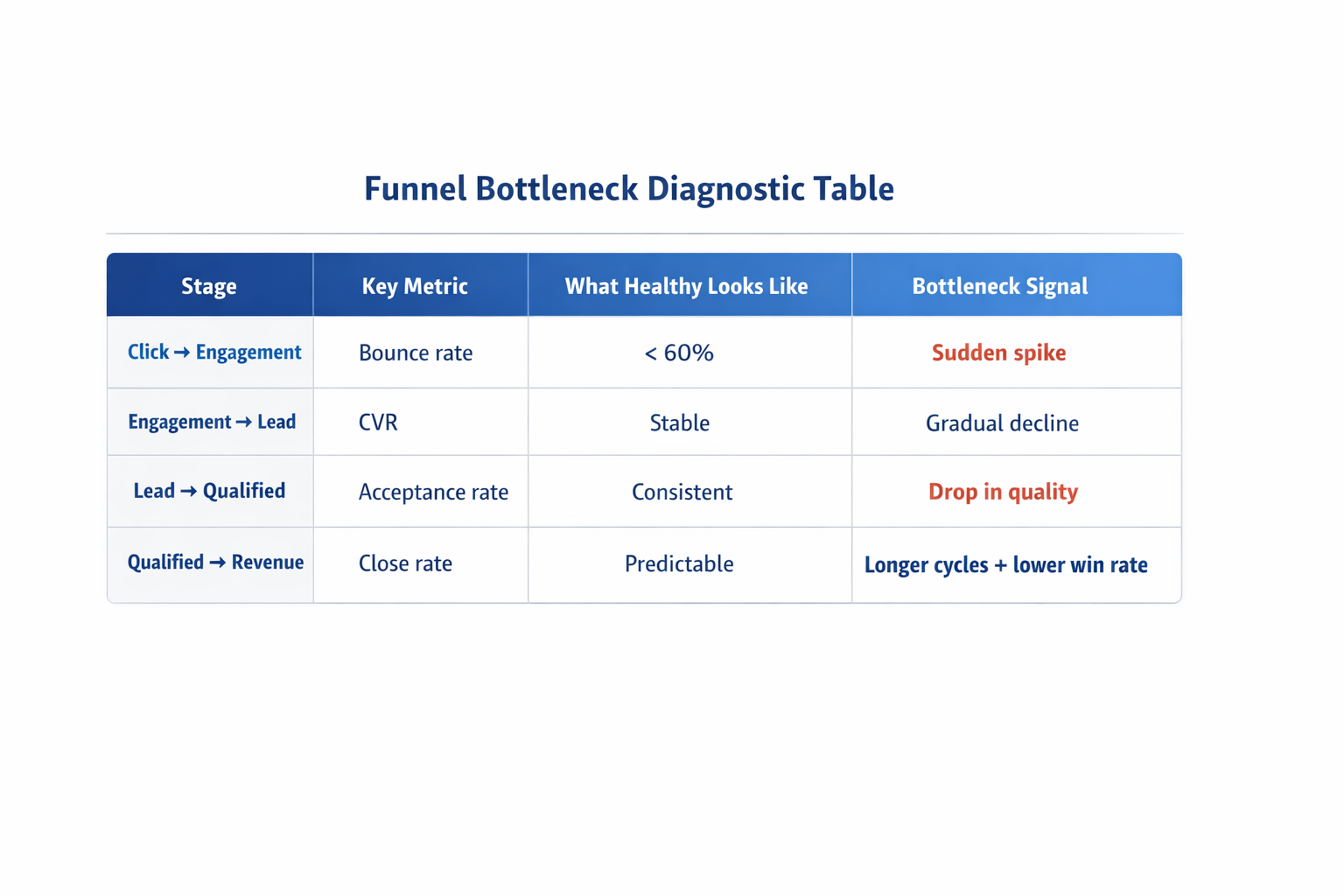
Compare transitions between stages:
-
Click → Engagement (bounce rate, time on page).
-
Engagement → Lead (form completion rate).
-
Lead → Qualified lead (acceptance rate).
-
Qualified lead → Revenue (close rate).
These transitions show how intent moves through the funnel. When one step underperforms relative to the others, you’re not dealing with a general issue — you’re looking at a specific point of friction.
A more structured way to analyze this is covered in How to Analyze Campaign Performance Beyond CTR and CPC.
Pre-Click Misalignment
You’ll see high CTR but weak downstream performance.
-
Messaging is too broad or curiosity-driven.
-
Creatives attract clicks without qualifying intent.
-
Audience expansion drifts into low-relevance segments.
In this case, the system keeps delivering because engagement signals look strong. The mismatch only becomes visible after the click, when users fail to engage or convert.
Fix:
-
Make the offer more specific so low-intent users filter out.
-
Align messaging with actual commitment level.
-
Segment creatives by audience intent.
This issue is explored in depth in Why Your Ads Get Clicks But No Sales: Fixing the Audience Misalignment.
Landing Page Friction
Users click but don’t convert.
-
CTR remains stable while CVR declines.
-
Bounce rate increases after page changes.
-
Time on page drops without traffic quality shifts.
These signals indicate that users arrive with a clear expectation but don’t find confirmation quickly enough. The friction appears in the first few seconds of the visit.
Fix:
-
Match the headline to the ad exactly.
-
Keep one clear action above the fold.
-
Reduce time-to-understanding to a few seconds.
If the first interaction fails, the rest of the funnel never gets a chance to work.
Form-Level Drop-Off
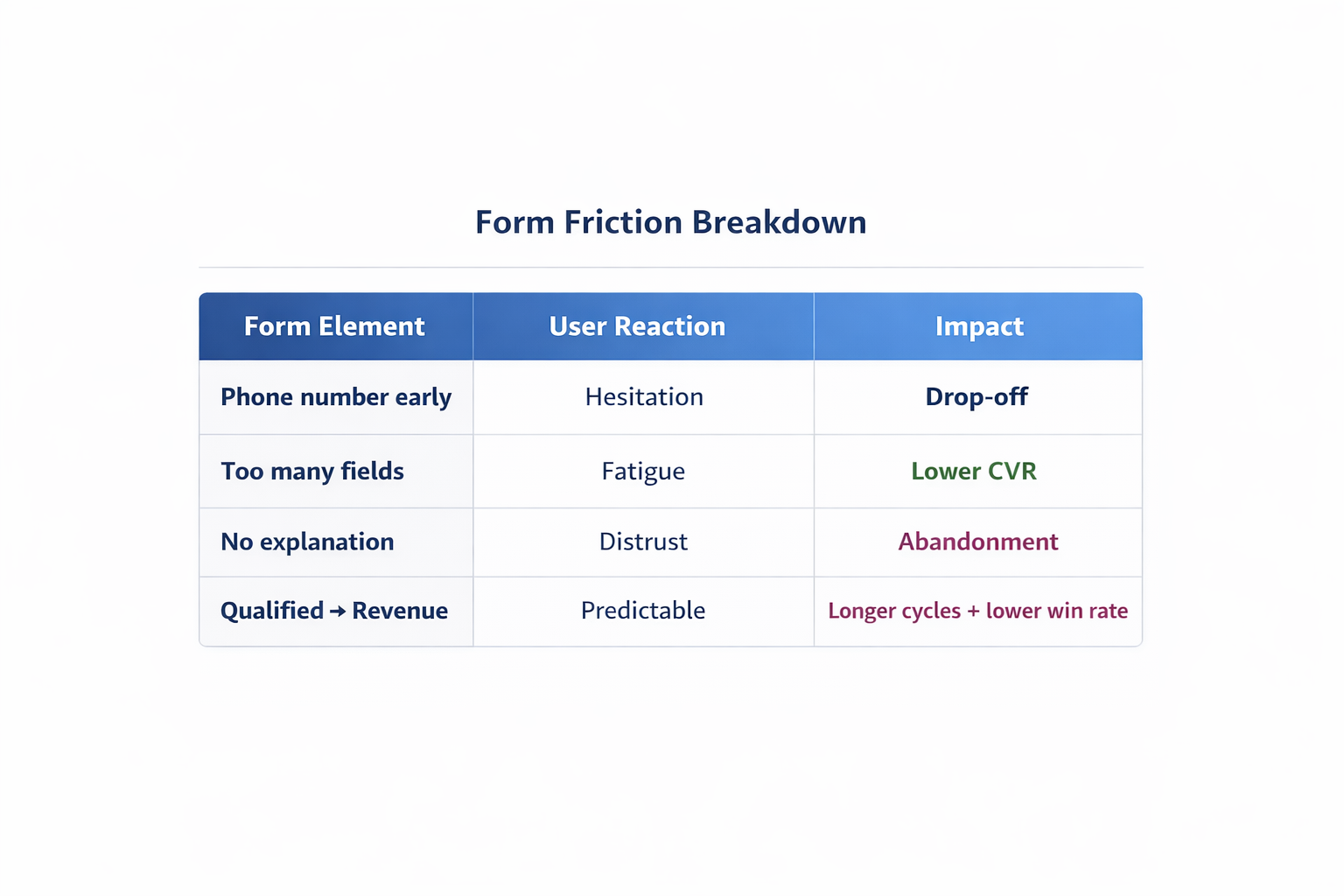
Users engage but don’t submit.
-
Scroll depth is strong but completion rate is low.
-
Drop-off concentrates on specific fields.
-
CVR drops after adding qualification steps.
This usually happens when friction is introduced too early or without context. Users are willing to convert, but the structure of the form interrupts that intent.
Fix:
-
Move high-commitment fields later.
-
Explain why information is needed.
-
Use conditional logic instead of static forms.
You can see practical examples of this in What Makes a Facebook Lead Form Convert? 5 Key Optimization Tips.
Post-Lead Quality Collapse
CPL looks healthy, but sales rejects more leads.
-
Acceptance rate declines.
-
Sales cycles become longer.
-
Close rates drop despite stable lead volume.
At this point, the campaign is optimizing for ease of conversion rather than business value. The algorithm finds users who submit forms, not users who are likely to buy.
Fix:
-
Optimize for qualified leads, not form fills.
-
Add soft qualification steps.
-
Align targeting with high-value segments.
Without correcting this, scaling only amplifies inefficiency, because more budget flows into low-quality acquisition.
Delivery Issues Disguised as Funnel Problems
Sometimes performance shifts come from delivery, not the funnel.
-
CPM rises while CTR remains stable.
-
Spend distribution becomes uneven.
-
Conversion rates fluctuate without funnel changes.
These patterns indicate reduced access to competitive auctions. The funnel appears inconsistent because the input traffic quality is unstable.
Fix:
-
Refresh creatives.
-
Expand audience if saturated.
-
Check delivery patterns before changing the funnel.
If you skip this step, you risk solving the wrong problem.
Final Takeaway
A funnel bottleneck is where user intent drops between stages.
If you focus on transitions — not aggregate metrics — you can isolate the exact failure point and fix it without disrupting the rest of the system.
For a deeper breakdown of funnel-stage optimization, see Funnel Drop-Off Fixes: How to Improve Each Stage with Facebook Ad Data.