If your ad copy still reads like a spec sheet, you’re doing it wrong.
Consumers don’t care that your product has 32 gigabytes of RAM or uses high-density polyethylene. They care about what it does for them. How it makes their life better, faster, easier, or even cooler.
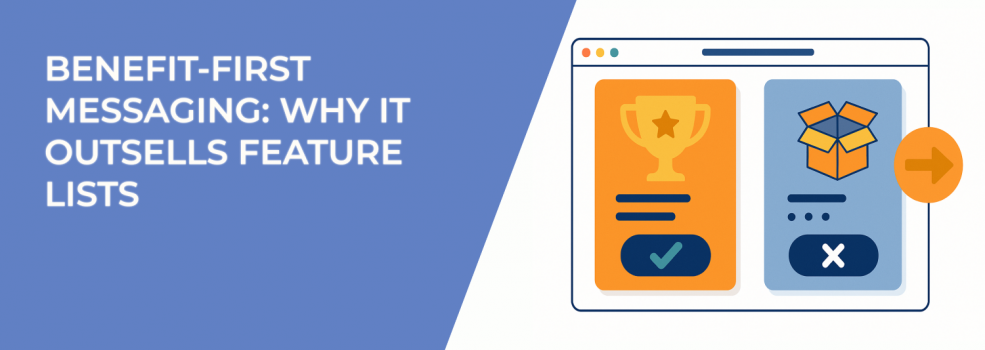
This is the shift that benefit-first messaging makes — and it’s why it consistently outperforms feature-based approaches across industries, platforms, and audience segments.
Let’s dig into why this works, how to apply it, and what it means for performance marketers aiming to drive real conversions.
What is Benefit-First Messaging?
At its core, benefit-first messaging leads with outcomes. Not components. Not technical specs. But the result someone can expect after buying, using, or subscribing.
Think of it like this:
- Instead of saying: “Our running shoes have dual-layer EVA foam,”
- Say: “Run longer without sore feet.”
One is a feature. The other is a benefit — and it hits home.
People make decisions based on emotion, then rationalize them with logic. Your job isn’t to list facts. Your job is to spark action.
Why Feature Lists Fail (Most of the Time)
Feature-heavy copy assumes the customer already understands the value. But in many cases, they don’t. Or they don’t care — yet.
Here’s why listing features alone can kill performance:
-
Lack of context: Features without explanation don’t translate to value.
-
Mental friction: Users have to connect the dots themselves. Most won’t.
-
Too much jargon: Especially in tech and SaaS, terminology becomes a wall, not a bridge.
-
Missing emotion: There’s no story, no aspiration, no motivation.
This kind of disconnect often leads to lowr click-through rates, or worse — the dreaded “Ad Set May Get Zero” warning on Facebook.
The Psychology Behind Benefit-First Copy
People don’t buy products. They buy better versions of themselves.
They buy more free time, less hassle, peace of mind, or social approval. They buy solutions to their frustrations. And they buy faster when those outcomes are obvious.
Benefit-first copy activates desire — not analysis.
Here’s what it taps into:
-
Self-interest: What’s in it for me?
-
Fear of missing out: What happens if I don’t act?
-
Instant clarity: What do I get, not what do I have to understand?
This matters in high-scroll environments like Facebook, TikTok, or Instagram Ads, where attention spans are short and decisions are gut-level. To write messaging that hits this emotional mark, explore how to tap into emotional triggers that drive ad performance.
And if you're still working on dialing in your target persona? Start with this step-by-step guide to defining a target audience.
How to Craft Benefit-First Messaging That Converts
Let’s break this into steps. Use these when writing ad copy, landing pages, emails — anything performance-focused.
1. Start With the Outcome
What’s the real-world result of your product or offer?
-
“Get better sleep in 7 days.”
-
“Never forget a password again.”
-
“Double your client leads without extra ad spend.”
Begin there. Don’t bury it in paragraph three.
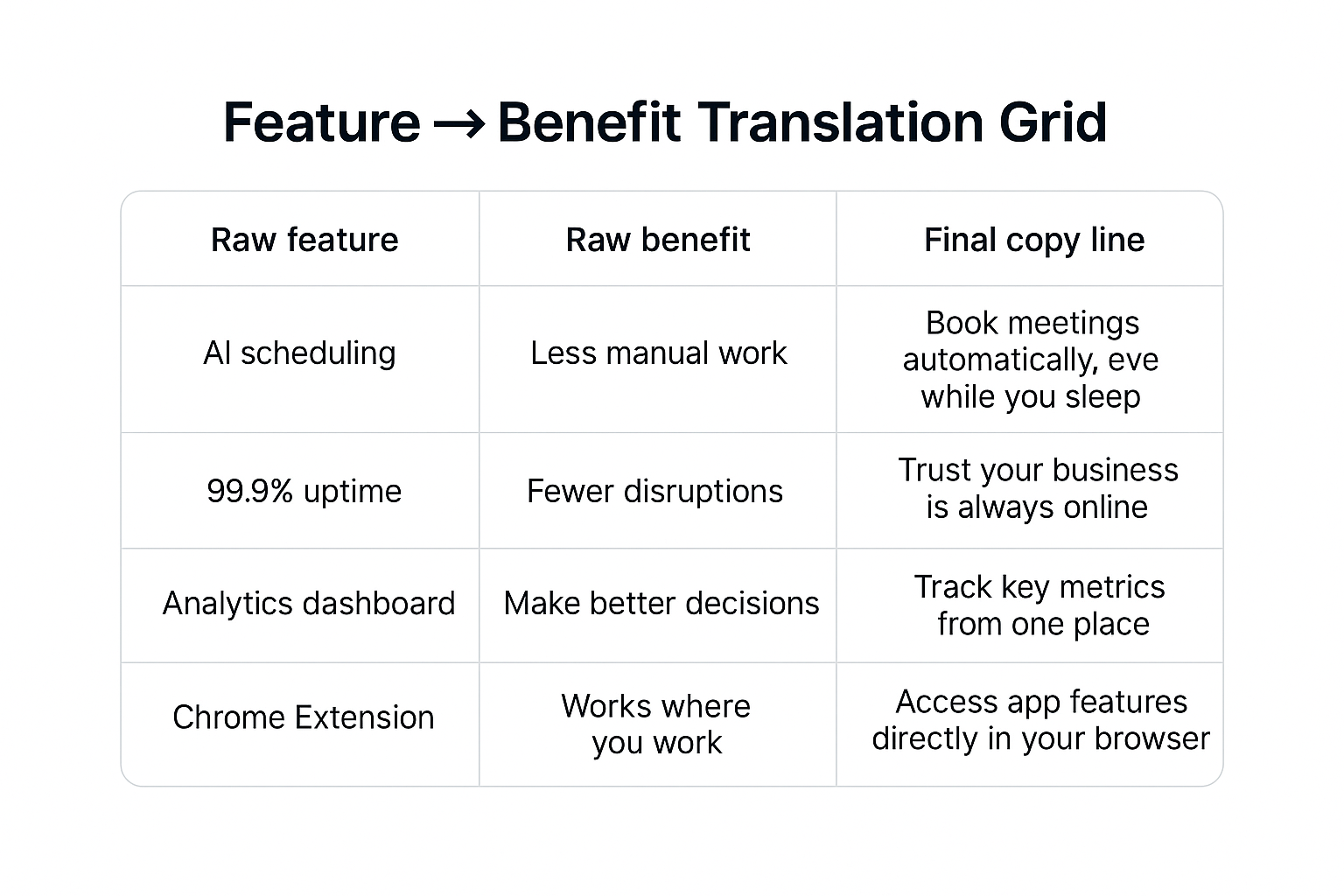
2. Translate Features Into Benefits
Every feature exists for a reason. Make that reason clear.
| Feature | Translate to Benefit |
|---|---|
| “AI-powered scheduling tool” | “Book more meetings without the back-and-forth” |
| “Ergonomic back support” | “Work 8 hours without nagging back pain” |
| “Built-in calorie tracker” | “Stay on top of your goals without logging manually” |
If you’re using AI to generate creative, make sure you’re prompting it for benefit-first copy — not specs. Check out these AI tools for text and image generation that can help speed up your workflow without compromising message quality.
3. Make It Tangible
Vague benefits don’t sell. Specific ones do.
Instead of “Improve productivity,” say “Free up 3 hours a week.”
Instead of “Feel better fast,” say “Relieve cold symptoms in 24 hours.”
Make the benefit feel real — even measurable. And if you’re writing static image ads, this step becomes even more critical. Here’s how to write copy that actually sells in static Facebook ads.
4. Use the Right Format for the Right Funnel Stage
Top-of-funnel? Lead with emotion.
Middle? Add proof and specifics.
Bottom? Bring in features and logic — after benefits have landed.
That approach also works well when you're choosing Meta ad objectives based on your campaign goals.
Ad Examples: Before vs. After
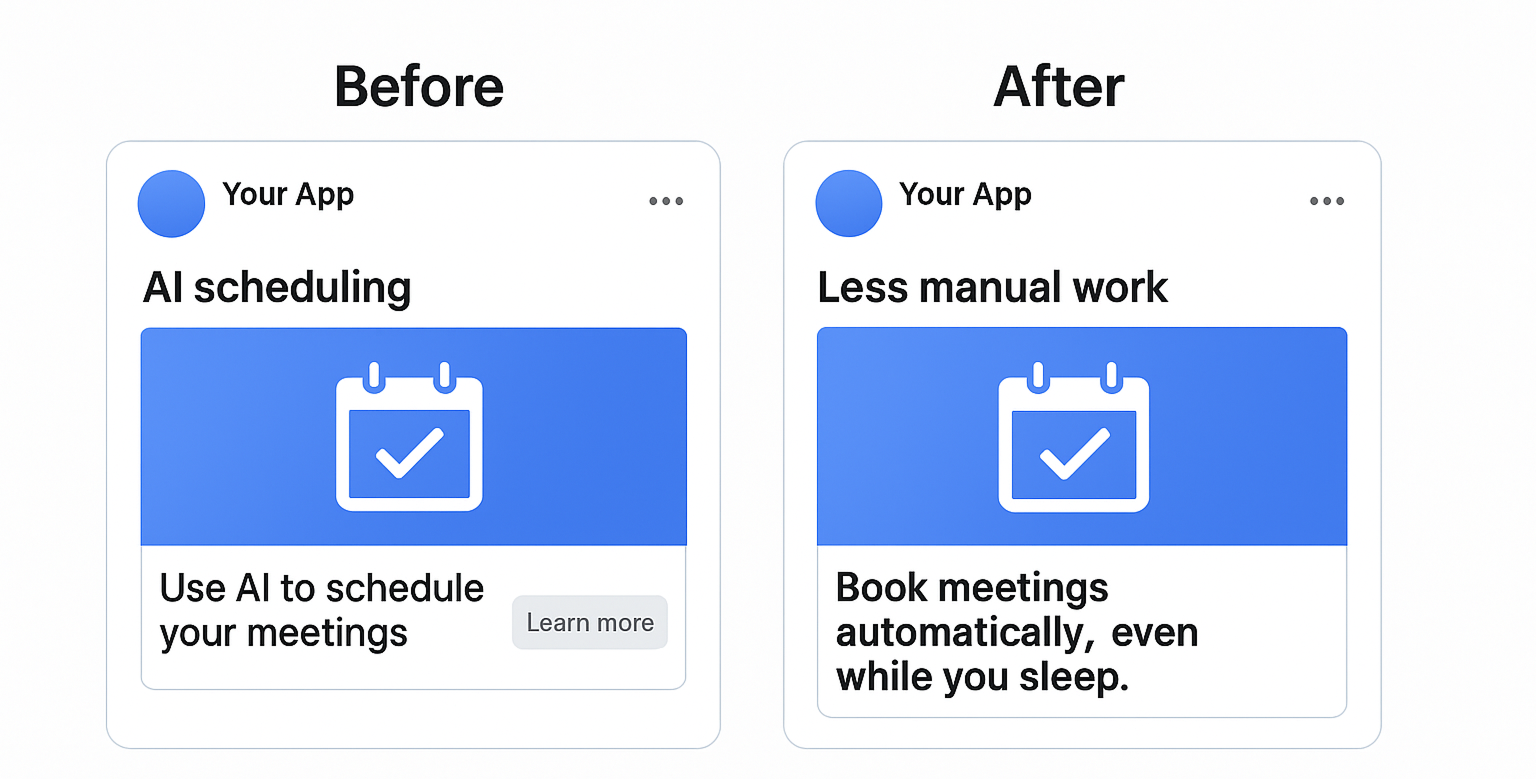
BEFORE (Feature-First):
“Our software offers API integrations, multi-layer encryption, and customizable dashboards.”
AFTER (Benefit-First):
“Secure your data and simplify workflows — all in one dashboard you can make your own.”
BEFORE:
“Now with triple-filtration and stainless-steel casing.”
AFTER:
“Cleaner water, better taste — and a filter that lasts for years.”
See the difference? The second version sells the result, not the mechanism.
If you’re still unsure where to start, review this guide to crafting compelling Facebook ad copy that converts.
Benefit-Based Messaging = Better Conversions
Still struggling to get your Facebook ads to convert even though the design and targeting seem solid? There’s a good chance your copy is the culprit. Weak messaging is one of the top reasons Facebook ads stop converting — even when everything else looks right.
Final Tip: Test Benefits Like You Test Creatives
Just like you'd A/B test videos or headlines, test different benefits.
Not all users care about the same thing.
-
One might care about speed.
-
Another about cost-saving.
-
A third about simplicity.
Try leading with each in separate ad sets. See which message finds the strongest signal — then scale. Here’s how to test ad copy variations strategically without wasting spend or muddying results.
TL;DR — People Buy Outcomes, Not Features
If you want better ROAS, stronger engagement, and lower bounce, make this your rule:
Always sell the result before the reasons.
Don’t list what your product does. Show what it delivers — and why that makes your audience’s life better, easier, or more successful.
Once that lands, the features just become the proof.