Meta Business Suite lets you turn existing posts or Reels into ads directly from desktop.
You select content, choose a few settings, and launch. The system automatically pulls in your creative and suggests audiences and goals.
That simplicity makes it attractive — but it also removes critical control.
The more decisions Meta makes for you, the less predictable your performance becomes.
Why Business Suite boosting hides important campaign decisions
Boosting from Business Suite is content-first. You start with a post, then adapt it into an ad.
That approach works for distribution, but not for structured campaign performance.
You’re not building targeting, testing variations, or controlling optimization at a granular level. Instead, you’re relying on pre-configured settings and recommendations.
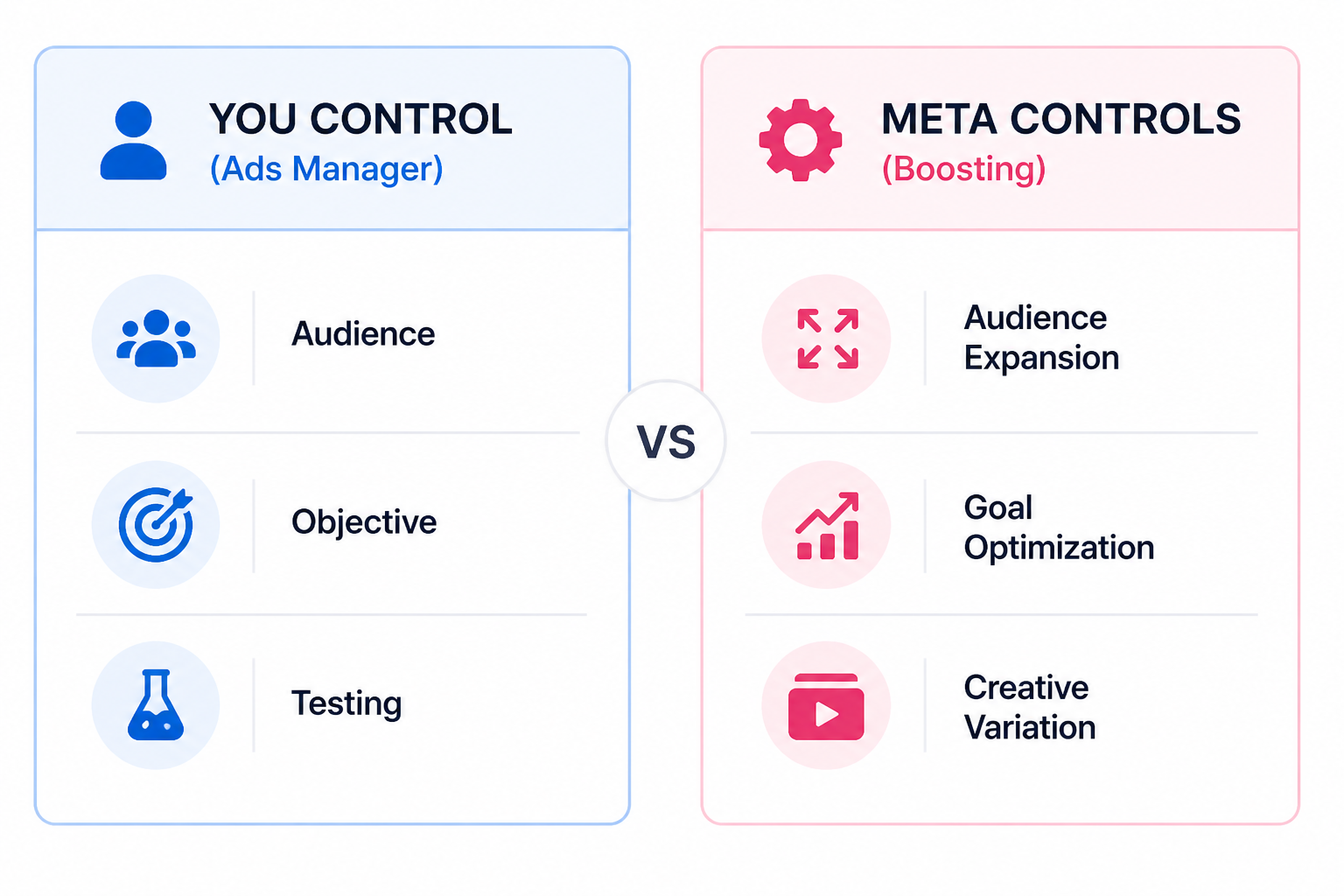
Inside Ads Manager, this often shows up as:
- Stable delivery with consistent spend.
- Healthy engagement metrics.
- Weak or inconsistent conversion outcomes.
The campaign is working — just not toward the metric that actually matters.
Automatic goal selection can misalign your campaign
When boosting content, Meta allows you to select a goal or leave it on automatic.
That automatic setting uses past activity to choose what it believes is the most relevant objective.
If left unchanged, Meta may optimize for engagement or traffic instead of conversions.
This becomes visible in campaign behavior:
- Click volume increases without conversion growth.
- Engagement rises, but lead quality drops.
- CPA increases while surface metrics look strong.
Once the system learns the wrong objective, it reinforces that behavior.
Fixing it later usually requires resetting the campaign — which slows down performance.
Advantage+ automation shifts how your ads are delivered
Meta Business Suite includes automation features such as Advantage+ creative and Advantage+ audience.
These tools adjust delivery dynamically. They test variations, expand audiences, and optimize toward users most likely to respond.
When supported by strong data, they can improve performance.
Without strong signals, they create a different effect.
- Delivery expands beyond your initial audience.
- Engagement increases, but relevance declines.
- Spend shifts toward lower-intent users.
Automation amplifies existing signals — it does not create new ones.
If your input data is weak, automation will scale that weakness.
Boosting Reels introduces a different performance dynamic
Reels behave differently from standard posts.
They are designed for fast consumption, short attention spans, and high engagement volume.
When boosted, that behavior carries into paid delivery.
You’ll often see:
- High video views.
- Strong engagement signals.
- Weak conversion performance.
The issue is intent.
Users watch Reels passively. They engage quickly, but rarely stop to evaluate an offer in depth.
High engagement on a Reel does not guarantee high conversion intent.
Before scaling, it’s important to validate whether your content can drive action. You can explore how to make Reels work for lead generation.
Continuous boosting can quietly increase wasted spend
Meta Business Suite allows you to run ads continuously or schedule them over time.
This flexibility can create hidden inefficiencies.
When campaigns run without intervention, performance typically follows a predictable pattern:
- Frequency increases as the same audience sees the ad repeatedly.
- CTR gradually declines as attention drops.
- CPA rises as the system reaches less responsive users.
Because boosted campaigns are often left running, these changes are not always caught early.
Continuous delivery without active optimization leads to performance decay.
Audience selection determines how far a boost can scale
Business Suite gives you the option to use recommended audiences or define your own.
Recommended audiences are easy to deploy, but they often rely on broad assumptions.
That leads to a familiar trajectory. Early results look strong, but degrade as delivery expands.
The system prioritizes scale, not precision.
You’ll typically observe:
- High reach with stable engagement.
- Declining relevance over time.
- Lower conversion efficiency as the audience widens.
Improving results requires more precise audience signals.
Without them, the system will continue to prioritize volume over quality.
Boosting content is not the same as building a campaign
Boosting is reactive. It promotes content that already exists.
Performance campaigns are proactive. They are built around a defined goal, audience, and structure.
This difference explains why boosted campaigns often struggle to scale.
When results decline, the root cause usually falls into one of three areas:
- The content was not designed to convert.
- The audience lacks intent.
- The goal does not match the business outcome.
Using organic post data to guide ad creative decisions helps reduce this gap before you invest budget.
How to evaluate boosted posts and Reels correctly
Boosted campaigns should not be judged by engagement alone.
You need to evaluate how traffic behaves after the click.
The key metrics to track are:
- CPC — indicates cost efficiency, not intent.
- Landing page views — confirm whether clicks are meaningful.
- Conversion rate — shows whether users take action.
- Lead quality — determines business relevance.
- ROAS — connects spend to revenue.
A common failure pattern is:
Stable delivery combined with high engagement but low conversion rates.
When that appears, the campaign is optimizing for attention rather than results.
Final takeaway
Boosting posts and Reels in Meta Business Suite is designed for speed and simplicity.
It works when the goal is visibility, engagement, or audience growth. It struggles when the goal is predictable CPA, high-quality leads, or scalable ROAS.
Automation can improve delivery — but only when your inputs are strong.
Use boosting to amplify content. Use structured campaigns to control performance.
That distinction is what separates efficient spend from wasted budget.