Instagram ad costs are not fixed. There is no standard CPC, CPM, or CPA you can rely on across campaigns because every impression is bought through a live auction. That means pricing changes constantly based on competition, audience behavior, and how your ad performs.
Most advertisers look for benchmarks, but those only tell you what others are paying — not why your campaign is more expensive. The real driver is how your campaign performs inside the auction. If you want a broader view of how pricing behaves across Meta, it helps to understand what influences ad costs across Meta platforms before focusing only on Instagram.
The auction system is what actually sets your price
Every time your ad is eligible to show, it enters an auction with other advertisers targeting the same audience. Meta evaluates your bid, the predicted likelihood of a user taking action, and the quality of your ad before deciding which ad wins.
This explains why two advertisers targeting the same audience can pay different prices. A more relevant ad with stronger engagement signals can win auctions at a lower cost because Meta expects it to perform better.
You are not paying for placement — you are competing for outcomes.
Why Instagram ad costs vary so much between campaigns
Cost variation is usually tied to a combination of structural factors rather than a single issue. Even small changes in targeting or timing can significantly shift pricing.
The most common cost drivers are:
- Audience competition — highly specific or high-income audiences attract more advertisers, which increases CPM.
- Industry pressure — e-commerce, fashion, and beauty campaigns tend to be more competitive and therefore more expensive.
- Seasonality — costs spike during peak periods such as Black Friday or holidays when demand increases.
- Campaign objective — conversion campaigns cost more than awareness because the action has higher value.
- Bidding strategy — manual bidding can reduce costs, but incorrect bids can quickly increase them.
These factors combine rather than operate independently, which is why costs can change even if your campaign setup looks identical.
CPC, CPM, and engagement costs don’t tell the full story
Benchmarks often show ranges like $0.40–$1.20 per click or $2–$6 CPM, but these numbers are only part of the picture. The type of click matters more than the price of the click.
A general click that expands an ad or triggers engagement is cheaper than a click that sends a user to your website. That’s why link clicks usually cost more.
This becomes clear when you analyze post-click behavior. If users click but do not stay or convert, the campaign may look efficient while actually underperforming. To better understand this, it’s useful to look at what impressions actually tell you about performance and how they relate to downstream metrics.
Cheap traffic without intent will always inflate your real CPA.
Ad relevance is the fastest way to reduce cost
Meta rewards ads that resonate with users. When engagement is strong relative to the audience, the platform lowers delivery costs because the ad is considered valuable.
You’ll usually see this reflected in performance trends. Higher CTR leads to more efficient delivery, more stable CPM, and improved cost per result over time. If CTR drops, costs increase because the system detects weaker alignment between your message and your audience.
Relevance directly affects pricing — it is not just a creative metric.
Budget size influences how quickly your costs stabilize
You can start with a small daily budget, but low spend often slows down the learning process. The system needs enough data to understand who is most likely to respond to your ad.
During the learning phase, costs tend to fluctuate more. CPM can be higher, CPC less stable, and conversion performance inconsistent. As more data accumulates, performance usually improves — but only if the campaign structure is strong.
This is why early results often look worse than long-term performance.
Why your objective determines how expensive your campaign is
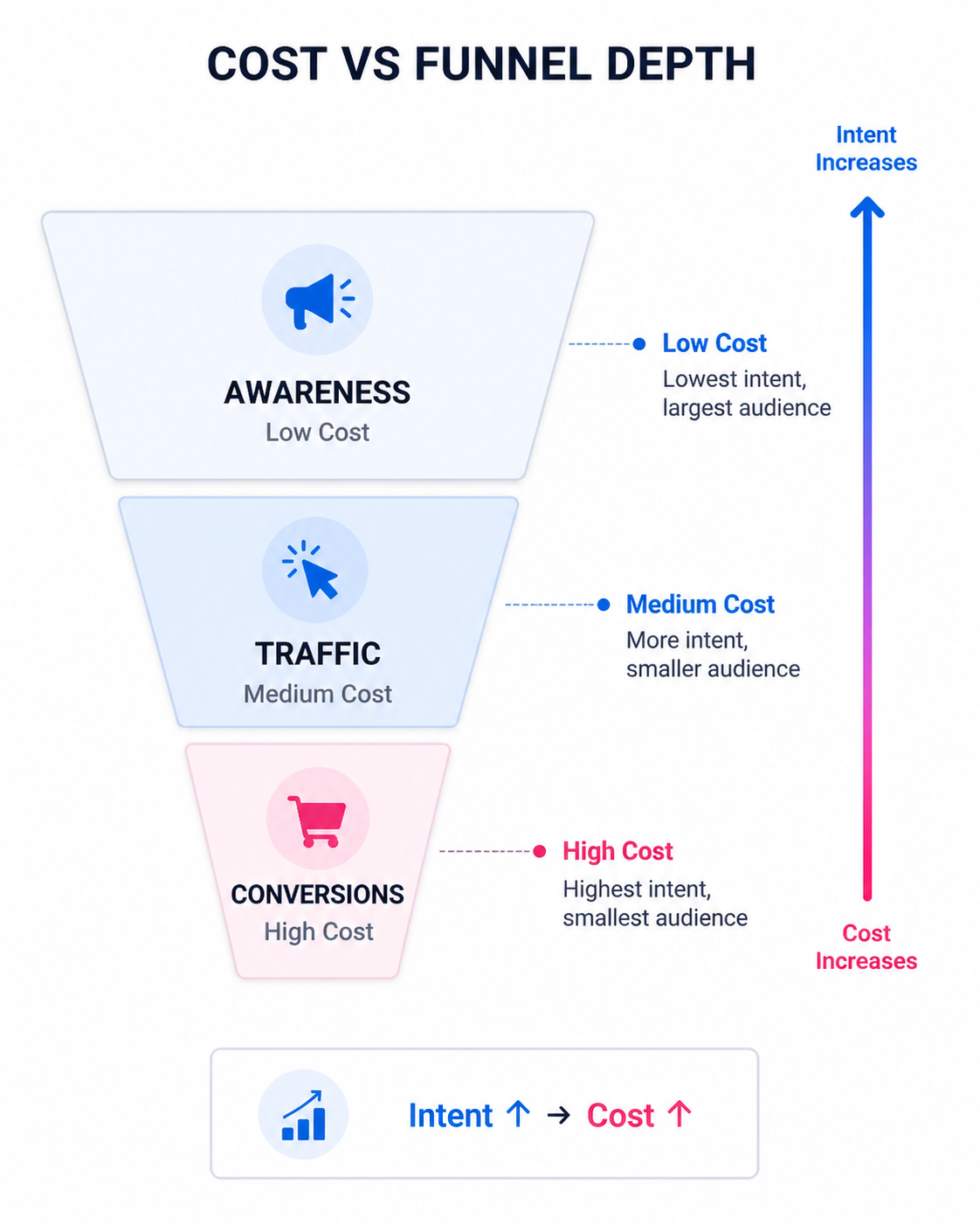
Different campaign objectives carry different levels of value, and pricing reflects that.
Awareness campaigns are cheaper because they optimize for reach and impressions. Traffic campaigns focus on clicks, which require slightly more intent. Conversion campaigns are the most expensive because they target users who are more likely to take meaningful action.
As you move down the funnel, costs increase — but so should revenue potential.
Higher CPA is not a problem if it scales profitably.
Where you create your ads also affects control
Instagram ads can be created through three main interfaces:
- Your Instagram profile — fast setup with limited control.
- Meta Business Suite — simplified campaign creation with standard settings.
- Ads Manager — full control over targeting, bidding, and optimization.
The more control you have, the more precisely you can influence cost. Advertisers who rely only on boosting typically give up the ability to optimize deeper performance drivers.
How to lower your Instagram ad costs without hurting performance
Lowering costs is not about reducing spend. It’s about improving how your campaign competes in the auction.
The most effective adjustments are:
- Align your objective with funnel stage so Meta optimizes for realistic user behavior.
- Use broader placement options to reduce competition pressure and access cheaper inventory.
- Continuously test creative variations to improve engagement and strengthen relevance signals.
If you want to go deeper into practical optimization, you can explore how to reduce your ad costs without killing performance and apply the same logic to Instagram campaigns.
Final takeaway
Instagram ad costs are dynamic because the system behind them is dynamic. Competition, audience behavior, and ad relevance all influence what you pay for each result.
You don’t control the price directly — you control the inputs that influence it.
Advertisers who focus only on CPC or CPM miss the bigger picture. The goal is not cheaper clicks, but more efficient conversions.
When your targeting is aligned, your creative resonates, and your objective matches user intent, costs decrease while performance improves.