Effective budget allocation is one of the biggest levers for improving paid acquisition performance. As platforms evolve, competition grows, and privacy changes reshape targeting, knowing exactly where to invest your ad spend across the funnel becomes crucial. In 2025, brands that intentionally structure budgets by awareness, consideration, and conversion stages are seeing stronger ROAS, more efficient CPAs, and more predictable scaling.
Below is a data-backed framework to guide your planning.
Why Funnel-Based Budgeting Matters More in 2025
Customer journeys have become longer and more multi‑touch. A single-channel, single‑stage approach no longer supports predictable growth. Recent surveys show that 68% of marketers increased their investment in top-of-funnel content in 2024, anticipating rising acquisition costs. Additionally, brands using three or more funnel stages in their campaign structure report 32% lower blended CPA.
A well-structured funnel distributes spend strategically, ensuring you’re not over-funding broad audiences or under-funding buyers already close to converting.
Recommended Budget Breakdown for 2025
While exact allocations vary by industry, average-performing digital programs in 2025 follow a reliable pattern:
-
Top of Funnel (TOF): 45–55% of budget
-
Middle of Funnel (MOF): 25–35%
-
Bottom of Funnel (BOF): 15–25%
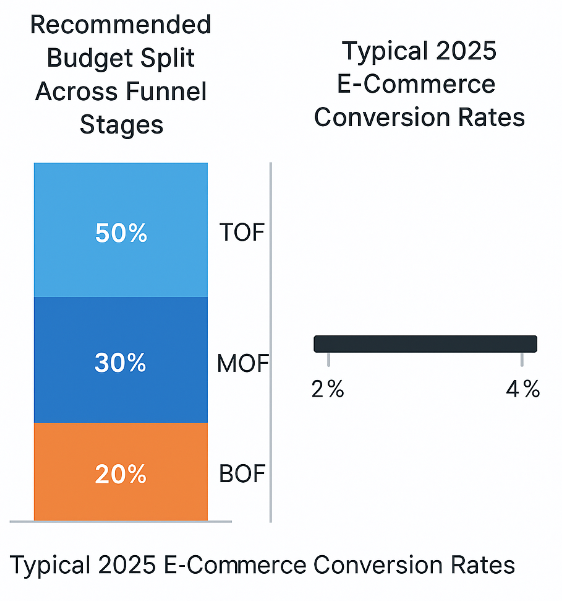
Recommended budget split across funnel stages vs. typical 2025 e-commerce conversion rates
This mix supports sustained reach, mid‑funnel education, and high-intent conversion opportunities.
Top of Funnel (TOF): Build Reach and Demand
In 2025, TOF is no longer seen as optional. Platforms report that brands investing at least 40% of spend in awareness see up to 28% stronger long‑term conversion volume than those heavily focused on BOF.
Best uses of TOF budget:
-
Broad targeting and algorithmic expansion
-
High-performing video formats
-
Brand messaging and product introduction
Key metric to watch: Cost per thousand impressions (CPM) and engagement rate.
Middle of Funnel (MOF): Educate and Qualify
The MOF stage bridges attention and purchase. Data from multiple ad platforms shows that retargeting based on engagement and website behavior decreases CPA by an average of 34%.

Bar chart showing 1.5% conversion rate for cold prospecting campaigns versus 3.8% conversion rate for retargeting campaigns
Best uses of MOF budget:
-
Retarget users who watched 25–75% of videos
-
Showcase product features and comparisons
-
Share case studies, social proof, or demonstrations
Key metric to watch: Cost per lead (CPL) and landing page engagement.
Bottom of Funnel (BOF): Capture Conversions
BOF investments deliver the highest intent users—cart abandoners, pricing‑page visitors, and engaged prospects. In 2025, advertisers are reporting 3–4× higher conversion rates at BOF compared to MOF audiences.
Best uses of BOF budget:
-
Dynamic product or offer ads
-
Time‑sensitive promotions
-
Automated abandoned‑cart sequences
Key metric to watch: Cost per acquisition (CPA) and purchase conversion rate.
How to Adjust Spend During Scaling
Scaling requires shifting budget dynamically, not locking in fixed percentages.
When to Increase TOF Spend
Increase TOF allocation when:
-
CPMs are stable
-
MOF and BOF audiences are saturating
-
You need to expand your pipeline for next month’s revenue
When to Increase MOF Spend
Shift budget to MOF when:
-
You’re getting high TOF engagement but low conversion volume
-
Video view or engagement pools are large
When to Increase BOF Spend
Increase BOF investment when:
-
MOF audiences are efficiently converting
-
You have active buyer intent signals
Common Mistakes to Avoid in 2025 Budget Planning
1. Overloading BOF campaigns. Many brands still allocate 50%+ of their budget to conversions, limiting reach and driving up CPA.
2. Ignoring mid‑funnel education. Skipping MOF causes drop‑off between discovery and purchase.
3. Using one creative set for all stages. Each funnel level requires tailored messaging.
4. Not refreshing TOF creative. Fatigue hits faster in 2025 due to increased content volume.
Final Thoughts
Budget allocation is no longer just a planning exercise—it’s a growth strategy. Brands that distribute spend intentionally across TOF, MOF, and BOF will see more efficient pipelines, better ROAS, and more predictable scaling throughout 2025.