Instagram ad optimization is often treated as a list of quick fixes.
Lower the budget. Change the audience. Refresh creative. Try a new CTA. Boost another post. Extend the campaign. Pause the ad. Relaunch it.
Those actions can be useful, but only when they are part of a loop.
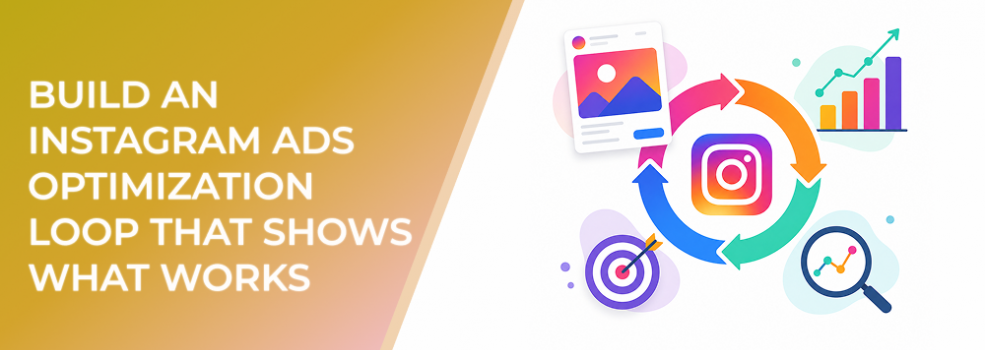
An optimization loop is a repeatable process that turns results into learning, learning into decisions, and decisions into the next test. Without that loop, marketers keep reacting to metrics without understanding what actually works.
For performance marketers, agencies, SMB owners, startup marketers, affiliate marketers, and B2B lead-generation teams, a strong optimization loop is what turns Instagram ads from random spend into a learning engine.
The Problem
The problem is that many Instagram ad accounts collect data but do not convert it into structured next actions.
The team checks reach, impressions, clicks, engagement, messages, leads, CPA, ROAS, or conversion rate. They notice what looks good or bad. Then they make a change.
But the process often skips the most important step: deciding what the result means.
If a campaign has high CTR but low conversion, what does that suggest? If lead volume is high but sales acceptance is low, what should change next? If profile visits increase but inquiries stay flat, what needs to be improved? If a boosted post performs well at first and then weakens, what should be tested?
An optimization loop answers those questions in a consistent way.
Why This Problem Hurts Performance
Without an optimization loop, campaign performance becomes reactive.
Marketers may chase low CPC while ignoring lead quality. They may scale engagement-heavy posts that do not create revenue. They may keep changing audiences without documenting which sources produce better customers. They may refresh creative without knowing whether fatigue, poor fit, or weak offer clarity caused the decline.
This can increase CPA and CAC, reduce ROAS, weaken conversion rate, and make scaling unstable.
It also slows learning. Every campaign produces data, but not every campaign produces insight. Without a loop, the account spends money to relearn the same lessons.
For agencies, this weakens strategic recommendations. For in-house teams, it makes budget conversations harder. For SMB owners, it makes paid social feel inconsistent.
Common Scenarios Where This Happens
An ecommerce brand reviews purchases but does not compare which content themes created stronger product intent.
A B2B team tracks CPL but does not review qualified lead rate by audience source.
A local service business tracks message volume but does not classify which messages turned into appointments.
An agency sends campaign reports but does not translate results into rules for the next month.
A startup runs multiple small boosts but does not connect early engagement signals to future ad selection.
Why the Problem Happens
This problem happens because reporting and optimization are often separated.
Reporting asks: “What happened?”
Optimization asks: “What should we do next?”
A dashboard can answer the first question, but it does not automatically answer the second.
Another cause is metric overload. Instagram ads can produce many numbers. Without a hierarchy, teams may focus on whichever metric changed the most instead of the metric that matters most.
The third cause is inconsistent review timing. Some teams review campaigns only when results drop. Others review too frequently and overreact to small fluctuations. A loop needs a clear cadence.
Finally, many advertisers do not connect platform metrics to business feedback. That makes the loop incomplete.
The Solution
The solution is to build an Instagram ads optimization loop with five stages.
Stage 1: Define the objective
Every loop starts with a clear objective.
Are you trying to generate qualified leads, purchases, booked calls, profile visits, messages, product-page traffic, or audience learning?
The objective determines which metrics matter.
Stage 2: Read the result by metric layer
Use layered analysis.
Delivery layer: spend, reach, impressions, frequency, CPM.
Attention layer: CTR, engagement rate, video hold, comments, saves, shares.
Intent layer: profile visits, website taps, product questions, messages, form starts.
Business-quality layer: qualified leads, sales acceptance, purchases, booked calls, ROAS, CAC, revenue quality.
This prevents the team from treating surface activity as final success.
Stage 3: Diagnose the constraint
Ask what limited performance.
Was it audience relevance?
Creative clarity?
Offer strength?
CTA alignment?
Goal mismatch?
Destination quality?
Budget fragmentation?
Conversion signal quality?
Choose the most likely constraint based on evidence.
Stage 4: Choose the next test
The next test should address the constraint.
If audience relevance is weak, test a more qualified audience.
If creative clarity is weak, test a clearer hook or visual.
If offer strength is weak, test a more specific value proposition.
If CTA alignment is weak, test a next step that matches user intent.
If destination quality is weak, improve the landing page or message flow before spending more.
Stage 5: Document the rule
Every loop should end with a rule.
Examples:
“Do not scale boosted posts based on likes alone.”
“Test customer-fit audiences before broad reach audiences for B2B offers.”
“Use message goals only when the conversation flow can qualify users.”
“Do not compare campaigns with different goals as if they are equal.”
“Promote content themes that produce buyer questions, not just engagement.”
Rules create compounding learning.
How LeadEnforce Helps
LeadEnforce helps with the audience-learning part of the optimization loop.
If the review shows weak lead quality, poor-fit clicks, irrelevant engagement, or unclear audience performance, the next loop may need better audience inputs.
LeadEnforce can help advertisers build audiences from Instagram profile followers, Instagram engagers, Facebook group members, LinkedIn-derived professional data, and custom social-profile sources. This allows teams to create source-based audience tests that fit the optimization loop.
For example:
A B2B advertiser can test professional-fit audiences after reviewing weak lead quality.
An ecommerce brand can test competitor or niche profile followers after seeing broad engagement but weak purchase behavior.
A local business can test community-based audiences after discovering that broad local targeting creates irrelevant inquiries.
An agency can label audience tests by source so client reporting explains not only what happened, but what the next audience test should be.
LeadEnforce does not replace the loop. It strengthens one of the most important inputs inside it: audience relevance.
Risks and Considerations
An optimization loop can fail if the team overreacts to small data sets.
Avoid changing campaigns too quickly before enough signal accumulates. Also avoid waiting so long that wasted spend compounds.
Do not blame every problem on audience quality. Creative, offer, CTA, goal, landing page, budget structure, and tracking quality can all limit performance.
If using LeadEnforce, validate source-based audiences with business-quality metrics. A source may look relevant but still produce low purchase intent or weak sales fit.
Compliance and platform policy considerations still matter. Audience sourcing should be used responsibly and aligned with applicable requirements.
Prerequisites and Dependencies
You need a defined ICP, clear campaign objectives, enough budget to produce useful signals, and access to both platform metrics and downstream performance data.
You also need a consistent review cadence. For short boosts, review after the campaign has enough activity. For always-on campaigns, use scheduled checkpoints rather than constant reactive changes.
You need a shared definition of success. Sales, marketing, agency teams, and business owners should agree on what counts as a qualified action.
If LeadEnforce is part of the workflow, prepare audience sources around specific hypotheses and label them clearly in the testing log.
Practical Recommendations
Build a simple optimization loop document.
Use these fields:
- Campaign objective
- Main result
- Metric layer affected
- Likely constraint
- Evidence
- Next test
- Decision rule
- Follow-up date
Review every meaningful Instagram boost or ad campaign through that structure.
Do not optimize only from platform metrics. Include CRM feedback, sales notes, ecommerce behavior, booking quality, or message quality whenever possible.
Use the loop to separate improvement from movement. A metric changing is not automatically progress. Progress means the account learned what to do next.
Final Takeaway
An Instagram ads optimization loop shows what works by turning every campaign into structured learning.
Define the objective, read results by metric layer, diagnose the constraint, choose the next test, and document the rule. That is how Instagram ad performance becomes more repeatable over time.
To add clearer source-based audience tests to your Instagram ads optimization loop, join the free 7-day LeadEnforce trial period.
Related LeadEnforce Articles
- Access Instagram Ad Insights After Publishing — Helps advertisers find and review post-launch insights.
- Monitor Instagram Ads After Launch Without Missing Performance Problems — Supports ongoing monitoring across delivery, audience, creative, and conversion issues.
- Use Instagram Insights to Choose Better Future Ads — Shows how to turn past results into better future ad decisions.
- Stop Repeating Instagram Ad Mistakes — Explains how to convert reviews into rules that prevent recurring mistakes.
- How to Fix Weak Instagram Ad Results With Insights Data — Helps advertisers diagnose weak results before changing campaigns.