Scaling campaigns rarely fails because of budget limits. It usually breaks when the creative system behind the campaigns can’t keep up.
You can see it directly in delivery. Frequency climbs, CPM rises, and additional budget stops producing incremental conversions.
At that point, most teams try to optimize what already exists. The real issue is simpler — the system producing creatives isn’t structured for scale.
Why Creative Volume Alone Doesn’t Solve Scaling
Launching more creatives feels like progress. In reality, delivery systems don’t respond to volume — they respond to clear signals.
You’ll typically see a few patterns:
-
Most spend goes to 1–2 ads, even if many are active.
-
New creatives spike briefly, then drop to the same baseline.
-
CPM stays elevated because auction competition doesn’t change.
This is exactly why testing without structure fails — as explained in Why Testing Too Many Ads at Once Hurts Your Campaign Results.
Before launching new creatives, pause and ask:
-
What exactly is this creative testing?
-
What result should appear within 48 hours?
-
If it works, what are we scaling?
If these answers aren’t clear, the creative will not produce useful data.
What a Creative System Looks Like in Practice
A creative system is a repeatable loop. It produces structured inputs and turns performance into decisions.
To make it actionable, a few rules need to be enforced.
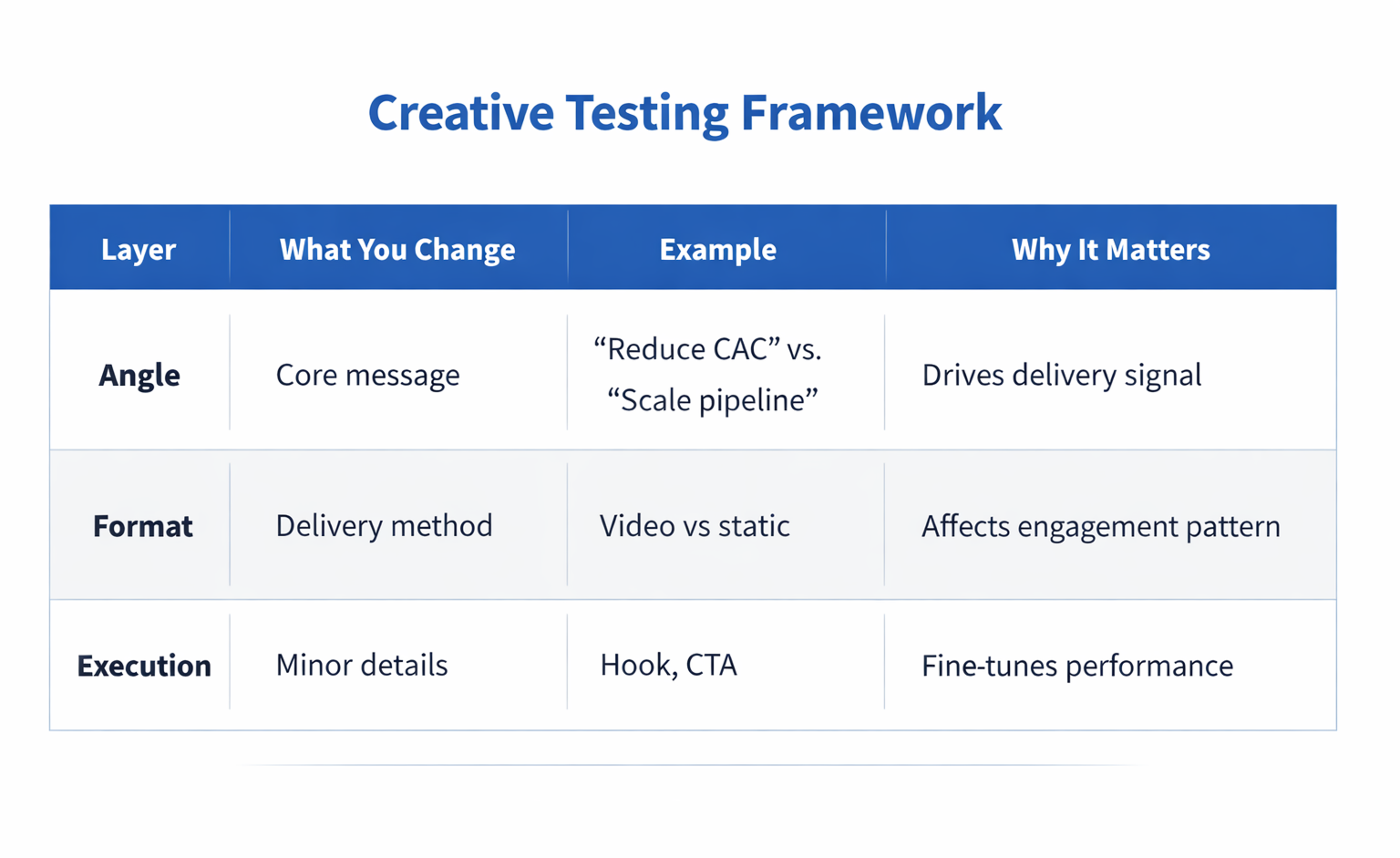
First, every creative must map to a single angle. If one ad mixes multiple ideas, you won’t know what actually worked.
A simple structure helps:
-
[Angle] - [Format] - [Variation]
This allows you to group performance quickly.
Second, creatives should be launched in batches. Uploading ads one by one removes context and slows learning.
In practice:
-
Launch 3–5 creatives per angle.
-
Keep the message identical.
-
Change only execution.
This mirrors how structured testing is done in How to Structure Facebook Campaigns for Rapid Testing and Iteration.
Third, decisions must happen quickly. Slow reactions dilute learning.
Use simple rules:
-
Kill clear underperformers early.
-
Scale creatives that attract spend naturally.
The Real Constraint — Signal Density
At low budgets, messy inputs can still work. At scale, they don’t.
You’ll notice instability:
-
Campaigns re-enter learning after small changes.
-
CPA fluctuates heavily.
-
Budget increases reduce efficiency immediately.
This is not a bidding issue — it’s a signal issue.
To fix it, simplify:
-
Reduce active angles to 2–3.
-
Increase spend per angle.
-
Remove weak creatives faster.
This is often the underlying issue described in Why Your Creative Testing Strategy Isn’t Working (And How to Fix It).
A Simple Weekly System You Can Run
Without a routine, systems break down.
Start the week by reviewing where spend actually went. That tells you which angles the system prefers.
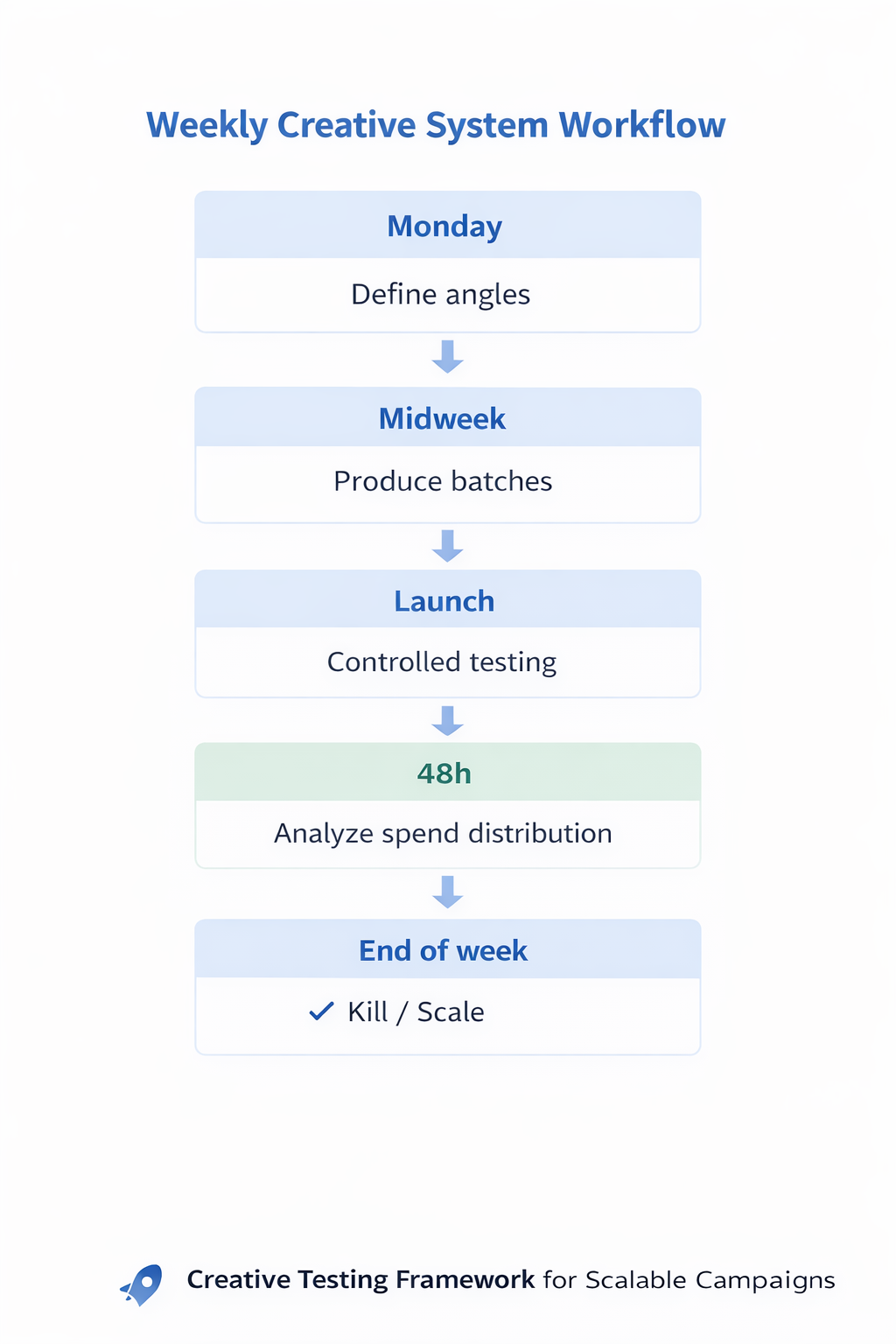
Then define:
-
1 angle to scale.
-
1–2 angles to test.
Midweek, produce creatives.
For each angle:
-
Create 3–5 variations.
-
Keep the message constant.
-
Change only execution.
Avoid overproduction. Structured output matters more than volume.
After launch, wait 24–48 hours. Then check allocation, not just metrics.
At the end of the cycle:
-
Remove creatives with no spend.
-
Expand angles that receive budget.
Then repeat.
Diagnosing Fatigue vs System Failure
When performance drops, the cause matters.
Fatigue follows a gradual pattern:
-
Frequency increases.
-
CTR declines slowly.
-
CPA rises over time.
Here, the angle still works.
You need new executions.
System failure looks different:
-
New creatives get no spend.
-
Old ads dominate delivery.
-
Learning resets frequently.
In that case, the structure is broken.
If you want a deeper breakdown of fatigue signals, see Ad Fatigue on Facebook: How to Spot It Early and Fix It Fast.
Where Creative and Media Buying Connect
Creative output only matters if it changes budget allocation. Instead of focusing on individual ads, shift to angles.
If multiple creatives from the same angle get spend, that’s your signal. That’s what you scale.
To make this work:
-
Allocate budget based on angle performance.
-
Separate testing from scaling campaigns.
-
Watch spend distribution daily.
Where the system sends money often tells you more than CTR or CPA.
Practical Takeaway
When campaigns stop scaling, don’t start with targeting or bidding. Run a quick structural check:
-
Are creatives launched in batches?
-
Can you evaluate performance at the angle level?
-
Are weak inputs removed quickly?
If not, the issue isn’t creative quality — it’s system design.
Fix the system, and scaling becomes predictable.