At some point, every Meta account hits the same pattern: you make changes, but performance barely moves. Budgets increase, creatives rotate, targeting shifts — yet CPA, volume, and efficiency stay locked.
This is not a random issue or “bad luck.” It’s a structural state where the system stops reacting to your inputs.
When Optimization Stops Working, It’s a Signal Saturation Problem
A campaign becomes unresponsive when the algorithm no longer treats your changes as new information.
This usually happens after the system has stabilized around:
-
a consistent conversion pattern;
-
a defined audience cluster;
-
a predictable auction environment.
At that point, the model is confident. It already “knows” where to spend.
You can verify this inside Ads Manager through signals like:
-
Budget increases that don’t increase spend proportionally;
-
CPA staying within a narrow band despite multiple changes;
-
Frequency slowly rising while conversions stagnate;
-
New ads receiving limited delivery unless heavily pushed.
This overlaps with what many describe in why Facebook ads performance declines over time and how to prevent it, but the root issue here is slightly different — the system isn’t declining, it’s stabilizing too hard.
Why Incremental Optimization Stops Working
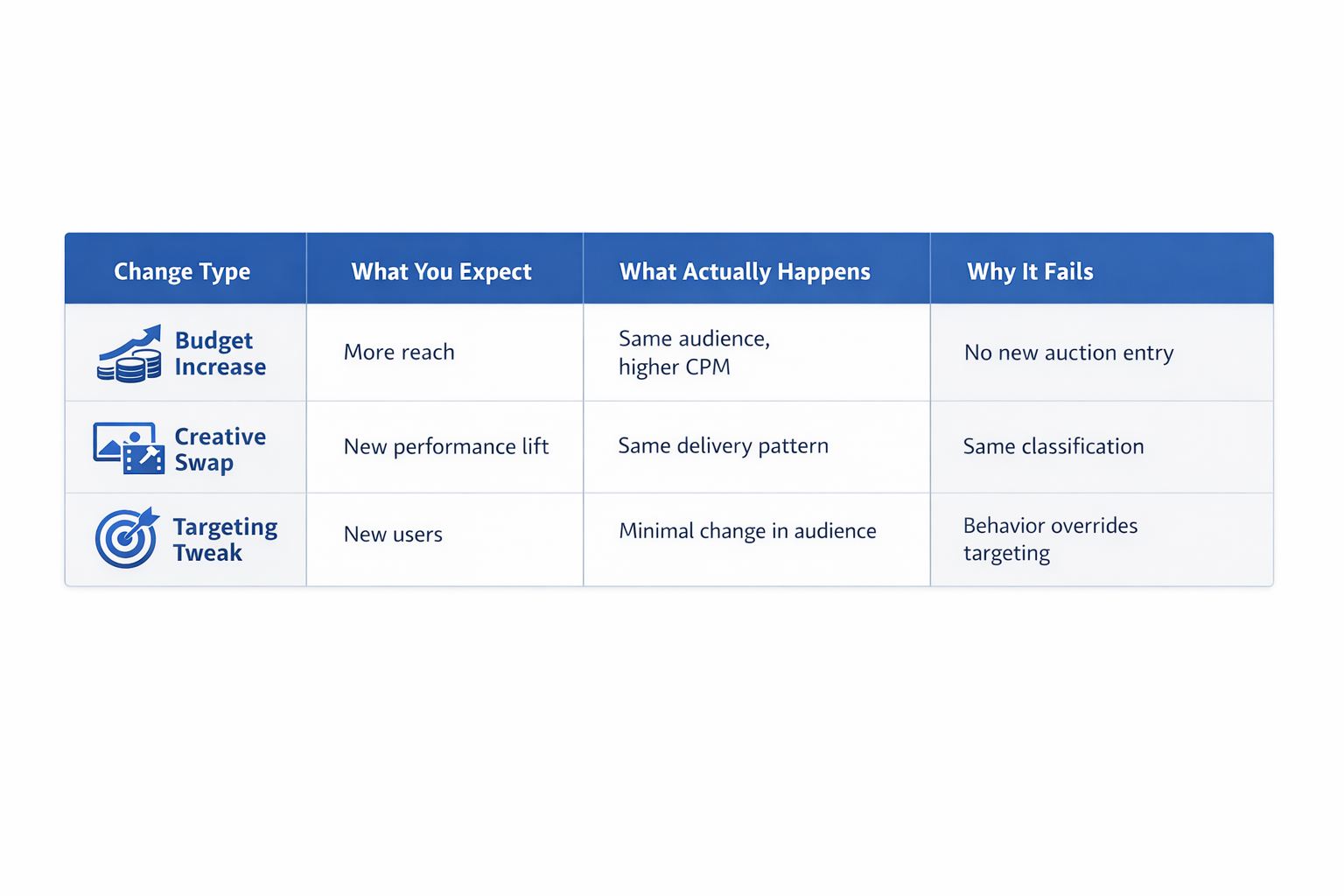
Most advertisers rely on gradual changes: adjusting budgets, swapping creatives, tweaking targeting.
That approach eventually loses effectiveness.
-
Budget increases stay inside the same delivery pocket.
A 20% increase doesn’t force the system into new auctions. It just bids slightly more within the same user pool. -
Creative updates don’t change audience selection.
If your new ads follow the same structure, they get delivered to the same behavioral clusters. -
Targeting becomes secondary.
Once enough data accumulates, Meta prioritizes observed behavior over your manual inputs.
This is where many accounts fall into the loop described in Facebook Ads optimization mistakes to avoid — doing more of the same while expecting different outcomes.
The Hidden Constraint: Auction Position Lock-In
A less obvious constraint is that campaigns get locked into a specific auction position.
Over time, your campaign stabilizes around:
-
a CPM range;
-
a conversion likelihood;
-
a competitive set of advertisers.
This creates a fixed “lane.”
Inside that lane:
-
scaling increases costs rather than reach;
-
efficiency declines as you push volume;
-
new audiences are rarely introduced.
This dynamic is closely tied to how auctions behave, which is explained in Facebook ad auction: do ad sets compete against each other — the system optimizes within competitive boundaries, not outside them.
What Actually Resets Delivery Behavior
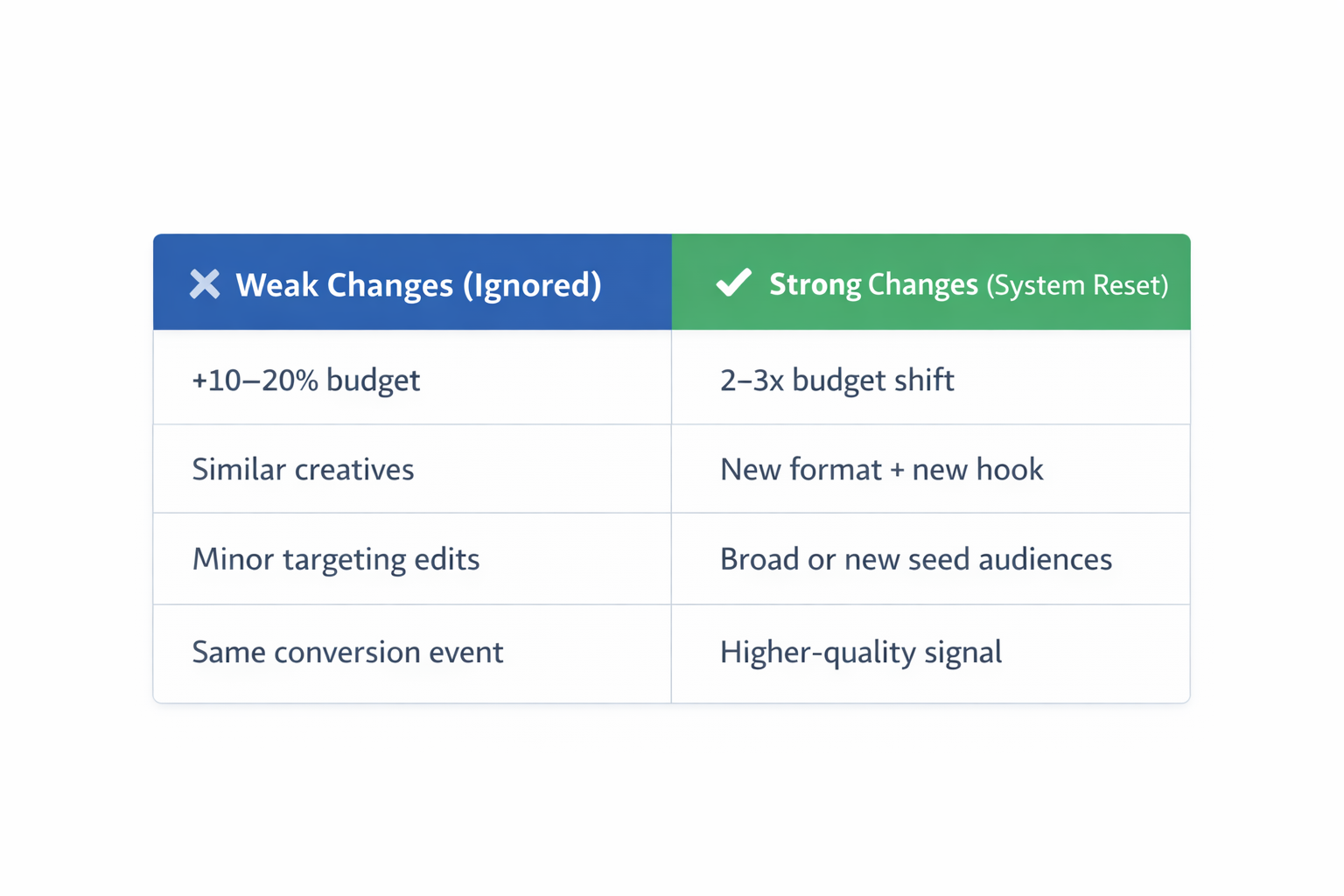
To regain responsiveness, you need to introduce changes that force the system to re-evaluate its model.
These are structural shifts, not tweaks.
1. Change the Conversion Signal
If you optimize for a low-quality or broad event, the system settles into inefficient patterns.
You can reset this by:
-
switching to a more qualified event;
-
feeding offline conversion data;
-
filtering out low-quality leads.
This changes how the algorithm defines success — and that directly affects bidding and targeting.
2. Break the Creative Pattern
If your creatives follow the same structure, the system treats them as variations of the same input.
To create real differentiation:
-
change format (e.g., static → video);
-
change the opening hook entirely;
-
shift the message angle, not just wording.
This also helps prevent the stagnation described in ad copy fatigue: why Facebook ads stop working after a few weeks, where repetition limits delivery expansion.
3. Reset Audience Exploration
When campaigns plateau, the system often cycles through the same users.
To force expansion:
-
launch a broad ad set without detailed targeting;
-
rebuild lookalikes from a different seed;
-
isolate remarketing from prospecting more strictly.
This pushes the algorithm to explore new behavioral clusters instead of reinforcing existing ones.
4. Rebuild Campaign Structure
Sometimes the issue isn’t inputs — it’s the structure holding them.
Instead of editing endlessly:
-
duplicate into a simplified campaign;
-
reduce unnecessary segmentation;
-
allow fewer, larger ad sets to gather data faster.
This removes historical constraints and gives the system more flexibility in early delivery.
5. Force Auction Repositioning
If you’re stuck in a specific CPM and performance range, you need to break out of it.
Ways to do that:
-
scale budgets aggressively, not gradually;
-
change optimization events;
-
introduce a radically different creative angle.
The goal is to move into different auction conditions — not optimize within the same one.
What Not to Do When Performance Stalls
Certain reactions make the problem worse.
Constant Micro-Edits
Frequent small changes reset learning signals without changing system behavior.
This creates instability without progress.
Over-Segmentation
Too many ad sets dilute signal density.
That leads to:
-
slower learning;
-
higher CPMs;
-
inconsistent results.
Creative Volume Without Real Variation
Uploading many ads that look similar doesn’t increase diversity.
The system clusters them and delivers them the same way.
A More Effective Optimization Mindset
When campaigns stop responding, the problem is not effort — it’s input relevance.
Instead of asking “what should I tweak,” ask:
-
Does this change affect who the system targets?
-
Does it redefine what a valuable conversion is?
-
Does it push the campaign into new auctions?
If the answer is no, the system will likely ignore the change.
Practical Takeaway
When Facebook ads stop responding, stop iterating within the same structure.
Introduce one decisive shift:
-
a new conversion signal;
-
a fundamentally different creative approach;
-
or a reset in campaign structure.
That’s what reactivates delivery — not more optimization, but more meaningful inputs.