Many Meta advertisers choose the wrong budget setup before the campaign even launches.
They build good creatives, target the right audience, then let the budget structure create delivery problems. One ad set spends too much, another gets ignored, or the campaign becomes difficult to scale.
Most of the time, the issue comes down to one decision:
Should Meta control the budget, or should you?
That is the real difference between campaign budgets, ad set budgets, and budget sharing.
When campaign budgets work best
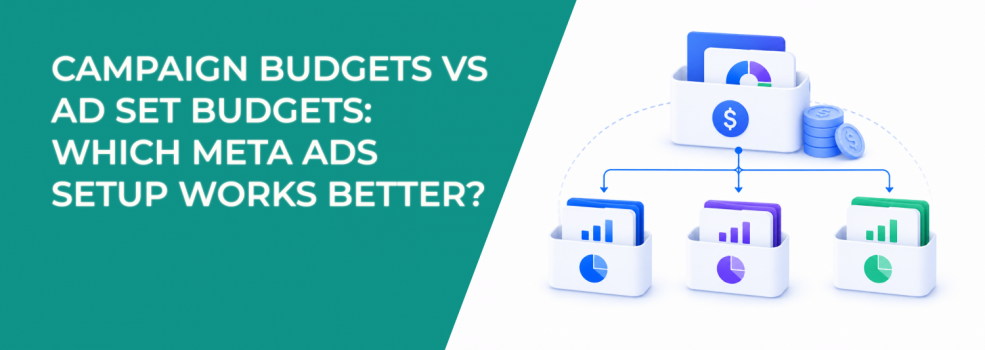
Campaign budgets, also called Advantage+ campaign budget or CBO, give Meta one shared budget across the campaign.
Meta automatically pushes more spend into the ad sets getting the best results. You do not decide how much each ad set spends. Meta handles that in real time.
This setup works best when the ad sets are similar.
A simple ecommerce example:
- Ad set 1 targets skincare interests.
- Ad set 2 targets beauty influencers.
- Ad set 3 targets broad female audiences.
All three ad sets sell the same product and use the same optimization goal.
In this situation, campaign budgets usually work well because Meta can quickly shift spend toward the audience generating the cheapest purchases.
This is why many advertisers use a CBO or ABO budget strategy built around campaign-level scaling.
The downside of campaign budgets
CBO can make testing messy.
Meta does not split spend evenly between ad sets. If one ad set gets early conversions, Meta may push most of the budget there very quickly.
Inside Ads Manager, this usually looks like:
- One ad set spending 70–80% of the budget.
- Smaller audiences barely getting impressions.
- New creatives struggling to leave learning.
- CPA looking unstable across ad sets.
This becomes frustrating during audience testing.
Imagine testing three completely different audiences for a SaaS demo campaign. If Meta heavily favors one audience after several early leads, the test becomes less reliable because the spend was never balanced properly.
This is also where audience overlap is killing your Facebook ad performance becomes a real problem. Similar audiences often compete against each other inside CBO campaigns.
When ad set budgets make more sense
Ad set budgets, also called ABO, give each ad set its own dedicated budget.
That means you decide exactly how much each audience spends.
ABO usually works better when audiences behave differently or when testing accuracy matters more than automation.
A good example is local lead generation.
A home services company may run:
- One ad set targeting homeowners.
- One targeting recent movers.
- One targeting high-income zip codes.
Those audiences may produce very different lead quality and conversion rates.
With ABO, the advertiser can control spend separately and compare results more clearly.
ABO also works well when:
- Audience sizes are very different.
- Ad sets use different bid strategies.
- Lead quality varies between audiences.
- You need cleaner testing data.
Many agencies use ABO during the early testing stage, then switch to CBO later when scaling.
Where budget sharing fits in
Budget sharing sits between CBO and ABO.
Meta still keeps separate ad set budgets, but the platform can move up to 20% of one ad set’s budget into another ad set if it sees stronger opportunities there.
This reduces some manual budget work without fully giving Meta control.
A simple scenario:
An ecommerce brand runs three ad sets with separate budgets. During the weekend, one audience suddenly starts converting much better than the others.
With budget sharing enabled, Meta can temporarily shift part of the available spend toward the stronger audience instead of waiting for manual edits.
This setup works well for advertisers who:
- Want tighter control than CBO.
- Still want some automation.
- Run small or mid-sized budgets.
- Need flexible delivery during promotions.
How to choose the right setup
Most advertisers overcomplicate this decision.
A simple framework usually works best:
- Use campaign budgets when ad sets are very similar and scaling speed matters most.
- Use ad set budgets when testing control matters more than automation.
- Use budget sharing when you want some flexibility without fully handing control to Meta.
A practical example helps.
If you run a broad ecommerce campaign with several similar audiences, CBO is usually the strongest option.
If you run a B2B campaign targeting very different industries or job roles, ABO is often safer because lead quality can vary significantly between audiences.
Better targeting matters more than the budget setup
Many advertisers blame the budget structure when the real problem is audience quality.
Meta can only optimize the traffic you give it.
If the audiences are weak, CBO may scale weak traffic faster. ABO may waste spend evenly across poor-performing audiences. Budget sharing may simply redistribute inefficient spend.
That is why audience quality matters first.
LeadEnforce helps advertisers build stronger audiences using Facebook groups, Instagram engagers, and social profile data. Better audience inputs usually make every budget structure perform more efficiently.
This becomes especially important during scaling because weak audiences break faster once budgets increase.
Final takeaway
Campaign budgets are usually better for scaling. Ad set budgets are usually better for testing and control. Budget sharing works well when you want something between the two.
The best setup depends on how different your audiences are and how much control you actually need during optimization.