Many Facebook boost decisions are based on recency.
The newest post gets boosted because it is already live, tied to the latest campaign, or easiest to justify internally. That may feel organized, but it is not always performance-driven.
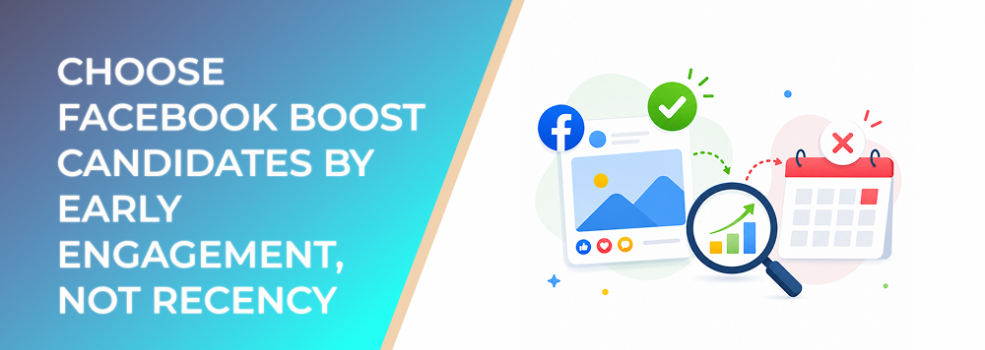
A better approach is to choose boost candidates based on early engagement quality.
The question is not “Which post is newest?” The question is “Which post is already showing signs that the right audience cares?”
The Problem
The problem is choosing boosted-post candidates by recency instead of early engagement.
A recent post may be timely, but timeliness does not prove paid potential. It may have weak clarity, low relevance, poor engagement quality, or no connection to the business goal.
Meanwhile, a slightly older post may have stronger signals: buyer questions, shares, saves, link clicks, profile visits, or comments from people who resemble the target audience.
When teams automatically boost the newest content, they ignore evidence that could help them spend better.
Why This Problem Hurts Performance
Recency-based boosting hurts performance because it puts budget behind convenience instead of signal.
The result can be higher CPC, weaker click quality, poor CPA, unstable CAC, and lower ROAS. It can also reduce testing speed because the campaign starts with weak creative evidence.
This is especially damaging for agencies and growth teams. A boost may look like action, but if the post was chosen for recency rather than engagement quality, the test may not teach anything useful.
For B2B lead-generation teams, recency-based boosting can produce social activity from the wrong audience. For ecommerce brands, it can promote content that looks good but does not create product interest. For SMBs, it can waste limited budget on posts that never earned attention.
Common Scenarios Where This Happens
An agency boosts the client’s latest post because it is part of this week’s content calendar, even though an older post generated better questions.
A startup boosts a new launch update because the timing feels important, while a previous problem-focused post created stronger audience response.
A local business boosts a fresh announcement but ignores a prior post where users asked about availability, pricing, and booking.
An ecommerce brand promotes the newest product image while an older comparison post had stronger saves and clicks.
A B2B marketer boosts a new company update instead of an older educational post that attracted target-role comments.
Why the Problem Happens
This happens because recency is easy to defend.
Stakeholders understand “this is the latest post.” It feels current and campaign-aligned. But recent does not mean relevant.
Another cause is content-calendar thinking. Organic publishing calendars are built around cadence, themes, and deadlines. Paid promotion should be built around evidence, audience fit, and campaign outcomes.
A third cause is shallow reporting. If teams only look at total likes or the newest activity, they may miss posts with better engagement rates, better click behavior, or better comment quality.
The Solution
Build a boost-candidate process based on early engagement.
Start by creating a candidate pool. Do not limit the review to the most recent post. Look at posts from a meaningful recent period and compare them fairly.
Next, normalize engagement. A post with more reach may have more total reactions, but that does not mean it performed better. Compare engagement rate, click rate, share rate, comment rate, and negative feedback relative to reach.
Then separate engagement types.
Likes show light approval.
Comments show interaction.
Shares suggest broader relevance.
Saves suggest future interest.
Clicks suggest active consideration.
Buyer questions suggest stronger intent.
Negative feedback suggests mismatch or fatigue.
Finally, match the post to the campaign goal. A post with strong shares may be good for awareness. A post with link clicks may be better for traffic. A post with buyer questions may be better for lead generation or message campaigns.
How LeadEnforce Helps
LeadEnforce helps when the selected boost candidate needs a stronger paid audience test.
Early engagement tells you which content is worth considering. LeadEnforce helps with the next step: deciding which audience sources should see that content.
Advertisers can use LeadEnforce to build audience inputs from Facebook groups, Instagram followers, Instagram engagers, LinkedIn professional data, and custom social-profile sources.
That is useful because early engagement and audience relevance should work together. If a post gets strong buyer-relevant comments, it deserves more than broad targeting guesswork. If a niche post performs well with a specific community, promoting it to similar community-based or profile-based audiences can create a cleaner test.
LeadEnforce does not replace post-performance analysis. It supports the paid distribution decision after the post has already earned consideration.
Risks and Considerations
Early engagement can be misleading if the audience is too small or too warm.
A post that performs well with loyal followers may not work with cold prospects. A post with a few strong comments may still need more evidence before scaling. A post with high engagement may still fail if it lacks a clear CTA or landing page alignment.
If LeadEnforce is used, audience sources must be chosen carefully. A Facebook group or Instagram profile should reflect the target market, not just the general topic.
Also avoid turning the process into a rigid formula. Judgment still matters. Engagement signals should inform the decision, not replace strategy.
Prerequisites and Dependencies
You need access to post-level performance data, a clear ICP, and a defined campaign goal.
You also need enough organic activity to compare posts. If the Page has very low reach, early signals may be directional rather than conclusive.
For LeadEnforce-supported promotion, identify the audience sources that best match the post’s message and campaign goal before launch.
Practical Recommendations
Stop using recency as the default selection rule.
Create a boost-candidate review that includes:
Post date.
Reach.
Engagement rate.
Comment quality.
Share and save behavior.
Click behavior.
Audience relevance.
Negative feedback.
Campaign-goal fit.
Then select the post that shows the strongest pattern of relevant engagement, not the post that happens to be newest.
Start with a controlled paid test. If early engagement survives broader distribution, consider increasing budget. If it weakens, diagnose the content, audience, or goal before scaling.
Final Takeaway
The newest Facebook post is not automatically the best post to boost.
Better boost candidates are chosen by signal, not recency. Review early engagement quality, normalize the data, match the post to the campaign goal, and promote the content that has already shown paid potential.
To test proven Facebook boost candidates against more relevant audience inputs, join the free 7-day LeadEnforce trial period.
Related LeadEnforce Articles
- Find Strong Facebook Boost Candidates From Page Performance Data — Directly related to using Page data for candidate selection.
- How to Choose Facebook Posts Worth Boosting Before Spending Ads Budget — Helps evaluate posts based on paid potential.
- Avoid Wasted Boosted Post Budget by Promoting Content With Proven Traction — Reinforces the traction-first approach.