Many Instagram advertisers choose destinations by habit.
Website traffic goes to the homepage.
Lead campaigns go to a form.
Ecommerce campaigns go to a product page.
Engagement campaigns go to a profile.
Sometimes that works. Often, it does not.
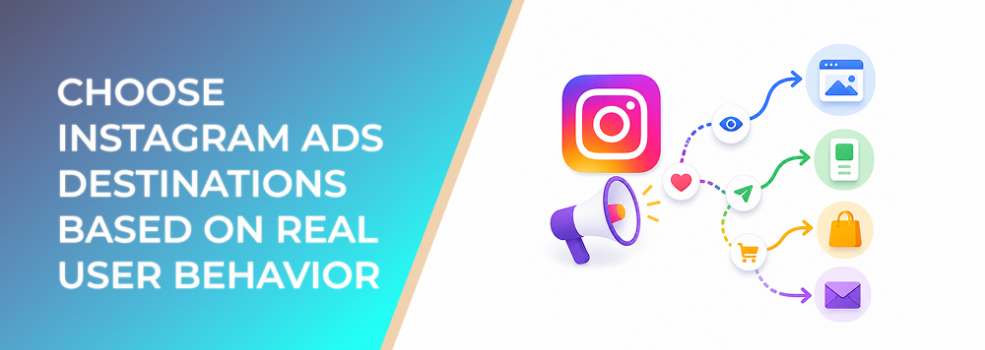
The better approach is to choose Instagram ad destinations based on real user behavior. What users save, click, watch, comment on, revisit, ask about, and ignore should influence where paid traffic goes next.
A destination should reflect what the user is ready to do, not just what the advertiser wants them to do.
The Problem
The problem is that advertisers often choose destinations before they understand behavior.
They assume cold users are ready for a landing page.
They assume profile visitors are low value.
They assume all clicks represent buying intent.
They assume DMs are only useful for small businesses.
They assume a lead form is always better than a conversation.
These assumptions can create campaigns that look busy but fail to move users forward.
Real behavior tells a more useful story.
A user who saves a product post may need a timely offer or product proof.
A user who watches a full demo Reel may be ready for a product page.
A user who taps through highlights may need reassurance before converting.
A user who comments with a specific question may be better suited to a DM flow.
A user who clicks pricing but bounces may need retargeting with comparison or objection-handling content.
Why This Problem Hurts Performance
When destinations are chosen based on assumptions, budget gets routed into weak paths.
This can increase wasted spend in several ways:
Users are sent to high-friction destinations before they are ready.
High-intent users are sent to soft content instead of conversion paths.
DM-ready users are forced through forms.
Research-stage users are pushed into sales pages.
Retargeting audiences are built from shallow actions instead of meaningful behavior.
The result is often poor CPA, weak lead quality, unstable ROAS, and slow testing cycles.
The campaign may still collect data, but the data becomes hard to interpret because the destination was not aligned with actual user behavior.
Common Scenarios Where This Happens
An ecommerce brand sees users saving product posts and watching product Reels, but sends all ad clicks to the homepage. The behavior suggested product-specific intent, but the destination added unnecessary steps.
A B2B SaaS company sees strong engagement on problem-focused carousels, but sends users directly to a demo request page. The behavior suggested education and evaluation, not immediate sales readiness.
A local service business receives repeated Instagram profile visits but runs ads only to a website form. The behavior suggested users were checking trust signals first.
A creator-led brand sees many comments asking “how does it work?” but sends traffic to a checkout page. The behavior suggested a need for explanation.
An agency tests multiple audiences but does not separate behavior by source. Competitor followers, warm engagers, and broad-interest users are all sent to the same page, making results difficult to interpret.
Why the Problem Happens
Behavior-based destination planning requires more discipline than default campaign setup.
Advertisers need to look at the journey before the click and after the click.
Many teams skip that work because they are under pressure to launch quickly. They choose the page that already exists, the form the sales team wants, or the destination used in previous campaigns.
Another cause is over-reliance on top-level metrics. CTR, CPC, reach, and engagement rate are useful, but they do not fully explain readiness.
A user can click because they are curious.
A user can save because they are considering.
A user can DM because they need help.
A user can visit a profile because they need trust.
A user can open a product page because they are comparing.
These behaviors should not be treated as equal.
The Solution
The solution is to build a behavior-to-destination framework.
Instead of asking, “Where should this ad send people?” ask, “What behavior has this user shown, and what destination best supports the next step?”
Send profile researchers to trust assets
If users visit your profile, tap highlights, view tagged content, or scroll older posts, they are likely evaluating credibility.
Send them to a stronger profile experience, proof-based posts, UGC, testimonials, or a destination that reinforces trust.
Make sure the Instagram profile is ready. Bio, highlights, pinned posts, reviews, product information, and CTAs should all support the campaign.
Send content engagers to deeper education
If users watch educational Reels, save carousels, or engage with how-to posts, they may need more information.
Send them to guides, explainers, webinars, comparison pages, product demos, or educational landing pages.
This is especially useful for B2B, SaaS, high-ticket products, and complex offers.
Send question askers to conversation paths
If users comment with questions, reply to stories, or react to service-specific content, DMs may be the best destination.
Conversation can reduce friction when users need availability, pricing, fit, customization, or reassurance.
This works only when the business can respond quickly and qualify the conversation.
Send high-intent users to conversion paths
If users click product pages, revisit pricing, add to cart, start checkout, watch full demos, or engage repeatedly with proof content, they may be ready for a direct destination.
Send them to product pages, booking pages, lead forms, checkout flows, quote pages, or demo request pages.
Do not keep high-intent users in soft engagement loops.
Test destination behavior separately
Do not judge every destination with the same metric.
A profile visit should be evaluated by follow-on engagement, trust-building actions, and retargeting quality.
A DM path should be evaluated by response quality, qualification rate, and booked outcomes.
A product page should be evaluated by add-to-cart, purchase rate, revenue per visitor, and CAC.
A lead form should be evaluated by qualified lead rate, not just CPL.
How LeadEnforce Helps
LeadEnforce helps advertisers connect audience behavior with destination planning.
Behavior-based destination strategy works best when audience sources are clear. If all users are grouped into one broad audience, it becomes difficult to understand which destination fits which segment.
LeadEnforce helps build audiences from Instagram profiles, Instagram followers, Instagram engagers, Facebook groups, LinkedIn-derived professional data, and custom social-profile sources.
That makes it easier to build destination logic around audience source and likely intent.
For example, users from competitor Instagram profiles may need comparison-based proof.
Followers of niche creator accounts may respond well to product education or UGC.
LinkedIn-derived professional audiences may need industry-specific landing pages.
Instagram engagers may be ready for retargeting paths that move from content to offer.
Facebook group-based audiences may respond better to problem-aware messaging and educational destinations.
LeadEnforce does not replace behavioral analysis. It helps advertisers create clearer audience inputs so behavior and destination tests are easier to interpret.
Risks and Considerations
Behavior-based destination planning requires enough data to make useful decisions.
Small audiences may not produce stable patterns. Some behaviors may look meaningful but represent too few users. A single strong post may not indicate a repeatable pattern.
There is also a risk of over-segmentation. If every behavior gets its own ad set, budgets may become too thin and learning may slow down.
Creative alignment matters as well. If the ad promises education but the destination pushes a hard sale, users may drop off even if the audience is strong.
Compliance and privacy considerations also matter. Use platform-approved audiences, follow Meta policies, and avoid making sensitive assumptions about users.
Prerequisites and Dependencies
To choose destinations based on behavior, you need:
A clear campaign goal.
Defined user behavior signals.
A strong Instagram profile.
Destination options that are actually ready.
Enough audience size to test.
Reliable post-click measurement.
A clear offer and CTA.
A way to compare lead or purchase quality after the first action.
If LeadEnforce is part of the process, you need relevant source audiences that match the behavior hypothesis. For example, Instagram engagers for warm retargeting, niche profile followers for interest-based testing, or LinkedIn-derived audiences for B2B decision-maker paths.
Practical Recommendations
Start with observed behavior, not the default page.
Map each major behavior to one likely next step.
Use profile destinations for trust-building behavior.
Use educational assets for research behavior.
Use DMs for question-driven behavior.
Use product or booking pages for high-intent behavior.
Use lead forms only when the offer and qualification process are strong enough.
Compare downstream quality by destination. Do not optimize only for CPC or CTR.
Use LeadEnforce when you need more precise audience sources to make destination tests cleaner and more meaningful.
Final Takeaway
The best Instagram ad destination is not always the website, profile, DM, form, or product page.
The best destination is the one that matches what users have already shown they are ready to do.
Use real behavior to choose the path, then use performance data to refine it.
To build clearer behavior-based audience segments before your next Instagram ads destination test, join the free 7-day LeadEnforce trial period.
Related LeadEnforce Articles
- The Instagram Behavior Patterns Behind High-Value Buyers — Explains how saves, profile exploration, UGC engagement, and other behaviors can signal purchase intent.
- How To Stop Misreading Instagram Ads Goals By Tracking Button Taps By Destination — Shows why advertisers should evaluate actions by destination rather than treating all taps equally.
- How Destination Testing Reveals Weak Instagram Ad Intent — Helps advertisers separate passive engagement from real commercial intent.
- What to Do When Instagram Ads Drive Clicks but Not the Right Actions — Useful for diagnosing traffic that clicks but does not continue into meaningful actions.
- What to Do Before Launching Your First Instagram Ad: A Practical Checklist — Provides launch-readiness guidance for audiences, tracking, creative, and landing page continuity.