Marketing teams rarely lose performance because of targeting alone. In many cases, the issue sits downstream — inside how lead data moves, gets interpreted, and feeds back into platforms.
CRM integration is supposed to close the loop between acquisition and revenue. When it’s implemented poorly, it does the opposite: it corrupts signals, delays optimization, and gives teams a false sense of control.
If you’ve ever seen strong front-end metrics but weak pipeline outcomes, this is the layer to inspect.
Treating All Leads as Equal Signals
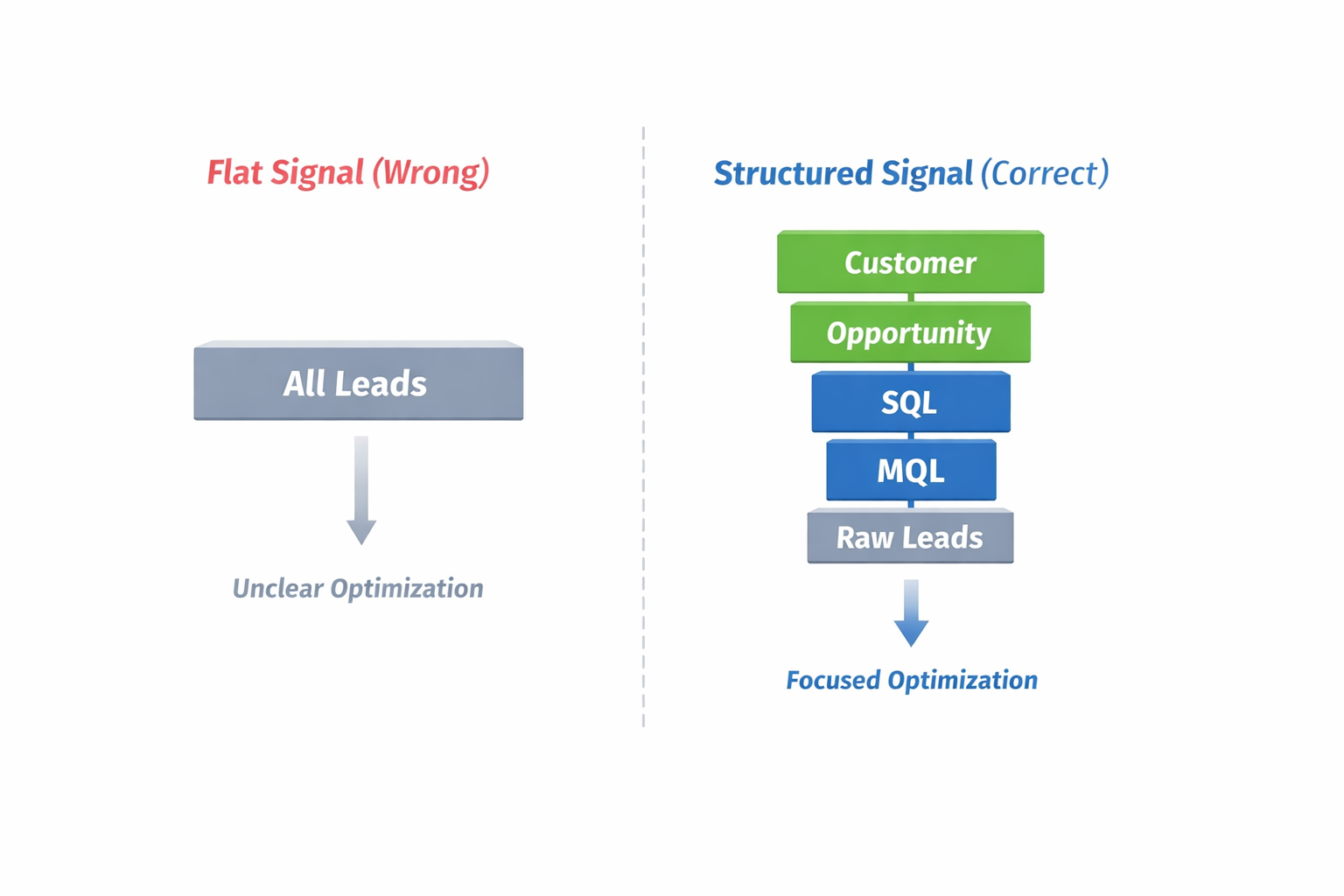
A common failure starts the moment a lead enters your system. Every form fill is treated as the same event, regardless of intent, company fit, or readiness to buy.
From the platform’s perspective, this flattens signal quality. It cannot distinguish between someone casually downloading a guide and someone requesting a demo.
You’ll typically notice this pattern:
-
CPL looks stable or even improves, yet sales teams reject more leads.
-
Lead volume increases, but qualified pipeline does not.
-
Campaigns gradually optimize toward lower-intent users.
This is the same dynamic explained in Lead Quality vs Lead Volume: What Facebook Advertisers Need to Know.
To correct this, you need structured feedback:
-
Define qualification stages clearly, such as MQL, SQL, and opportunity, so downstream systems can differentiate value.
-
Send these stages back as separate conversion events, instead of relying on a single “lead” signal.
-
Standardize qualification criteria, otherwise the feedback loop becomes inconsistent.
When platforms receive tiered signals, optimization starts aligning with revenue instead of cheap conversions.
Delayed Data Sync Between CRM and Ad Platforms
Many integrations technically work, but operate too slowly to be useful.
If your CRM updates are pushed back in batches or delayed by hours, the ad platform is making decisions without fresh data.
You can spot this issue through:
-
Conversion events appearing in irregular spikes instead of a steady flow.
-
Learning phases resetting without obvious changes.
-
Performance volatility without clear causes.
This timing issue is closely related to Meta Ads Attribution: What to Know About Windows, Delays, and Data Accuracy.
To fix it:
-
Push events in near real-time, ideally within minutes.
-
Avoid large batch uploads, or keep them consistent.
-
Preserve accurate timestamps, so attribution stays valid.
Broken or Incomplete Field Mapping
Field mapping issues rarely break integrations outright. Instead, they quietly distort your data.\
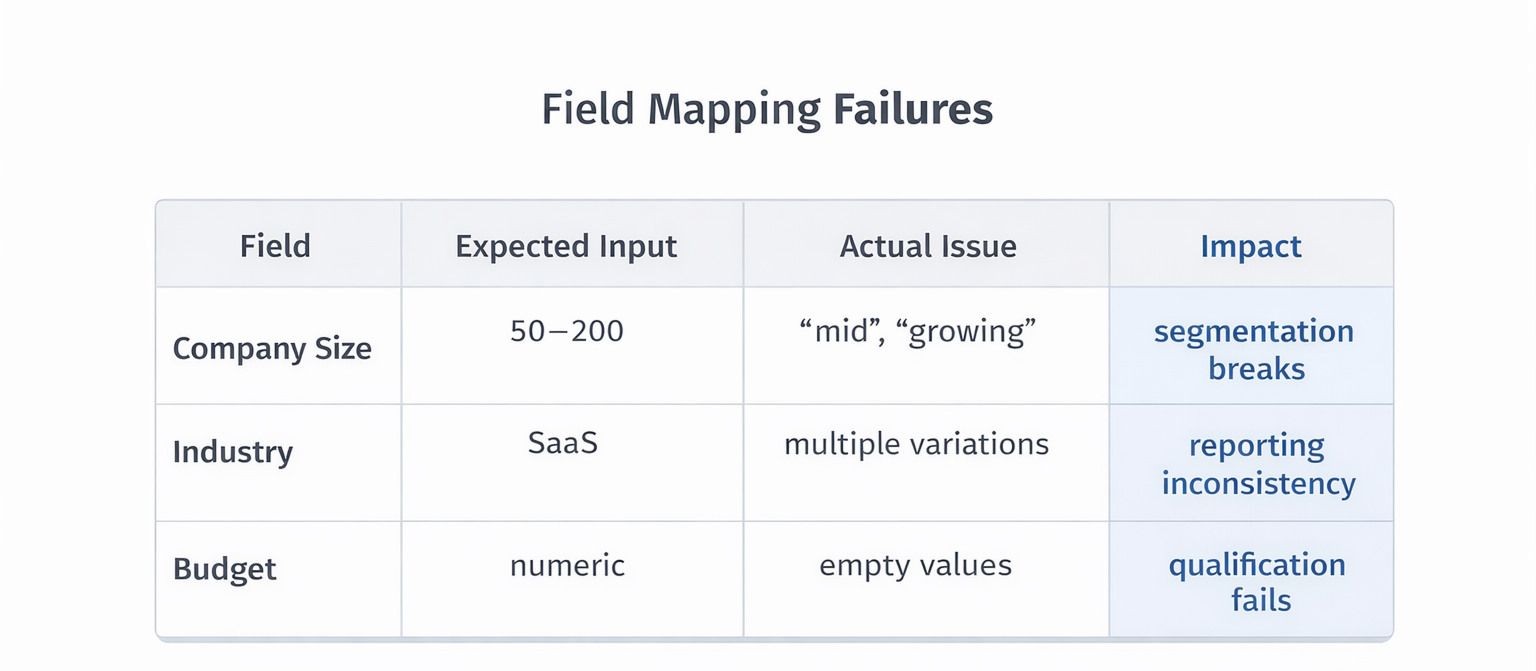
You’ll see:
-
Missing segmentation data.
-
Incorrect categorization of leads.
-
Inconsistent CRM records.
This becomes critical when building audiences, as covered in How to Use CRM Data to Build B2B Facebook Audiences That Convert.
To fix this:
-
Audit mappings end-to-end (form → CRM → platform).
-
Standardize formats, especially for key fields.
-
Validate incoming data before storing it.
No Feedback Loop to Advertising Platforms
Many setups send data into the CRM — and stop there.
Without feedback, platforms keep optimizing for front-end events, not revenue.
You’ll see:
-
High lead volume with declining quality.
-
Weak lookalike performance.
-
Retargeting pools filled with low-intent users.
This limitation is explored in Why CRM Retargeting Alone Isn’t Enough.
To close the loop:
-
Send offline conversions back (qualified leads, deals).
-
Use consistent identifiers for matching.
-
Prioritize meaningful events, not just volume.
Overloading the CRM With Low-Intent Leads
Sometimes the integration works perfectly — but the inputs are wrong.
If campaigns push too many low-intent leads:
-
Sales teams slow down.
-
Acceptance rates drop.
-
CRM data becomes noisy.
Fix this upstream:
-
Add qualification earlier, inside forms or messaging.
-
Align marketing and sales criteria.
-
Reduce unnecessary fields that don’t affect qualification.
Ignoring Data Normalization and Deduplication
Duplicate records distort both reporting and optimization.
You’ll notice:
-
Inflated lead counts.
-
Mismatched reporting across systems.
-
Multiple entries for the same user.
To fix:
-
Deduplicate using unique identifiers.
-
Normalize formats across fields.
-
Audit data regularly, especially after campaign spikes.
Disconnect Between CRM Logic and Campaign Structure
Campaigns evolve quickly. CRM systems often don’t.
This leads to:
-
Leads entering wrong pipelines.
-
Broken automation workflows.
-
Reporting inconsistencies.
To stay aligned:
-
Update CRM structure alongside campaigns.
-
Review workflows regularly.
-
Coordinate changes across teams.
Final Takeaway
CRM integration defines how marketing performance is interpreted.
If signal quality, timing, or feedback loops break, campaigns optimize in the wrong direction — even when everything else looks fine.
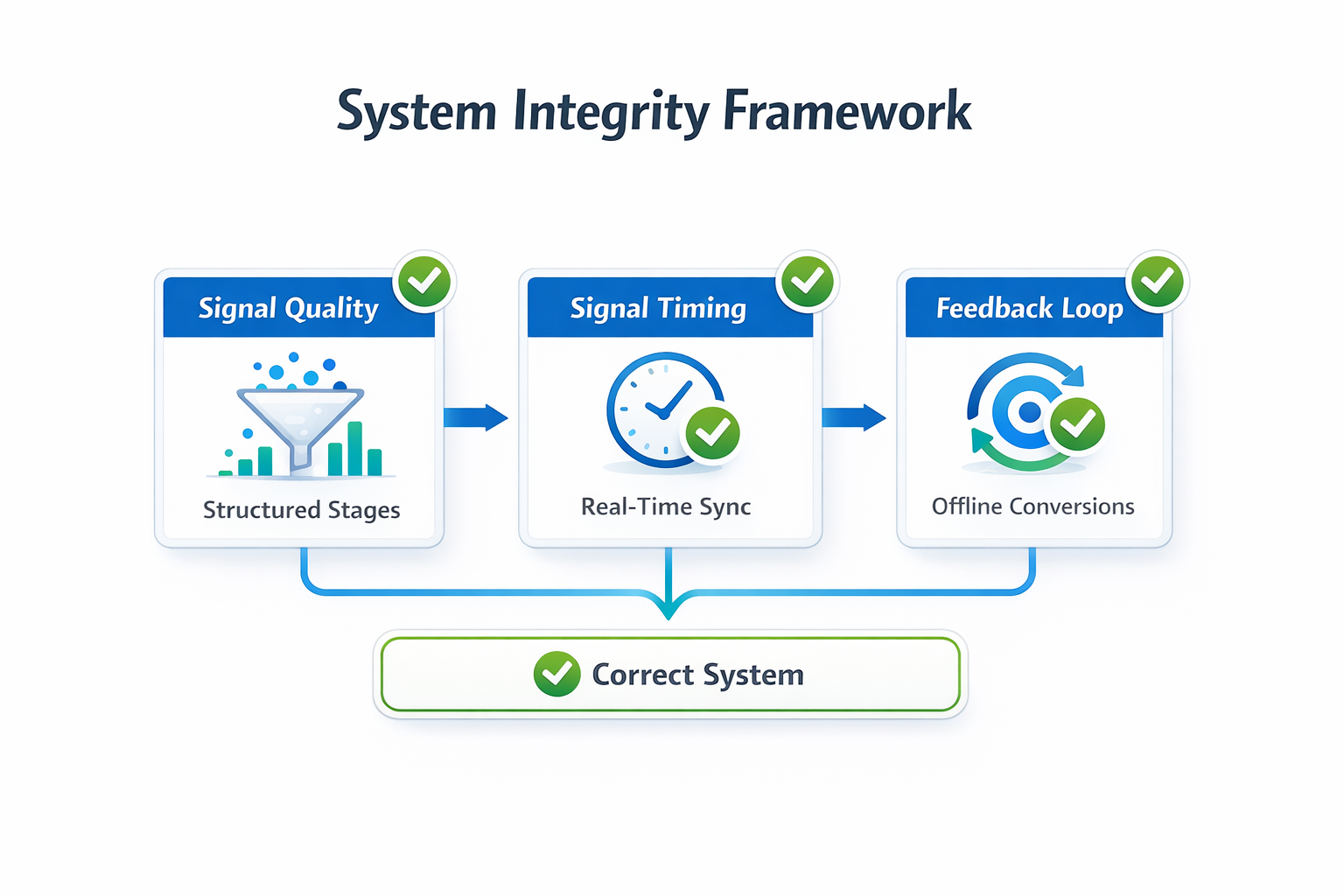
A strong integration:
-
Preserves signal quality.
-
Maintains real-time feedback.
-
Connects marketing activity to revenue outcomes.
If scaling feels harder than it should, the issue is often not in your ads.
It’s in your data flow.