If your CPM spikes the moment you move into a competitor-heavy audience, you are already competing — whether you planned to or not.
In B2B advertising, “competitive targeting” is rarely direct. You are not selecting your competitor’s users from a list. Instead, you are entering auctions where multiple vendors are bidding for the same behavioral signals.
The platform decides which message wins that moment.
That shifts the entire approach. Competitive targeting is not about selecting the right audience — it is about aligning with how intent is interpreted.
Why Most Competitive Targeting Setups Underperform
Many campaigns start with competitor keywords, interest stacks, or brand-based audiences. Early metrics look promising — CTR increases — but downstream performance collapses.
This happens because of signal distortion.
When you introduce competitor inputs without controlling what the system optimizes for, you attract mixed intent. The algorithm then learns from inconsistent outcomes.
You will typically see:
-
CTR rises while lead quality drops.
Users engage because the ad references something familiar, but they are still in research mode. These users compare tools instead of choosing vendors, which lowers qualification rates. -
Conversion rates fluctuate day to day.
The system fails to stabilize because it is learning from multiple intent types at once. This creates inconsistent delivery patterns across auctions. -
Identical ad sets produce different outcomes.
Even with similar setup, expansion pushes delivery into adjacent behavioral clusters, each with different conversion probability.
What the Algorithm Actually Uses as “Competitive” Signal
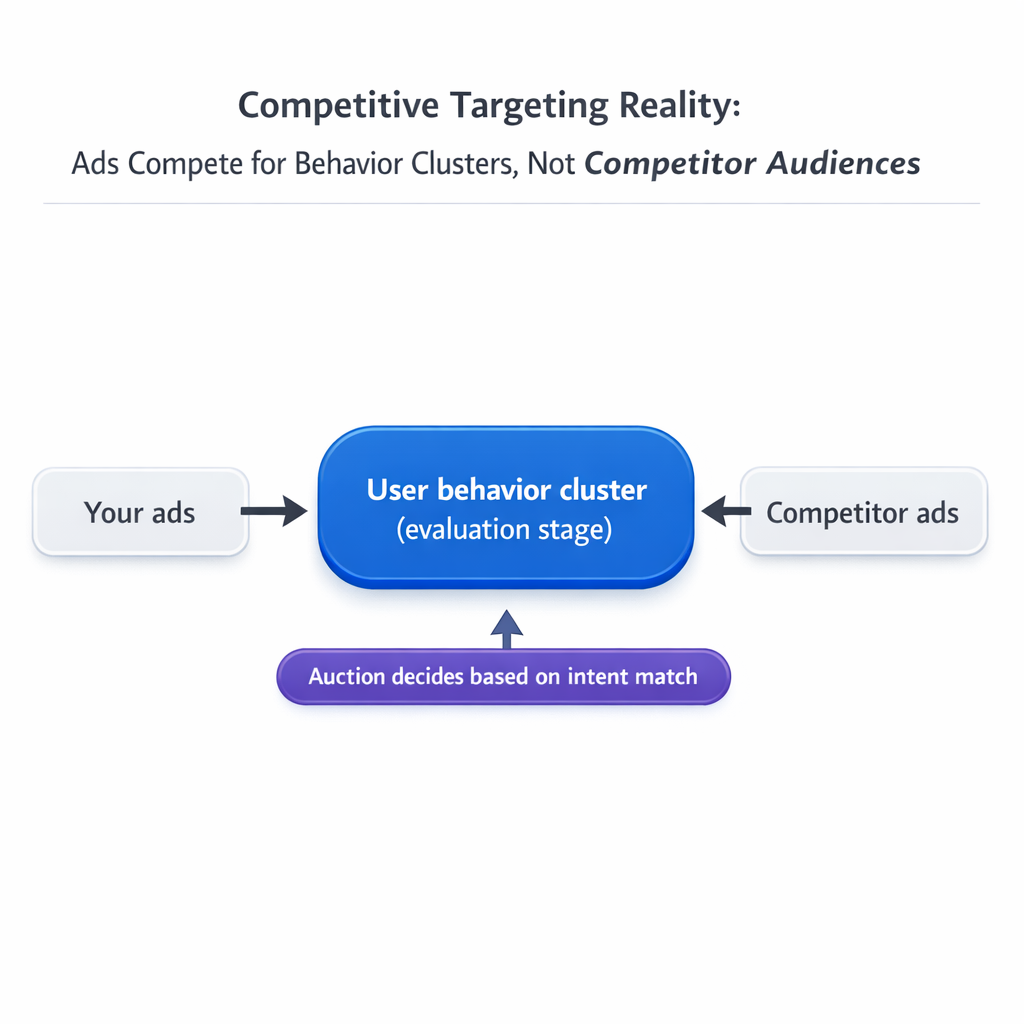
There is no internal “competitor audience” inside Meta.
Instead, platforms build clusters from behavioral sequences.
A user who:
-
visits several vendor websites within a short time frame;
-
interacts with pricing, feature, or comparison pages;
-
returns to similar tools multiple times;
gets classified into an evaluation-stage cluster.
At that point:
-
the algorithm increases bid competitiveness for that user;
-
and prioritizes ads historically linked to conversion in similar situations.
This explains why generic messaging fails.
If your ad does not match evaluation-stage intent, it loses auctions regardless of targeting setup.
For a deeper breakdown, see How to Adapt to Facebook Ads Targeting Updates.
Where High-Intent Competitive Traffic Actually Comes From
Not all competitor-related activity signals the same level of intent. The difference becomes visible when you analyze behavior patterns and timing.
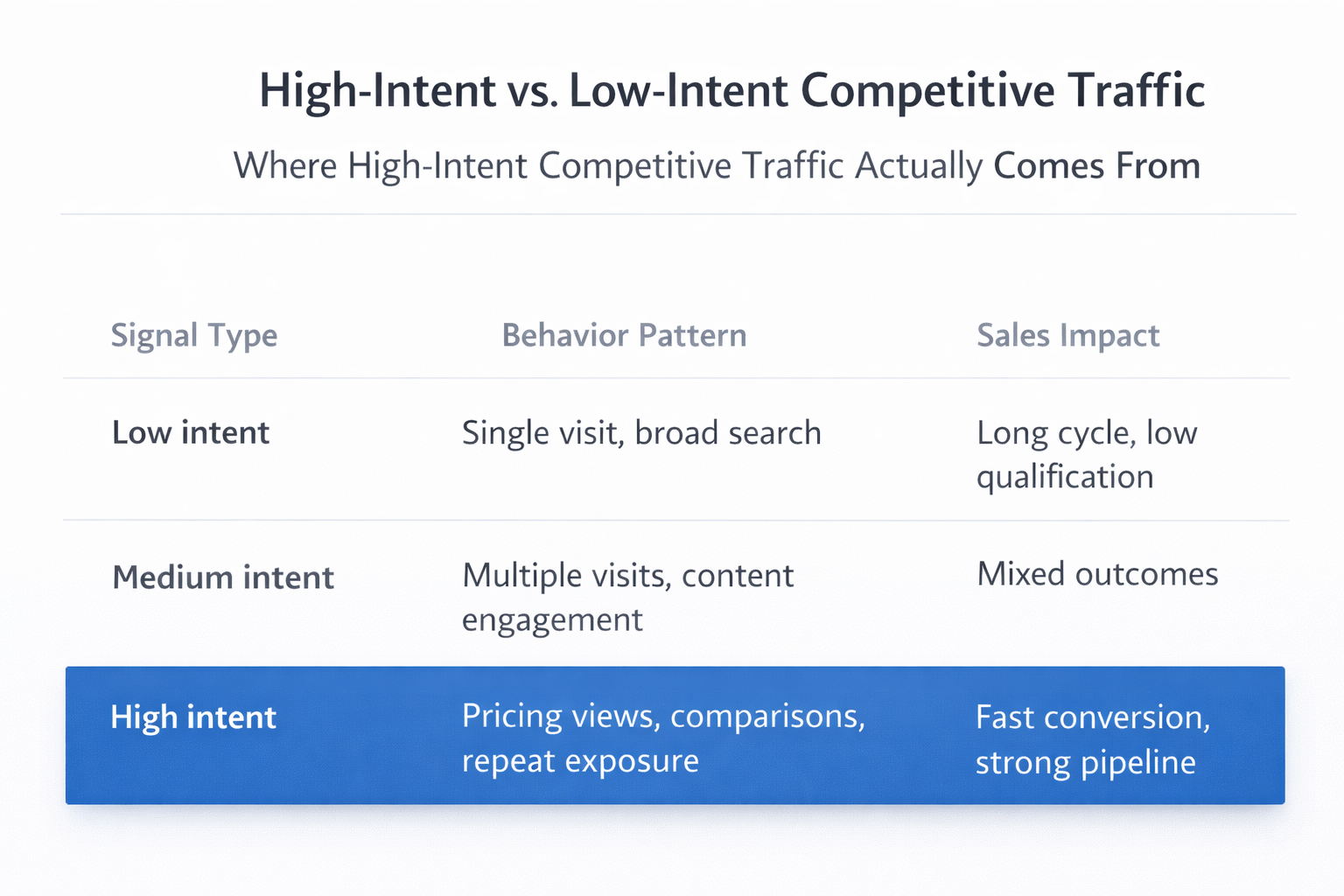
The most valuable segments usually show:
-
Compressed research windows.
Users who evaluate multiple solutions within 24–72 hours tend to convert faster. In CRM data, they move through stages with fewer delays. -
Cross-vendor exposure with rising frequency.
When users repeatedly see ads or visit sites within the same category, it often indicates narrowing consideration rather than early exploration. -
Interaction with decision-stage assets.
Engagement with pricing pages, integration documentation, or onboarding flows signals operational evaluation, not curiosity.
These users typically produce:
-
shorter sales cycles;
-
higher acceptance rates;
-
fewer disqualified leads.
Structuring Campaigns to Capture Competitive Intent
Treating competitor targeting as a separate campaign limits performance because it fragments learning.
A more effective approach is to integrate it into your broader system.
Build a Stable Signal First
Before adding competitor inputs, your campaign must produce reliable signals.
-
Use conversion events tied to qualification, not just form submissions.
-
Remove low-intent entry points that inflate volume but dilute signal.
-
Consolidate ad sets to ensure sufficient data density for learning.
Without this layer, competitive targeting amplifies noise rather than intent.
If your campaigns struggle at this stage, review Why Facebook Ads Aren’t Converting (And How to Fix It).
Introduce Competitive Inputs Without Breaking Stability
Once your signal stabilizes, you can layer competitor-related inputs.
-
Add them inside existing high-performing campaigns instead of isolating them.
-
Monitor conversion stability, not just lead volume.
-
Scale gradually to avoid disrupting learned patterns.
Match Messaging to Evaluation Behavior
This is where most campaigns fail.
Users comparing competitors are trying to reduce uncertainty. They are not looking for discovery.
Messaging should reflect that:
-
Reduce comparison effort.
Present structured comparisons such as pricing models, onboarding timelines, or feature gaps. This shortens decision time. -
Address switching friction directly.
Explain how migration works, what support is included, and how risk is reduced. This removes a major barrier. -
Use proof from similar companies.
Case studies from comparable businesses carry more weight than generic testimonials because they validate the decision context.
If messaging skips this step and pushes immediate conversion, performance drops despite strong traffic.
For more on this, see How to Align Ads With Buyer Intent for Better Results.
Budget Behavior Under Competitive Pressure
Higher CPM is expected in competitive targeting. You are entering auctions with more aggressive bidders.
The mistake is evaluating performance through CPL alone.
A typical pattern:
-
CPL increases due to auction pressure;
-
qualified lead rate improves due to higher intent;
-
overall pipeline efficiency increases.
In this scenario, reducing spend to “fix CPL” harms performance.
Instead, track:
-
cost per qualified lead, which reflects actual signal quality;
-
opportunity rate, which reflects sales alignment;
-
revenue per lead, which ties spend to business outcomes.
For a deeper perspective, see Audience Quality vs Quantity: What Drives Better Results.
Diagnosing Where Competitive Targeting Breaks
When performance becomes inconsistent, the issue is rarely the targeting input itself. It is usually structural.
You can isolate the constraint using observable signals:
-
Stable CTR with unstable CVR.
This indicates that messaging attracts attention but does not match decision-stage intent. -
Rising frequency with declining performance.
This suggests saturation without sufficient differentiation. -
Wide variation in lead quality across ad sets.
This points to audience expansion drifting away from the original signal. -
Delayed or inconsistent post-lead outcomes.
This often means your conversion event does not reflect real qualification.
The Strategic Shift That Changes Results
Competitive targeting starts working when you stop thinking about competitors and start focusing on evaluation behavior.
That shift changes how you:
-
define conversion signals;
-
structure campaigns;
-
design messaging;
-
interpret performance metrics.
Key Takeaway
Competitive targeting becomes reliable when three conditions align:
-
the system receives stable, qualification-based signals;
-
the audience reflects active evaluation behavior;
-
the messaging reduces friction instead of forcing conversion.
If one breaks, performance becomes inconsistent.
If all hold, competitive campaigns consistently generate high-intent pipeline.