You open Ads Manager and your CPM is up 28%. Yesterday everything looked fine. You didn’t touch the campaign.
This happens all the time.
Daily cost changes in Facebook Ads aren’t random. They come from how the auction shifts, how recent conversions affect delivery, and how your budget gets distributed throughout the day.
Once you understand what’s actually driving those changes, the fluctuations stop feeling unpredictable and start becoming readable.
Auction Pressure Changes Faster Than You Think
Your campaign can become more expensive even when nothing inside it changes.
The reason is simple: you’re not bidding in isolation. Every time your ad is shown, it enters an auction with other advertisers targeting the same user at that exact moment.
What typically changes:
-
More advertisers enter the same audience, which increases competition and pushes CPM higher even if your ad performance remains stable.
-
Existing advertisers increase budgets or bids, which raises the cost of winning impressions across the same segment.
-
Seasonal or weekly demand shifts (for example, Monday budget resets) temporarily inflate auction prices.
You’ll recognize this situation when CPM rises but your CTR and conversion rate stay consistent. In that case, your campaign is still working — it’s just operating in a more expensive auction.
If you want to understand these dynamics in more depth, read why CPMs rise and what you can actually control.
Conversion Signals Can Shift in a Single Day
The system doesn’t rely on long-term averages. It reacts to recent conversion activity.
Even a short disruption in conversions can change how your campaign behaves.
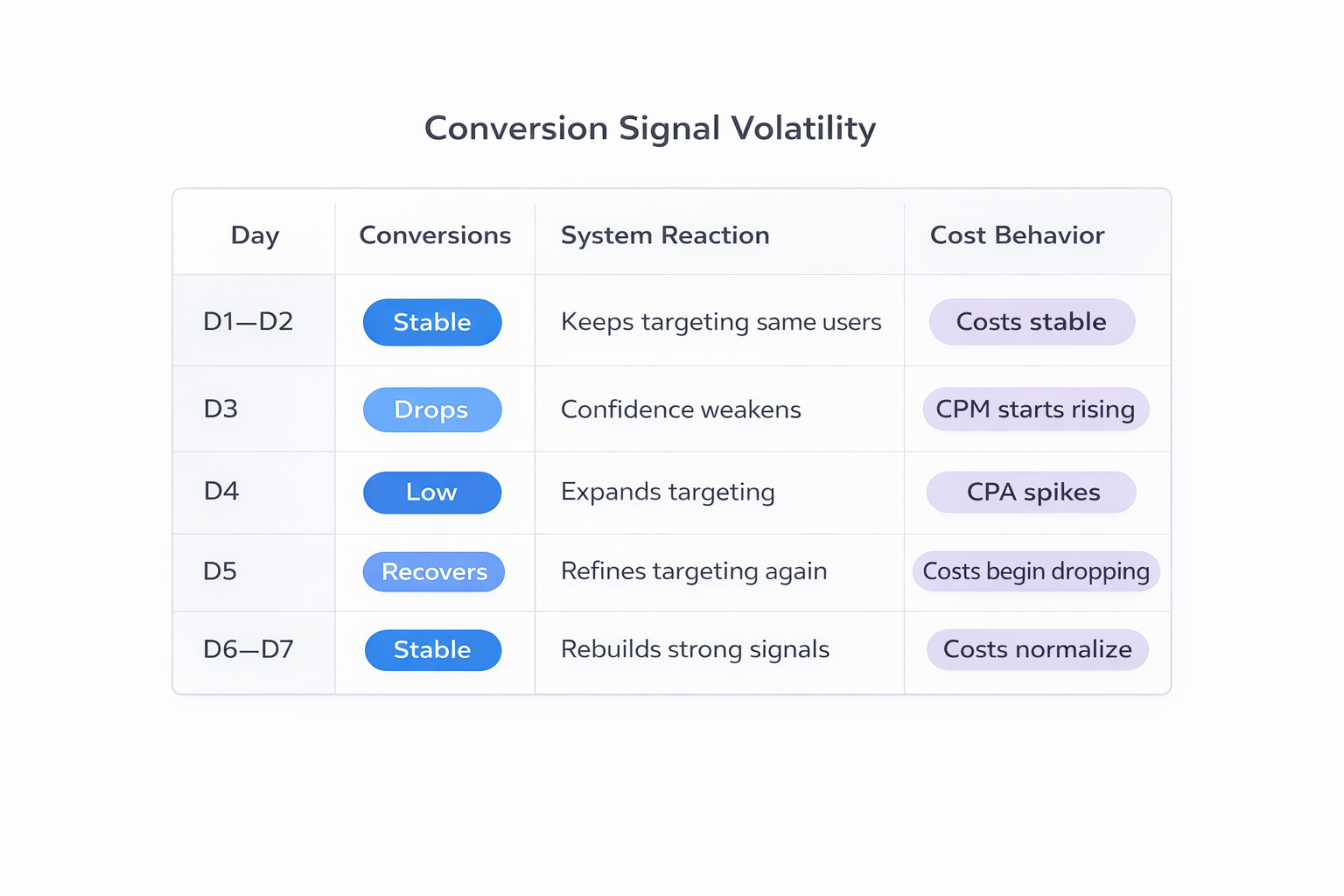
Here’s what typically happens:
-
When conversions come in consistently, delivery becomes more efficient because the system keeps targeting similar users.
-
When conversions drop for a short period, the system reduces confidence in that audience and starts exploring new segments.
-
When new conversions appear again, delivery tightens and costs often stabilize or decrease.
This is why you often see a pattern where a strong day is followed by efficient performance, while a weak day is followed by higher costs and unstable results.
If you’ve ever seen performance suddenly drop without changing anything, this is closely related to what’s explained in what to do when your Facebook ads suddenly stop converting.
Budget Distribution Is Uneven by Design
Your daily budget is not spent evenly across the day, even though it might look that way at a high level.
The system allocates spend based on predicted conversion likelihood at different times.
In practice, that means:
-
More budget is pushed into hours where users are more likely to convert based on past behavior.
-
Less budget is spent during periods where conversion probability is lower, even if impressions are cheaper.
-
As the day progresses, remaining budget may be forced into weaker inventory, which increases CPC and CPM.
When you increase budget, this effect becomes more pronounced because the system has to expand beyond the most efficient time windows.
If you want to go deeper into how timing affects delivery, see why your audience reacts differently at different times of day.
Audience Saturation Happens Gradually, Not Suddenly
At the start of a campaign, your ads are shown to the users most likely to convert.
That group is always smaller than it appears.
Over time, as those users convert or stop responding, delivery expands into less responsive segments.
You’ll typically notice:
-
Frequency increases because the same users are seeing your ads more often.
-
CTR declines slightly as engagement drops with repeated exposure.
-
CPM rises because the system is now competing for less efficient impressions.
This is not a sharp drop. It’s a gradual shift that becomes visible over several days.
If you want to understand how to spot and manage this early, read how to detect audience saturation before it hurts performance.
Creative Performance Declines in Micro-Cycles
Creative fatigue is rarely a single event. It happens in short, repeatable cycles.
A typical pattern looks like this:
-
In the first few days, the creative performs well because it reaches new users and generates strong engagement signals.
-
After repeated exposure, engagement starts to decline as the same users see the ad multiple times.
-
Performance stabilizes at a lower level or continues to drop if no new variation is introduced.
Even a small drop in CTR can increase CPM because your ad becomes less competitive in the auction.
This is why cost fluctuations often appear even when nothing seems “broken.”
If you want a more structured way to manage this, see creative fatigue early signals and how to fix them.
Conversion Lag Distorts Daily Performance
Not every conversion happens immediately after a click.
In many campaigns:
-
A user clicks on your ad today.
-
They convert one or two days later after additional consideration.
This creates misleading daily performance data.
You might see:
-
A day with high spend and low conversions.
-
Another day with lower spend but more conversions.
Nothing actually improved. Attribution simply caught up.
This is one of the main reasons daily CPA can feel inconsistent, especially in B2B or higher-consideration funnels.
Frequent Edits Keep Campaigns Unstable
Some changes force the system to re-evaluate delivery:
-
Increasing budget too aggressively pushes the campaign into new, less efficient inventory.
-
Replacing creatives resets engagement signals and requires new testing.
-
Adjusting targeting changes the audience pool entirely.
After these changes, performance usually becomes less stable while the system tests again.
You’ll often see higher CPM, lower conversion efficiency, and uneven delivery patterns.
If changes are made too frequently, the campaign never stabilizes and daily cost fluctuation becomes constant.
How to Read Cost Changes Without Overreacting
Instead of reacting to every spike, match what you see to the underlying cause.
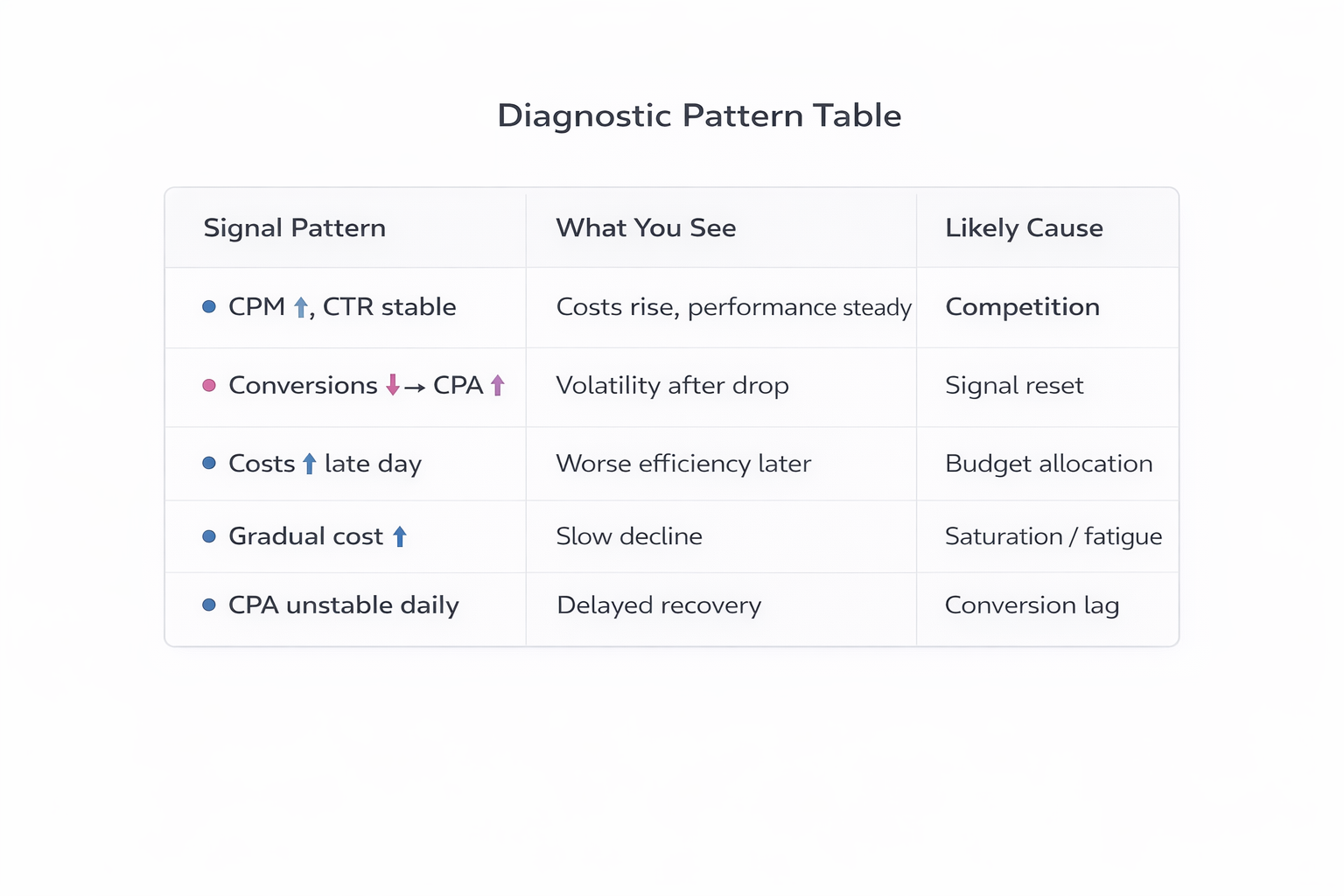
Here’s how to interpret common patterns:
-
If CPM increases while CTR and conversion rate stay stable, the likely cause is increased competition in the auction.
-
If conversions drop and costs rise shortly after, the system is expanding into new segments to find results again.
-
If costs increase later in the day, the budget is being pushed into weaker time windows.
-
If costs rise gradually over several days, audience saturation or creative fatigue is building.
-
If CPA fluctuates but corrects itself over time, conversion lag is distorting daily reporting.
Each of these patterns points to a different mechanism, and treating them the same usually leads to unnecessary changes.
What Actually Helps Reduce Volatility
You won’t eliminate daily fluctuations, but you can reduce unnecessary instability by aligning your actions with how the system works.
Focus on:
-
Using rolling performance windows of 3–7 days instead of reacting to single-day data, which removes noise from attribution delays and short-term shifts.
-
Limiting frequent edits so the system can stabilize and build consistent performance signals.
-
Refreshing creatives before performance drops significantly, which prevents sudden cost increases.
-
Scaling budgets gradually so delivery remains within efficient segments instead of expanding too quickly.
-
Monitoring CPM and CTR alongside CPA, since they often explain cost changes earlier than conversion data.
These actions don’t remove volatility, but they make it predictable and manageable.
Final Takeaway
Daily cost changes are not a sign that something is wrong.
They are a direct result of how Facebook Ads operates — auctions shift, conversion signals change, and attribution lags behind real user behavior.
Once you recognize these patterns, you stop reacting to individual days and start managing performance at the system level.