Most teams think about consent only when legal gets involved. In practice, it shows up somewhere else first — inside campaign performance.
You launch campaigns, traffic looks fine, CTR holds, but conversions don’t follow. Retargeting pools feel smaller than they should. CPA slowly climbs without a clear cause.
At that point, it’s tempting to blame creatives or targeting. But often, the issue sits lower in the system — in how much data you’re actually collecting.
Consent controls that.
When Consent Starts Affecting Performance
The first signal usually isn’t dramatic. It’s subtle inconsistency.
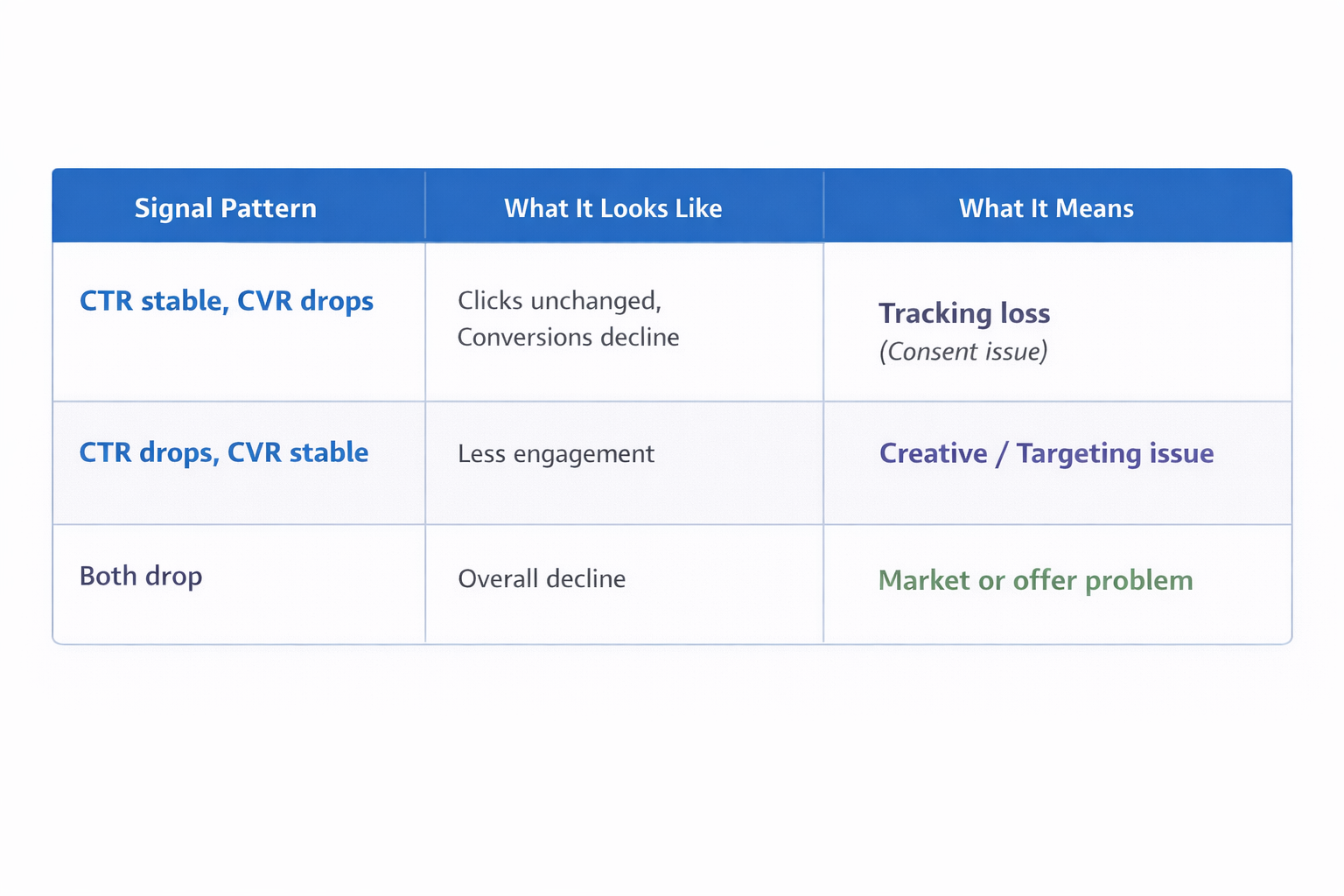
You might notice:
-
Stable traffic with declining conversion rate.
Users are still clicking, which means demand hasn’t changed. But fewer conversions are recorded, which usually points to missing tracking rather than weaker intent. -
Retargeting audiences growing slower than expected.
Even with steady traffic, fewer users are being captured. This often mirrors patterns explained in
Why Custom Audiences Shrink Over Time (and How to Rebuild Them). -
Performance drifting instead of breaking.
Consent issues rarely cause sharp drops. They reduce signal quality gradually, which leads to unstable optimization.
This is why consent problems are often misdiagnosed.
Where Consent Actually Breaks the System
Consent doesn’t fail in one place. It creates small gaps across the entire tracking flow.
Some of the most common ones:
-
No interaction with the consent banner.
If tracking only starts after user action, a large share of sessions never gets recorded. -
Partial consent (analytics yes, marketing no).
You’ll see users in analytics tools, but they won’t enter ad platform audiences. -
Key events blocked by consent conditions.
If purchases or qualified leads don’t fire reliably, the algorithm starts optimizing toward weaker signals. -
Inconsistent tracking across tools.
When Meta, GA4, and backend systems follow different consent rules, the data stops matching.
Each of these reduces the quality of feedback your campaigns rely on.
What Changes When Signal Becomes Incomplete
The platform doesn’t stop working when data drops.
It adapts — and that’s where performance shifts.
Instead of relying on direct feedback, it starts modeling outcomes.
You’ll typically notice:
-
Slower optimization cycles.
The system needs more time to confirm patterns. -
Higher volatility.
Fewer events mean less statistical stability. -
Mismatch between reported and real results.
This is closely related to attribution issues explained in
Meta Ads Attribution: What to Know About Windows, Delays, and Data Accuracy.
At this stage, the system is still optimizing — just with weaker input.
How to Recognize Consent Issues Early
You don’t need access to consent logs. The patterns show up in campaign data.
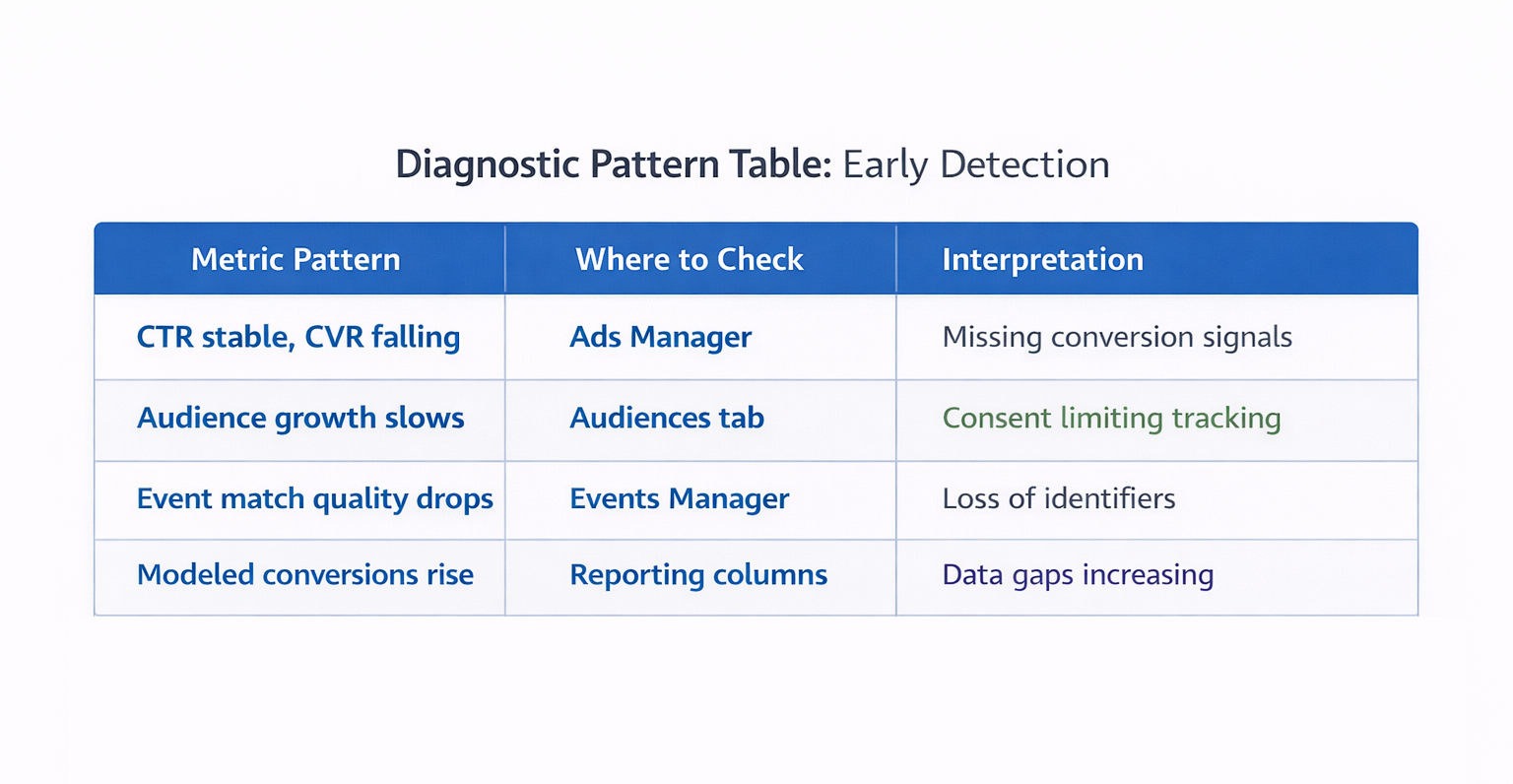
Look for:
-
CTR stable, CVR declining.
Demand is still there, but tracking is incomplete. -
Audience growth not matching traffic.
Users are visiting, but not being recorded. -
Drop in event match quality.
Fewer identifiers are available for optimization. -
More modeled conversions in reporting.
The platform is filling gaps with estimates.
All of these are observable directly in Ads Manager.
Why Most Consent Setups Hurt Performance
Most setups are designed for compliance, not performance.
That creates predictable issues:
-
Full tracking blocked by default.
Clean legally, but eliminates early-session data. -
No prioritization of important events.
Losing a purchase event is treated the same as losing a page view. -
Late activation of tracking.
By the time consent is given, key signals are already lost.
This is why campaigns can look fine on the surface but fail at the business level — a pattern similar to
Why Facebook Ads Data Alone Can’t Explain True ROI.
What a Better Setup Looks Like
A performance-oriented setup focuses on preserving signal.
That usually involves:
-
Granular consent categories.
Partial consent still produces usable data instead of losing everything. -
Early, controlled consent timing.
Capture key behavior without hurting user experience. -
Server-side tracking as backup.
When browser tracking fails, backend events still capture conversions.
If you’re not using it yet, see Server-Side Tracking for Facebook Ads: A Beginner’s Guide. -
Clear event prioritization.
Your most valuable actions must be consistently tracked.
These are structural decisions, not technical details.
The Tradeoff Most Teams Ignore
There’s no perfect setup.
More restriction means:
-
lower legal risk,
-
but weaker signal,
-
and slower optimization.
More flexibility means:
-
stronger performance,
-
but higher compliance exposure.
The key is making this tradeoff intentionally.
Where This Breaks in Practice
Consent is rarely monitored properly.
Common issues:
-
Consent rates not tracked as a KPI.
Teams optimize campaigns without knowing how much data they’re feeding into them. -
UI changes affecting acceptance rates.
Small design tweaks can impact performance within days. -
Mismatch between tools.
Different consent logic across platforms makes data impossible to reconcile.
These problems don’t look like consent issues — they look like performance issues.
Final Takeaway
Consent isn’t just a legal requirement. It defines how much of reality your campaigns can see.
And when visibility drops, the system doesn’t stop — it guesses.
If performance feels unstable or disconnected from actual results, don’t just check targeting or creatives.
Start with the signal. That’s usually where things break first.