AI rarely breaks marketing performance on its own. What usually breaks is the system it’s plugged into.
Most teams don’t rebuild their stack when introducing AI. They layer it on top of existing tools — CRM, Meta Ads, analytics — and expect improvement. Instead, they get unstable attribution, conflicting signals, and inconsistent optimization.
Integration works when AI is treated as part of the system, not an add-on.
Where AI Actually Fits in a Marketing Stack
Most components in your stack already follow strict logic.
Your CRM stores structured data. Your ad platforms distribute budget. Analytics report outcomes.
AI becomes useful where decisions are uncertain.
-
Prediction layers — estimating conversion or churn probability.
-
Prioritization layers — deciding where budget or attention goes.
-
Transformation layers — reshaping inputs like creatives or audiences.
If you look at how AI is already being used in platforms, this aligns closely with shifts described in How Advertisers Can Use AI to Optimize Facebook and Instagram Campaigns.
Trying to replace core systems with AI creates instability. Using it inside these layers creates leverage.
The First Integration Mistake: AI Without Signal Control
A typical lead gen setup looks fine at first:
-
Leads come in at a stable CPL.
-
CRM receives them.
-
Sales follows up.
But no quality signal goes back to the ad platform.
AI ends up optimizing for form submissions — not real outcomes.
This is the same failure pattern explained in AI in Lead Generation: Smarter Ways to Qualify Leads.
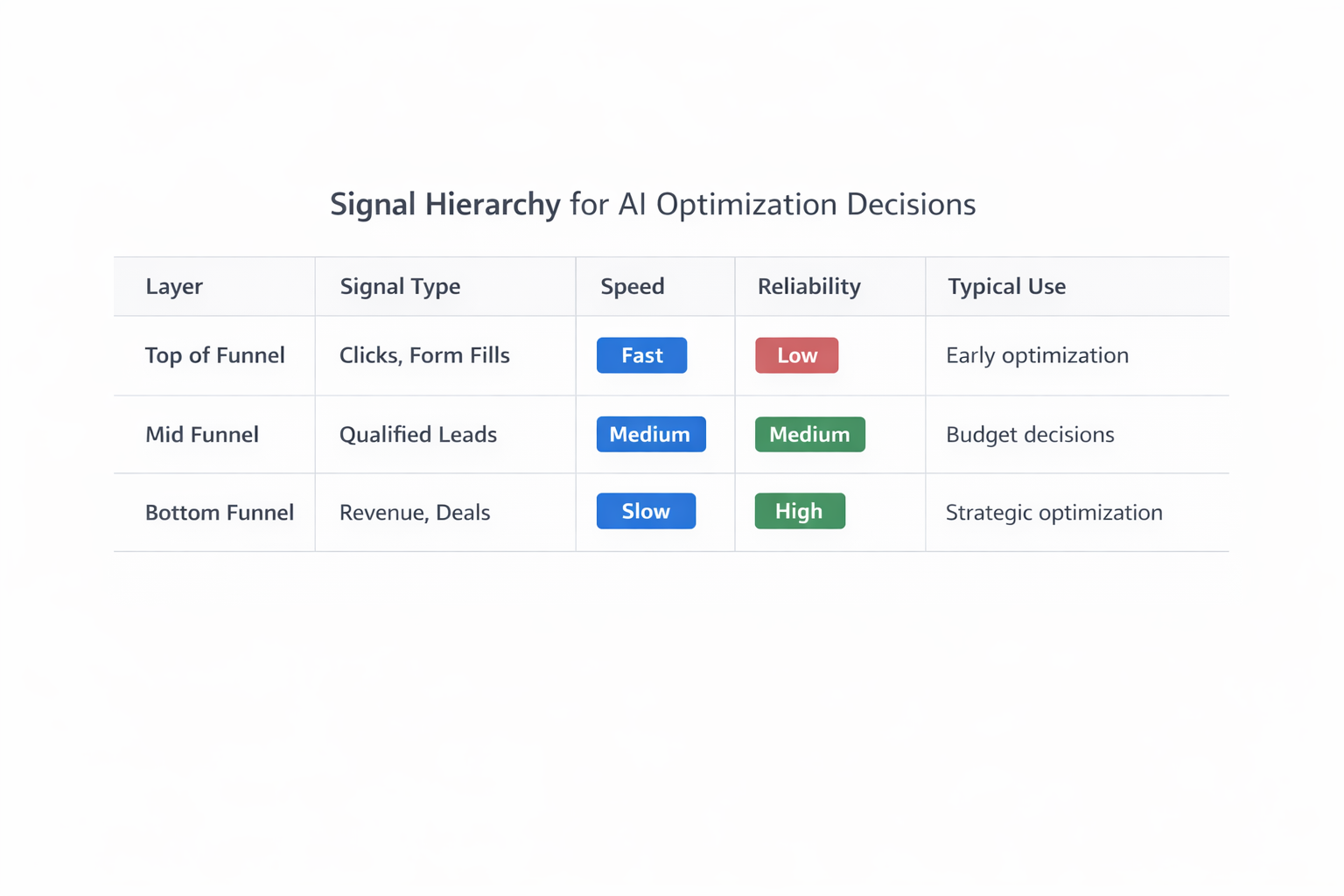
Before integrating AI, define your signal hierarchy:
-
Top-of-funnel signals — clicks, form fills (fast but noisy).
-
Mid-funnel signals — qualified leads, demos (slower but meaningful).
-
Bottom-funnel signals — revenue (accurate but delayed).
Without this structure, AI scales the wrong behavior.
Data Flow Matters More Than Model Choice
Most integration issues come from broken data flow, not weak AI tools.
A common breakdown:
-
Leads enter through ads.
-
CRM updates happen days later.
-
No structured feedback returns.
AI keeps optimizing early signals because nothing else exists.
A functional loop looks like this:
-
Lead enters from paid traffic.
-
CRM assigns status.
-
Status becomes a trackable event.
-
Event is sent back to the ad platform.
-
AI adjusts based on outcomes.
This feedback loop is the foundation behind approaches like How to Combine AI and Automation for Smarter Targeting.
If feedback doesn’t return, AI doesn’t learn.
Choosing Integration Points (Not Just Tools)
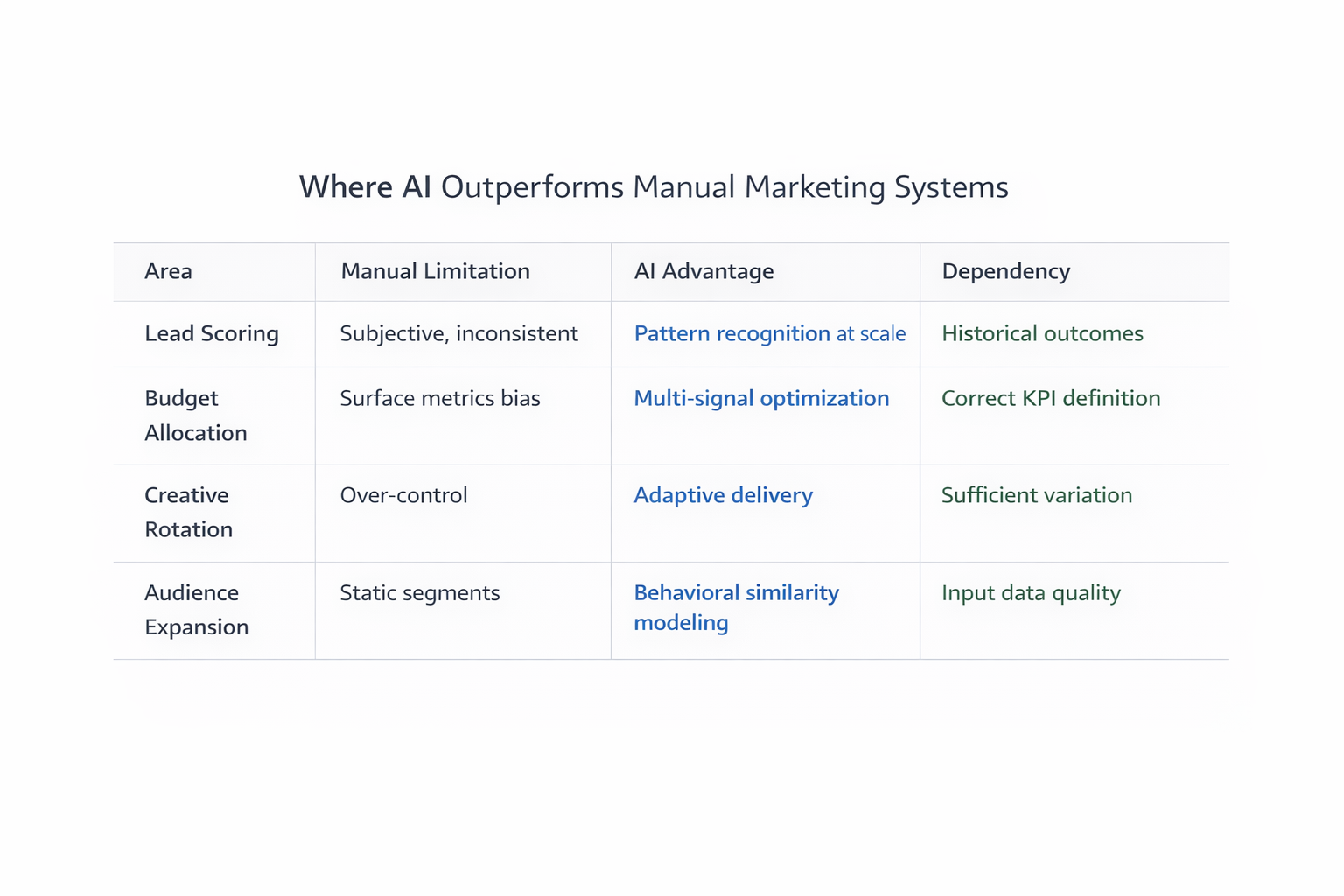
Instead of asking where to use AI, look for slow or subjective decisions.
Lead Scoring
Manual scoring breaks under scale.
AI works when:
-
Historical outcomes exist.
-
Scores influence real actions.
A simple setup:
-
AI assigns probability scores.
-
CRM segments leads by intent.
-
Low-intent segments are excluded from retargeting.
This is exactly where AI tends to outperform rule-based systems, as outlined in How AI Helps Marketers Build More Profitable Ad Audiences.
Budget Allocation Across Campaigns
Manual budget shifts usually rely on surface metrics.
AI can improve allocation — but only if performance is defined correctly.
-
Optimizing for CPL drives cheap traffic.
-
Optimizing for qualified leads changes allocation behavior.
You can see this dynamic in systems described in The Role of AI in Facebook Ad Budget Allocation and Scaling.
Without proper signals, AI optimizes for the wrong goal.
Creative Testing and Rotation
AI already controls delivery inside Meta.
The mistake is over-controlling it.
You’ll see it when:
-
Ads are paused too early.
-
Budgets are split evenly.
-
Variations are isolated.
A better structure:
-
Group similar creatives together.
-
Let the system bias delivery.
-
Evaluate at the cluster level.
This shift is part of a broader trend covered in The Rise of AI-Powered Creatives in Facebook and Instagram Ads.
Audience Expansion and Suppression
Audience systems depend on inputs.
-
Raw leads → expansion toward low intent users.
-
Qualified leads → expansion toward buyers.
On the suppression side:
-
Excluding disqualified leads reduces waste.
-
Syncing CRM segments improves efficiency.
AI-driven targeting increasingly relies on these inputs, especially in privacy-constrained environments, as discussed in How AI Builds Audiences Without Tracking.
The Hidden Constraint: Latency
Even with correct setup, timing can break everything.
You’ll notice:
-
Performance looks good early.
-
Quality drops later.
-
AI overreacts to delayed signals.
Common causes:
-
Slow CRM updates.
-
Daily batch syncing.
-
Attribution delays.
Reducing latency becomes critical as systems become more automated — a challenge also highlighted in How AI Tools Are Changing the Way E-Commerce Brands Run Facebook Ads.
AI decisions are only as current as the data they receive.
What Not to Automate
Some areas degrade when automated too early:
-
Offer strategy — requires positioning decisions.
-
Creative direction — AI generates variations, not angles.
-
Budget constraints — should remain controlled.
This balance is explored in AI vs Human Creativity in Marketing: Finding the Right Balance.
AI should support execution, not replace strategy.
A Practical Integration Sequence
Trying to integrate everything at once creates noise.
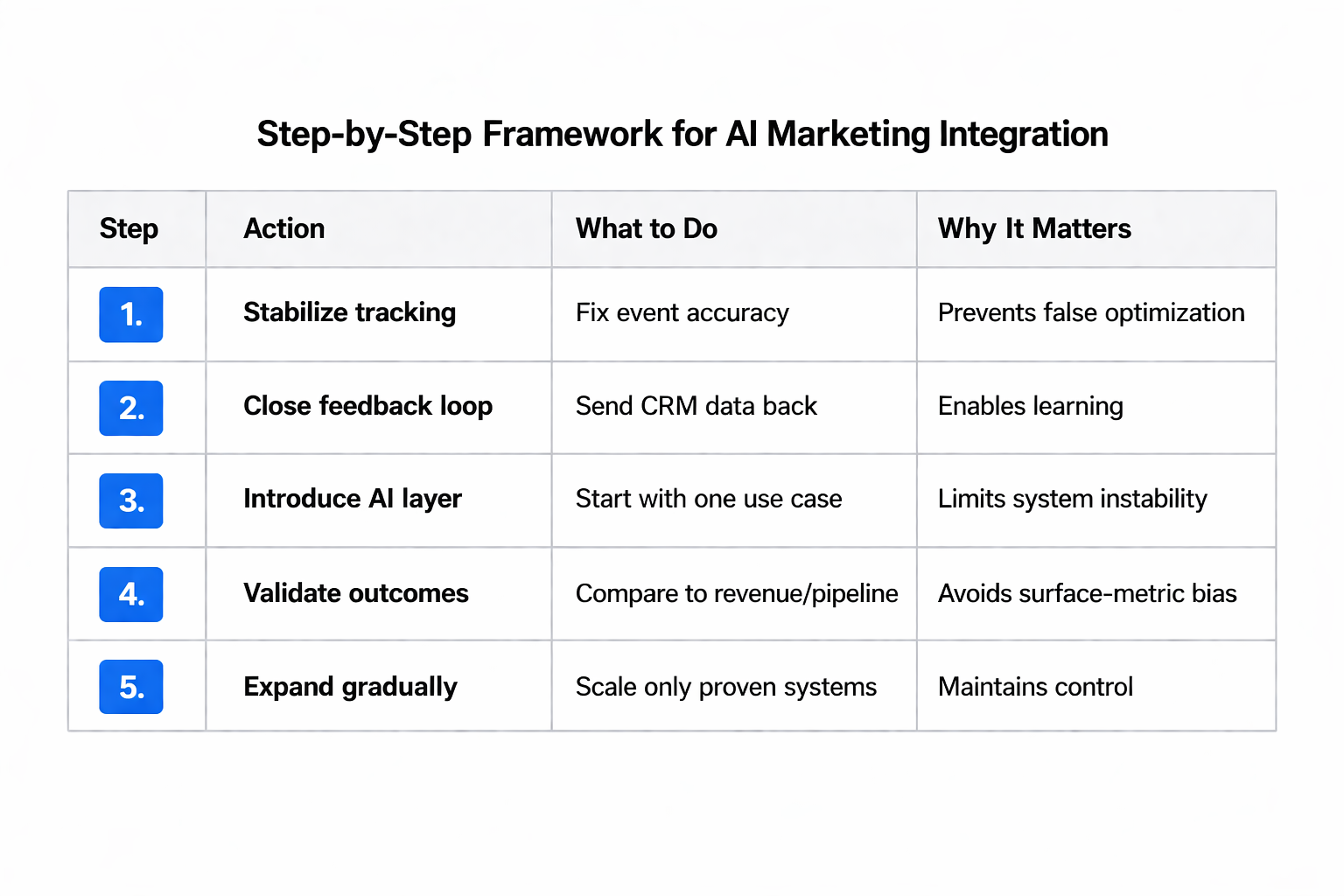
A more stable approach:
-
Stabilize tracking first.
Make sure events reflect real outcomes. -
Close the feedback loop.
Send CRM data back into ad platforms. -
Introduce AI in one layer.
Start with lead scoring or budget allocation. -
Validate against real outcomes.
Compare against pipeline or revenue. -
Expand gradually.
Only after one system proves reliable.
Final Takeaway
AI doesn’t fix marketing systems. It exposes them.
If your signals are weak, it scales noise.
If your feedback loops are broken, it accelerates drift.
If your system is structured, it compounds performance.
Integration is not a tooling decision. It’s a systems decision.