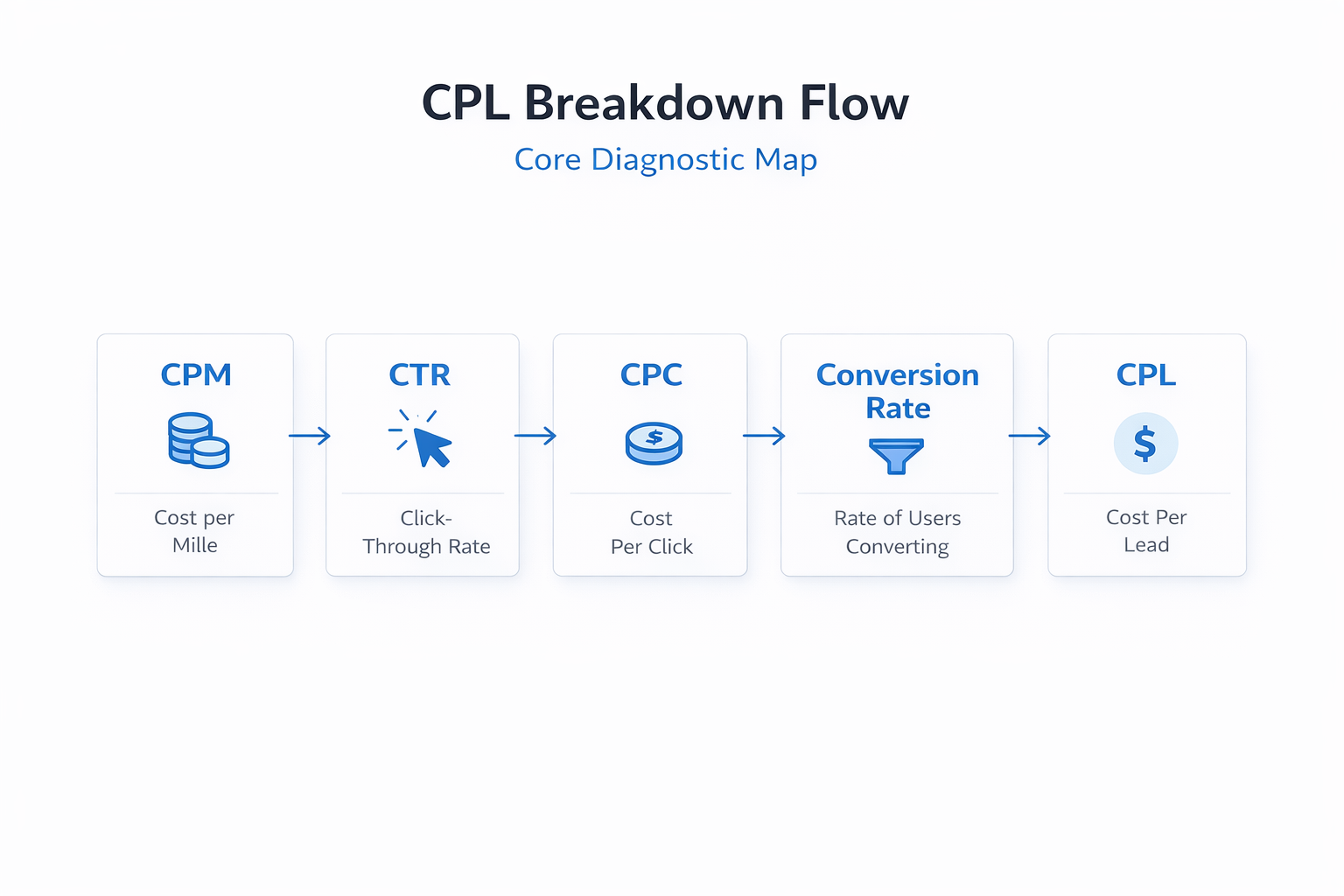
When CPL increases, the issue rarely starts at the moment someone submits a form. By that point, the system has already made several decisions — who to show the ad to, how much to pay for the impression, and how likely that person is to convert.
If you try to “optimize CPL” directly, you end up adjusting the outcome instead of the cause. The more reliable approach is to identify where the cost started increasing earlier in the funnel.
Rising CPM Means You’re Losing Auction Efficiency
In many accounts, CPL increases begin with a CPM shift. You might see stable CTR and conversion rate, but a steady rise in cost per thousand impressions.
This reflects weaker auction performance. Meta prioritizes ads based on bid, predicted action rate, and quality signals. When engagement starts to decline — even slightly — you lose cheaper auctions and get pushed into more expensive ones.
A few signals usually confirm this pattern:
-
Frequency increases while CTR slowly drops.
The same users see the ad more often but engage less, lowering your expected action rate. -
Smaller audiences show higher CPM spikes.
This often means you’ve exhausted efficient reach within that segment. -
Multiple ad sets target similar users.
Internal competition inflates CPM without any external pressure.
Fixing this is less about tweaking settings and more about removing inefficiencies inside the account:
-
Merge overlapping ad sets.
Consolidation reduces internal bidding and usually stabilizes CPM within a few days. -
Rotate creatives before performance drops.
If CTR decline is already visible, the algorithm has adjusted expectations downward. -
Expand audiences only when creatives can carry it.
Broader targeting works only if the ad maintains engagement outside the original segment.
If CPM is driving the increase, nothing downstream will meaningfully reduce CPL.
Lower CPL Can Signal a Drop in Lead Quality
A falling CPL can look like progress, but it often reflects a shift toward lower-intent conversions.
This usually becomes visible outside Ads Manager. Lead volume increases, but fewer leads turn into meetings or opportunities. Sales teams start rejecting more submissions, even though campaign metrics look “better.”
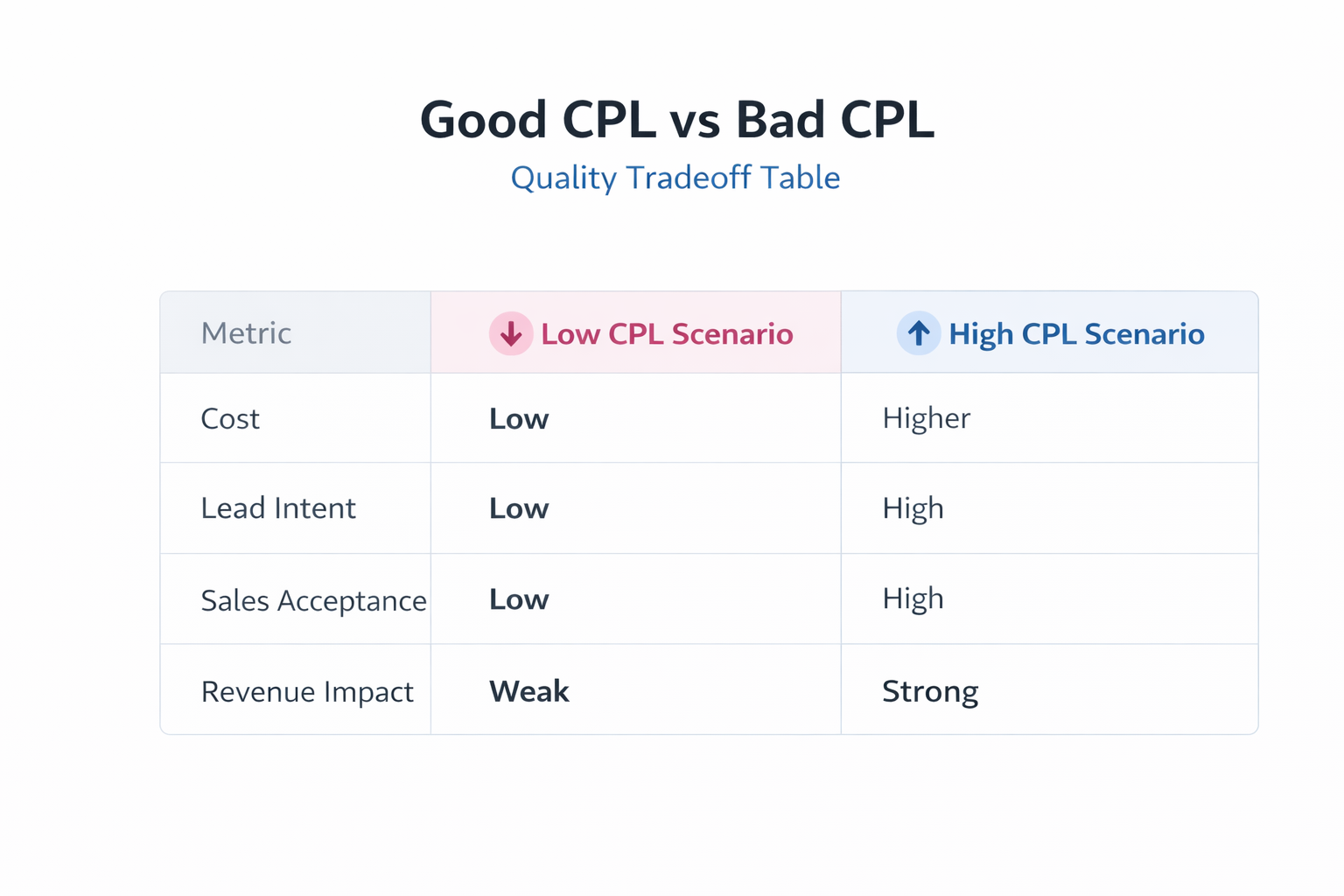
The system is behaving as expected. Meta optimizes for the event you select — typically a form submission. If low-intent users convert more easily, the algorithm will find and scale them.
This dynamic is closely related to Lead Quality vs Lead Volume: What Facebook Advertisers Need to Know.
This tends to happen in a few common setups:
-
Instant Forms with minimal friction.
Low effort increases submission rate but reduces intent. -
Broad messaging with no constraints.
Ads attract curiosity instead of qualified interest. -
No downstream feedback signal.
The system cannot distinguish good leads from bad ones.
To correct this, you need to shape both the input and the signal:
-
Add qualification inside the form.
Questions like budget, company size, or timeline filter out low-fit users. -
Tighten the message.
Calling out limitations or requirements reduces irrelevant conversions. -
Feed back better data when possible.
Even partial signals — like qualified leads — shift optimization over time.
Lower CPL only matters if lead quality holds.
Conversion Rate Drops Usually Come from Message Mismatch
Sometimes traffic metrics look stable, but CPL rises because fewer users convert after clicking.
This usually points to a disconnect between the ad and the landing page.
The user clicks with a specific expectation created by the ad. If the landing page doesn’t reinforce that expectation immediately, conversion probability drops.
A common pattern looks like this:
-
The ad promises a clear outcome or benefit;
-
The landing page opens with a generic company introduction;
-
The core offer appears too late.
Even small delays break momentum.
This type of issue is part of a broader post-click problem discussed in Optimizing for Post-Click Experience: What Happens After.
Fixing this is mostly about continuity:
-
Match the opening section of the page to the ad.
Use the same promise and problem framing. -
Remove competing actions.
Extra links or secondary CTAs reduce focus. -
Align intent level.
High-intent ads should lead directly to conversion, not exploration.
When conversion rate drops without traffic issues, the break is almost always post-click.
Optimizing for the Wrong Event Distorts CPL
Many campaigns optimize for “Leads” because that event generates enough volume for stable delivery. The problem appears when only a fraction of those leads are actually valuable.
Over time, you’ll see a pattern:
-
CPL stays stable or improves;
-
Lead-to-opportunity rate declines;
-
Revenue per lead drops.
The system is scaling what it can measure — not what you care about.
This happens because Meta prioritizes:
-
High-volume events;
-
Predictable conversion patterns.
Low-quality leads often fit both criteria.
To correct this, the optimization signal needs to move closer to real outcomes:
-
Shift to deeper funnel events when volume allows.
Qualified leads or booked meetings align better with revenue. -
Use offline data if volume is limited.
Even periodic uploads help the system adjust. -
Introduce partial signals.
Custom conversions tied to meaningful actions can improve targeting.
The closer your signal is to actual value, the more accurate your CPL becomes.
Creative Structure Can Reduce Click Intent
Not all creative problems show up as low CTR. Some ads attract attention but fail to generate strong intent.
This often happens when the ad fully explains both the problem and the solution. The user understands the message but doesn’t feel the need to click.
You’ll see:
-
Solid CTR;
-
Normal CPC;
-
Weak conversion downstream.
The issue isn’t visibility — it’s message structure.
A more effective approach creates a gap between what is shown and what is resolved:
-
State the problem clearly.
Make it immediately relevant. -
Show a partial result or insight.
Build credibility without resolving everything. -
Leave the explanation incomplete.
Give the user a reason to click.
This doesn’t reduce clarity. It sequences information so that the click becomes necessary.
Budget Changes Can Quietly Increase CPL
CPL often increases right after scaling, even when nothing else changes.
When budgets grow too quickly, the system has to find additional impressions fast. This usually pushes delivery into less efficient auctions or weaker audience segments.
You can often see this in delivery patterns:
-
Spend becomes uneven throughout the day;
-
Learning phase resets appear more frequently;
-
CPM rises during expansion periods.
This behavior is closely related to scaling mechanics explained in The Science of Scaling Facebook Ads Without Killing Performance.
Controlling this is mostly about pacing:
-
Increase budgets gradually.
Large jumps force the system into less efficient inventory. -
Watch how spend distributes hourly.
Sudden spikes often correlate with higher costs. -
Let stable ad sets run before scaling further.
Stability improves efficiency during expansion.
Scaling is less about how much you increase budget and more about how quickly you force adaptation.
Attribution Gaps Can Make CPL Look Worse
Sometimes performance hasn’t actually declined — measurement has.
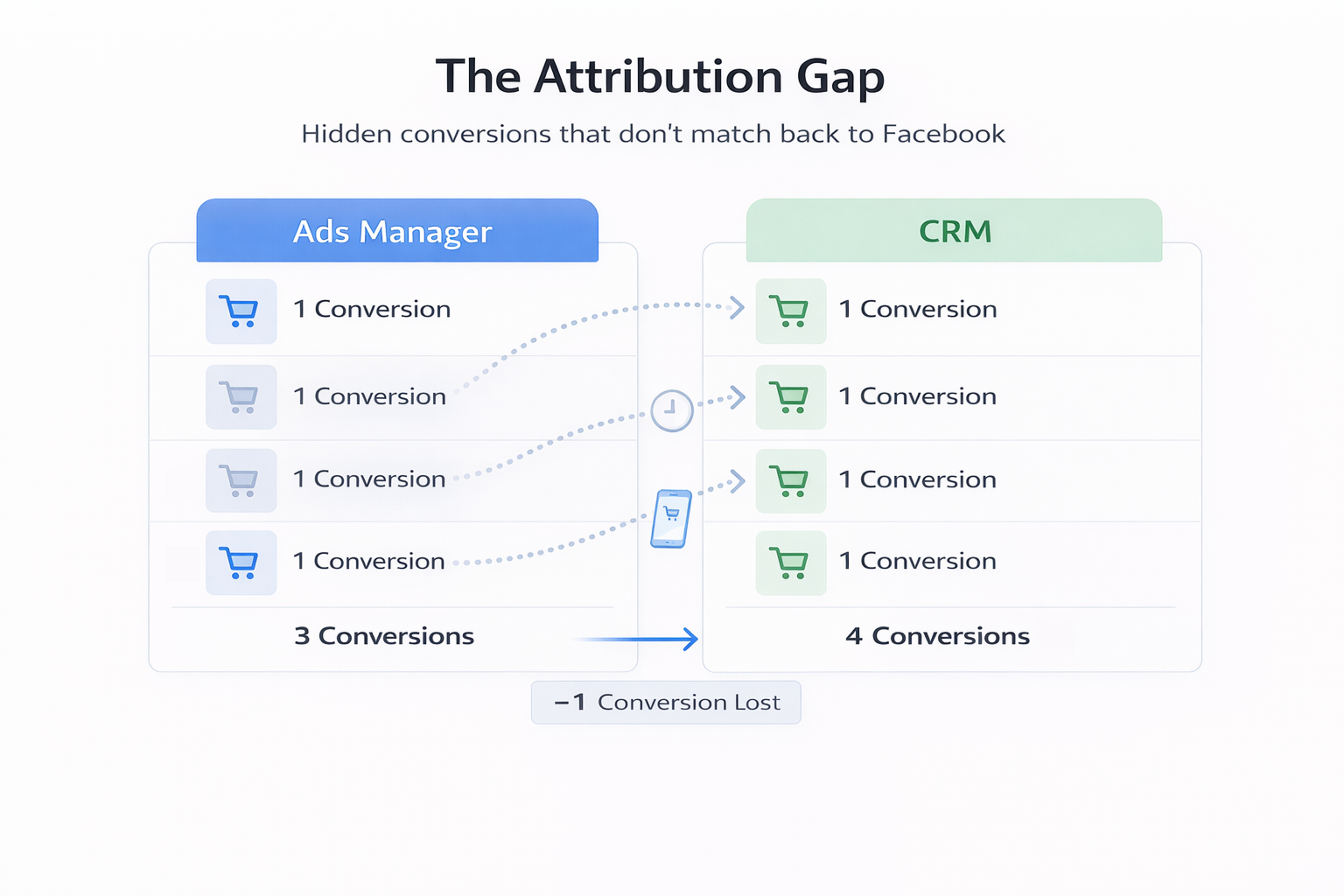
This is common in accounts with:
-
Longer sales cycles;
-
Cross-device user journeys;
-
Narrow attribution windows.
You might see stable traffic and consistent lead quality, but fewer reported conversions. The gap comes from conversions happening outside the platform’s tracking window.
To validate this, compare platform data with backend data. If CRM conversions remain stable while Ads Manager shows a drop, attribution is likely the issue.
Adjusting your evaluation approach helps:
-
Look at longer time windows.
Many conversions happen days or weeks after the click. -
Use CRM data as the primary reference.
Platform data should guide direction, not define performance. -
Account for assisted conversions.
Some campaigns influence results without capturing the final action.
Without this adjustment, you may try to fix a problem that doesn’t exist.
A Practical Way to Diagnose High CPL
Instead of testing random changes, break the problem into layers.
Start by identifying where the cost begins to increase:
-
CPM rising usually points to auction or audience issues.
-
CTR dropping indicates creative fatigue or weak messaging.
-
CPC increasing with stable CTR suggests more expensive auctions.
-
Conversion rate declining points to landing page or intent mismatch.
-
Lead quality dropping signals targeting or form issues.
This sequence isolates the failure point instead of treating CPL as a single variable.
Final Takeaway
CPL is not a standalone metric. It reflects how multiple system decisions interact — auction dynamics, click behavior, conversion flow, and lead quality.
When it increases, the solution is not to “optimize harder.” The solution is to identify which layer started drifting and correct it directly.
Once you isolate that layer, the fix becomes straightforward — and much more consistent over time.