Most ad copy fails because it’s too general. It tries to talk to everyone — and ends up connecting with no one.
If you're running Facebook or Instagram ads, you can't afford to waste time (or budget) on vague messages. What actually works is messaging that speaks directly to a person’s world — their work, their daily frustrations, and their goals.
This is where industry-specific frameworks come in. They give you a smart, repeatable way to structure your messaging for any vertical — and adjust it quickly based on who you’re targeting. Learn how this approach ties into campaign success in Mapping the Customer Journey to Facebook Campaign Structure.
Why generic ad messages usually flop
Think about the last ad you scrolled past without reading. Chances are, it was trying to be everything at once — offering a solution, but not showing who it was for or why it mattered.
Generic messaging fails for a few key reasons:
-
It doesn’t connect — the ad feels like it’s written for the masses, not for me;
-
It doesn’t convert — there’s no emotional or practical reason to click;
-
It wastes budget — every vague impression costs real money.
On the other hand, when an ad speaks your language and shows that it understands your situation, you're far more likely to click.
That’s the power of specificity.
A framework to structure your messaging (before you tailor it)
Before you get into industry details, start with a clear structure you can use across any campaign. Think of it like scaffolding — it holds everything together.
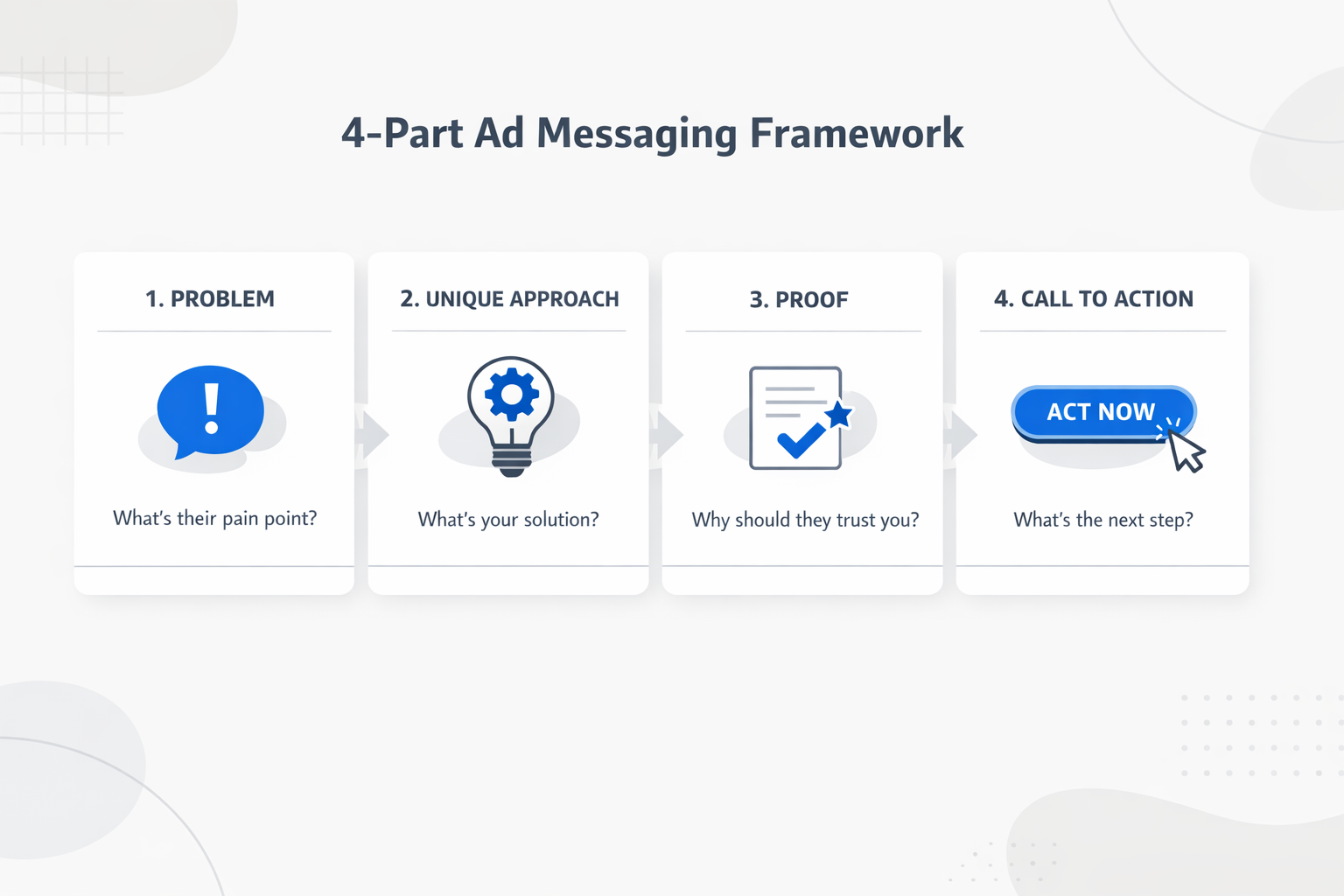
Here’s a basic 4-part framework to use when planning your ads:
-
The problem or tension — What’s the real pain point your audience is feeling right now?
-
Your unique approach — How is your product or offer solving that problem differently from others?
-
Credibility or proof — Why should they believe you? What evidence can you give?
-
The next step — What should they do next? How easy or low-risk is it?
If you're unfamiliar with messaging structures, explore Copywriting Frameworks That Work Best for Facebook Ads (AIDA, PAS, 4Cs) for more insight into formats that convert.
Industry example: Skincare brand targeting Gen Z
Let’s look at how that framework works for a skincare brand speaking to Gen Z shoppers.
This audience wants results, but they also want honesty and speed. They don’t respond well to heavily filtered ads or fluffy promises.
Here’s how you could structure your messaging:
-
Problem: “Still breaking out even after switching products?”
-
Approach: “We prevent acne by calming skin triggers — without drying your face out.”
-
Proof: “92% of users saw clearer skin in 4 weeks — backed by dermatologists.”
-
Next step: “Take the 30-second quiz to build your custom routine.”
This works because it leads with a relatable frustration, introduces a solution that feels fresh, provides real proof, and ends with a low-friction call to action.
You could tweak this same structure for other products in the beauty space. For example:
- “Frizzy hair by noon? Our 2-in-1 balm holds up in humidity — no crunchy feel. Find your match in 30 seconds.”
Industry example: CRM platform for fitness studios
Now imagine you’re selling to gym owners or fitness studios. These buyers are short on time and focused on operations. They don’t care about flashy features — they care about ease and efficiency.
Here’s how the framework works in this context:
-
Problem: “Still tracking member payments in spreadsheets?”
-
Approach: “Our CRM connects bookings, payments, and reminders — all in one place.”
-
Proof: “Used by 1,500+ studios. Saves up to 10 hours every week.”
-
Next step: “Watch a 3-minute demo — no signup needed.”
Notice how the tone shifts: it’s more practical, more grounded. The words "spreadsheets," "saves time," and "no signup" speak directly to a busy business owner.
You can reuse this same format in other service businesses too, like salons, medical clinics, or wellness centers. Just swap the terms and pain points to fit that audience.
- “No-shows costing you money? Our smart booking system sends automated reminders. See how it works in under 3 minutes.”
If you’re in this space, explore Facebook Ads for Service Businesses: Smart Targeting Tips for more context on messaging and placement strategies.
Don’t forget the journey stage — not everyone’s ready to buy
Many ad campaigns fail because they try to sell too soon. But someone seeing your ad for the first time isn't always ready to act.
That’s why it's smart to adjust your messaging based on where the audience is in the funnel.
Awareness (cold traffic)
People don’t know who you are yet. Your job is to earn attention — not push the sale. Use curiosity, emotion, or insight to hook them.
-
“Are your ads reaching the wrong people?”
-
“Which skincare habits are secretly hurting your skin?”
Use formats like: Reels, Stories, or interactive quizzes.
CTA examples: “Learn more,” “Take quiz,” “Watch now”.
Consideration (warm traffic)
Now they know your name — they’re just not sure you’re the right fit. Help them compare, explore, and trust you.
-
“Why 3,000 freelancers switched to us.”
-
“How we outperform [Competitor] on support, features, and ROI.”
Use formats like: Testimonials, carousel ads, stat-driven videos.
CTA examples: “See case study,” “Compare options,” “Try demo”.
Decision (hot leads)
They’re close. Don’t overload them with more info. Just make the decision feel safe and easy.
-
“Try it risk-free for 14 days.”
-
“Setup in minutes — with real human support.”
Use formats like: Offer pages, FAQs, lead forms.
CTA examples: “Start trial,” “Book a call,” “Sign up now”.
This funnel-based thinking is key to building high-performing campaigns. Your goal at each stage is to make the next step feel natural and low risk.
Adapt your copy by industry — even for the same product
Your product might serve multiple industries. But how you talk about it should change depending on who you're speaking to.
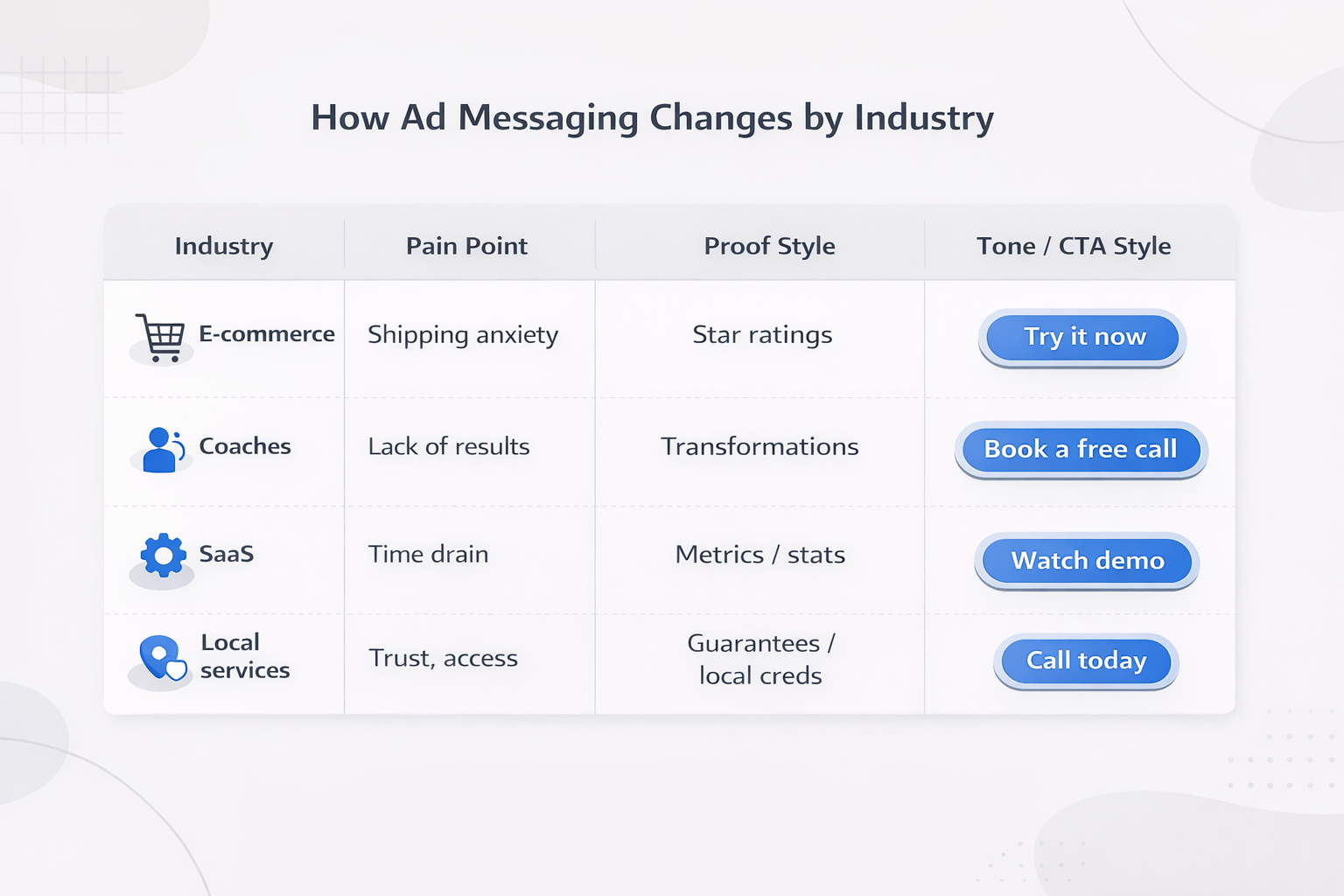
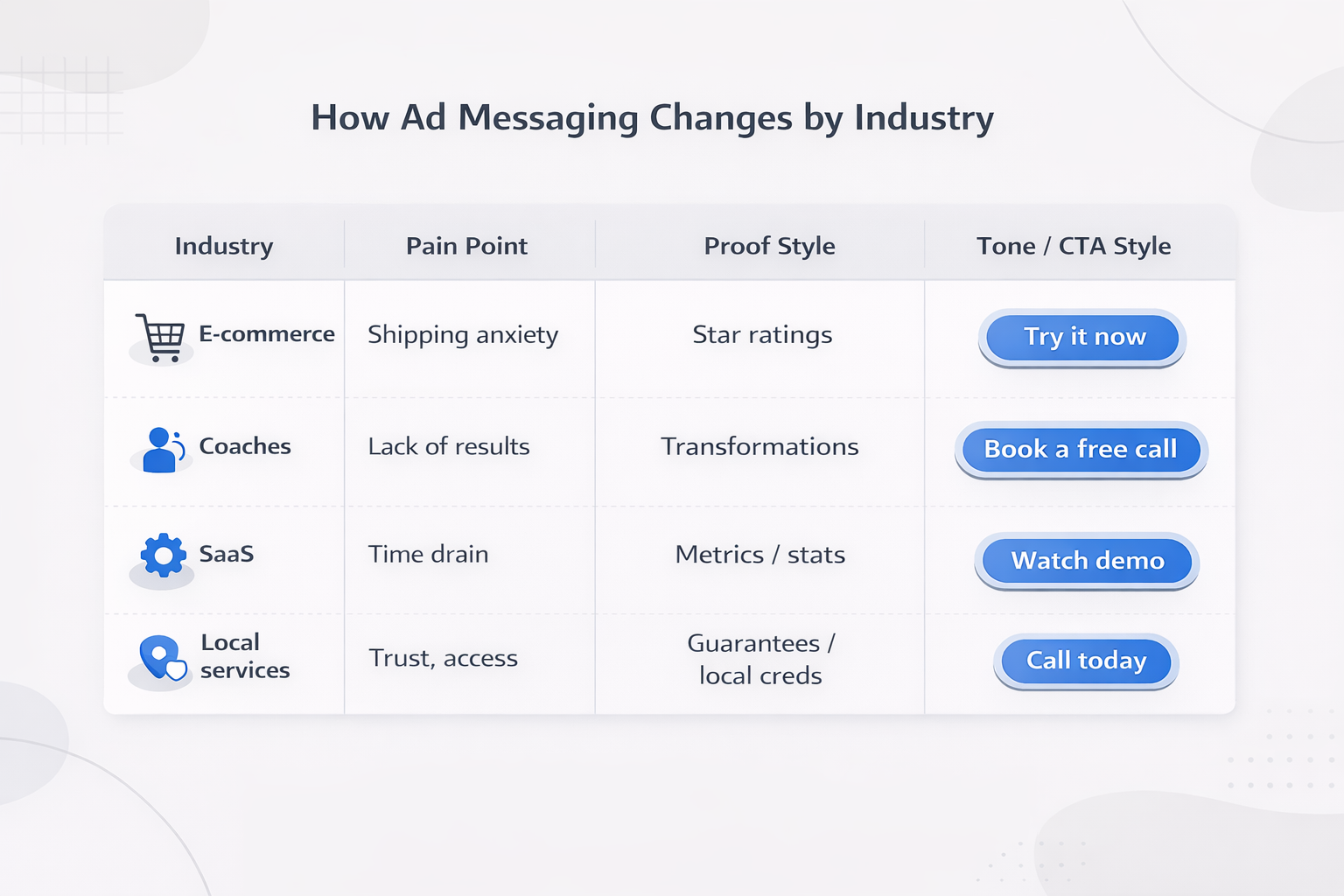
Here’s how to adjust your messaging by niche:
For e-commerce brands
-
Focus on delivery, ease, and trust;
-
Use everyday shopper language, not tech jargon;
-
Example: “Ships in 24 hours. Easy returns. 4.8/5 rating from 2,000 customers.”
For coaches and consultants
-
Talk about transformation and personal success;
-
Add credibility (credentials, media, client results);
-
Example: “From burnout to $5K months. Certified coach featured in Forbes.”
For SaaS tools
-
Lead with metrics and time savings;
-
Reassure around onboarding and integrations;
-
Example: “Cut churn by 18% in 90 days. Works with Zapier and Stripe — no dev needed.”
For local services
-
Emphasize reliability and availability;
-
Build trust with reviews and guarantees;
-
Example: “Licensed, local, and ready today. Fixed in one visit — or it’s free.”
Build your own ad swipe file (and keep it updated)
If you work across multiple verticals, a swipe file is essential. It helps you collect, study, and reuse proven messaging and ad styles.
Organize your file by:
-
Industry — to see how others speak to niche pain points;
-
Format — carousel, video, Story, quiz, etc.;
-
Tactic — hook, social proof, stat-based, comparison, etc.
When you’re stuck, revisit these examples to find structure and tone. For great ideas on hooks and click triggers, read 5 Ways to Make People Click Your Ad Thanks to Psychology.
Final thoughts: start with structure, finish with specifics
Ad messaging isn’t about being clever — it’s about being clear, relevant, and easy to act on.
To recap:
-
Use a repeatable 4-part framework;
-
Match the message to the buyer’s journey stage;
-
Tailor your language and examples to each industry.
The more tailored your message feels, the more likely it is to convert.