Audience segmentation is a core principle of digital advertising. In theory, tighter segments lead to stronger message-to-market fit and higher conversion rates. In practice, especially on Facebook Ads, excessive segmentation often results in fragmented delivery, unstable performance, and rising acquisition costs.
Meta’s advertising system is built on machine learning models that require statistically significant event volume to optimize effectively. When advertisers slice audiences too narrowly, they starve the algorithm of data. The result is slower learning, higher CPMs, limited scalability, and inconsistent performance.
This article outlines how to segment audiences intelligently without undermining delivery.
Why Over-Segmentation Damages Delivery
1. Learning Phase Instability
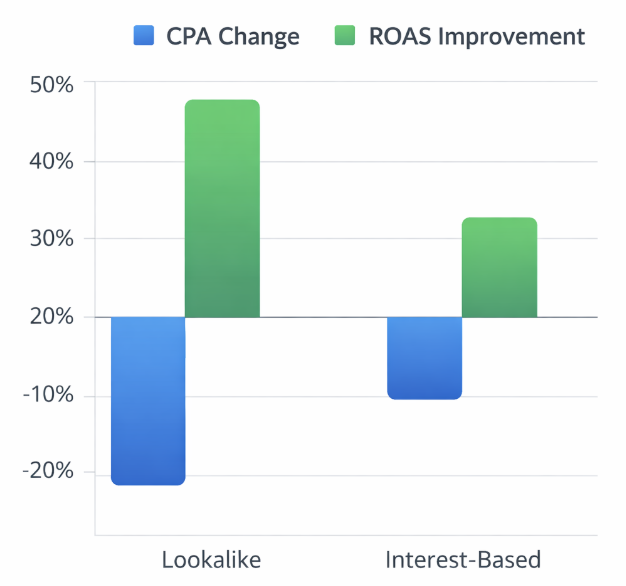
Lookalike audiences outperform interest-stacked audiences with a 20–40% lower CPA and 15–35% higher ROAS
Meta recommends generating approximately 50 optimization events per ad set per week to exit the learning phase effectively. When segments are too small, campaigns often fail to accumulate sufficient conversions. This leads to repeated learning resets and unstable CPA.
Accounts with fragmented audiences commonly experience 20–40% higher CPAs compared to consolidated structures that allow broader delivery.
2. Auction Fragmentation
Each ad set enters the auction independently. When multiple small ad sets target similar audiences, they compete against one another. This internal competition inflates CPMs and reduces overall efficiency.
Advertisers frequently observe CPM increases of 10–25% due to audience overlap across micro-segmented ad sets.
3. Limited Signal Density
Meta’s algorithm thrives on signal density. The broader the audience (within relevance), the more conversion patterns the system can detect. Restrictive segmentation limits the system’s ability to identify high-probability converters beyond manually defined attributes.
Broad targeting combined with strong creative has been shown in multiple performance studies to outperform narrow interest stacking by 15–30% in scalable campaigns.
Principles of Effective Segmentation
Segment by Intent, Not Demographics
Demographic slicing (age brackets, minor interest variations, device splits) rarely produces statistically meaningful differences unless your product is fundamentally age- or gender-specific.
Instead, segment based on behavioral intent tiers:
-
Cold audiences (broad + interest signals)
-
Warm audiences (engaged users, video viewers, profile visitors)
-
Hot audiences (website visitors, cart viewers, high-intent actions)
Intent-based segmentation preserves volume while maintaining strategic clarity.
Consolidate for Optimization Events
If an ad set cannot realistically generate 50 conversion events per week, it is too narrow. Merge adjacent audiences until sufficient event density is achieved.
A consolidated ad structure often results in:
-
Faster learning phase exit
-
Lower CPA volatility
-
Stronger budget scaling capacity
Use Creative Differentiation Instead of Structural Fragmentation
Rather than creating separate ad sets for minor persona variations, test creative angles within the same broader audience. Let the algorithm determine which users respond to which messaging.
Dynamic Creative and broad ad sets often outperform heavily segmented structures because they allow automated matching between creative variation and user behavior.
Control Overlap Intentionally
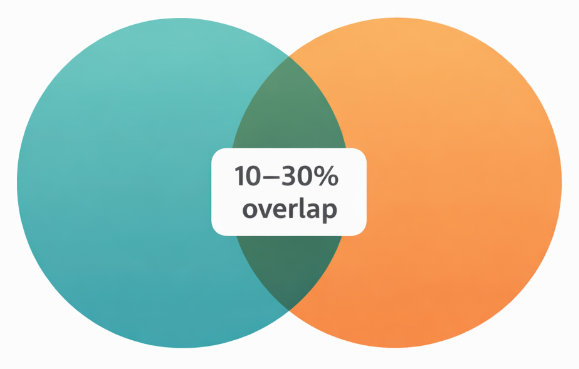
Typical interest-based audience overlap on Facebook ranges between 10% and 30%, contributing to higher CPMs if not managed
Audience overlap above 20–30% between active ad sets is typically inefficient. Use audience diagnostics to consolidate overlapping segments. Reducing internal competition can immediately improve delivery stability and CPM efficiency.
Recommended Structural Framework
A scalable Facebook account typically follows this structure:
-
Prospecting Campaign (Broad or Light Interest Layering)
-
1–3 large ad sets
-
Creative variation inside each
-
-
Retargeting Campaign
-
Website visitors (7–30 days)
-
Engaged users (30–90 days)
-
-
High-Intent Campaign
-
Cart viewers
-
Initiated checkout
-
This structure preserves intent separation while maintaining sufficient data density per ad set.
When Micro-Segmentation Does Make Sense
There are valid use cases for tighter segmentation:
-
Drastically different value propositions
-
Distinct geographic markets with different pricing
-
Enterprise vs. SMB buyers
-
Regulatory or compliance constraints
However, segmentation should be justified by materially different messaging or economics—not by minor interest differences.
Performance Benchmarks to Monitor
When evaluating whether segmentation is harming delivery, monitor:
-
Learning phase duration
-
Conversion events per ad set per week
-
CPM variance across similar audiences
-
Overlap percentage
-
CPA volatility (week-over-week change)
If CPAs fluctuate more than 30% week-over-week in stable spend conditions, structural fragmentation may be contributing to instability.
Strategic Takeaway
Modern Facebook advertising rewards controlled breadth. The algorithm performs best when it has room to explore. Your job is to define meaningful intent layers and messaging strategy—not to micromanage every micro-demographic.
Segment where it impacts economics or messaging. Consolidate where fragmentation reduces signal density.
Advertisers who shift from micro-segmentation to structured consolidation frequently report:
-
15–35% lower CPAs
-
10–20% lower CPMs
-
Faster scaling stability
-
Reduced management complexity
Delivery efficiency is not about controlling every variable. It is about feeding the system enough data to optimize intelligently.
Continue Reading
For deeper strategic optimization insights, explore:
Proper segmentation is not about slicing smaller. It is about structuring smarter.