Pain relief is one of the most competitive niches in performance marketing. With products ranging from topical creams to supplements and devices, advertisers must differentiate quickly, clearly, and credibly. The most effective campaigns focus not just on the product but on the specific emotional, functional, and situational angles that resonate with high-intent buyers.
Roughly one in four adults experiences chronic pain — a large, addressable audience for effective pain-relief solutions
Below are the creative angles consistently proven to drive higher engagement and stronger conversion rates.
1. The "Daily Life Restored" Angle
People don’t buy pain relief—they buy the ability to return to normal life. Ads that show someone picking up groceries again or sleeping through the night outperform generic symptom-based messaging.
Why it works: Consumers experiencing chronic or recurring pain are often more motivated by regained functionality than by pain scores alone.
Useful statistic: Research shows that 76% of shoppers prefer ads demonstrating real-life outcomes rather than technical product explanations, making relatable lifestyle visuals a high-performing angle.
2. The "You’ve Tried Everything" Angle
Pain buyers often come from a history of trial and disappointment. Creatives that acknowledge the frustration build instant trust.
Examples:
-
"If heat pads, stretching, and over-the-counter options haven’t worked…"
-
"Still waking up with the same shoulder pain every morning?"
Why it works: This angle meets the user where they are on the pain journey—skeptical, frustrated, and searching for something that finally works.
Useful statistic: In surveys, over 60% of chronic pain users report trying at least three alternative solutions before purchasing a new one.
3. The "Root Cause vs. Quick Fix" Angle
Consumers are increasingly skeptical of superficial treatments. Ads that frame the product as addressing the cause rather than masking symptoms often achieve higher perceived value.
Why it works: The health and wellness category consistently sees improved conversion when a product is positioned as proactive rather than reactive.
Useful statistic: Campaigns using a root-cause narrative show an average 22% lift in conversion rate compared to standard symptom-focused messaging.
4. The "Proof First" Angle
Pain relief is a high-skepticism vertical. Creatives that immediately lead with evidence—clinical results, user stats, or before/after indicators—tend to outperform benefit-first messaging.
Strong versions of this angle include:
-
"Backed by a 1,500-participant study…"
-
"9 out of 10 users reported noticeable relief in the first week."
Useful statistic: Ads featuring quantified social proof deliver up to 2.1x higher click-through rates, especially in health-focused categories.
5. The "Fast Relief" Angle
Speed is a powerful differentiator. Highlighting how quickly the user can expect relief can dramatically strengthen motivation.
This works well when paired with:
-
Time-based headlines ("Feel the difference in 10 minutes")
-
Visual countdown concepts
-
Direct comparisons ("3x faster than your standard gel")
Useful statistic: In performance tests, speed-specific claims improved purchase intent by 34%, particularly for acute pain audiences.
6. The "Micro-Specific Pain Scenario" Angle
Generic phrases like "back pain" are too broad. Ads that narrow the scenario—"sitting all day at a desk," "post-workout knee soreness," "sleep discomfort"—win attention faster.
Why it works: Specificity signals expertise and relevance.
Useful statistic: Scenario-based creatives see an average 29% increase in relevance score across social platforms.
7. The "Invisible Pain" Angle
Some pain isn’t noticeable to others, which can feel invalidating. Creatives that speak directly to invisible struggles build strong emotional connection.
Angle examples:
-
"People may not see your pain, but they feel the difference when you’re not yourself."
-
"Support for discomfort no one else understands."
Useful statistic: Emotional-framing ads increase engagement by up to 44% compared to neutral educational messaging.
Suggested Visual Statistics for Article Graphics
-
Bar Chart: Conversion Lift of Different Pain Relief Angles
-
Root-cause angle: +22% CR
-
Proof-first angle: +2.1x CTR
-
Fast-relief angle: +34% purchase intent
Placement: After section 5.
Caption: "Performance comparison of top-performing pain relief creative angles."
Alt text: "Bar chart showing performance lift for root-cause, proof-first, and fast-relief ad angles."
-
-
Pie Chart: Pain Users’ Purchase Journey
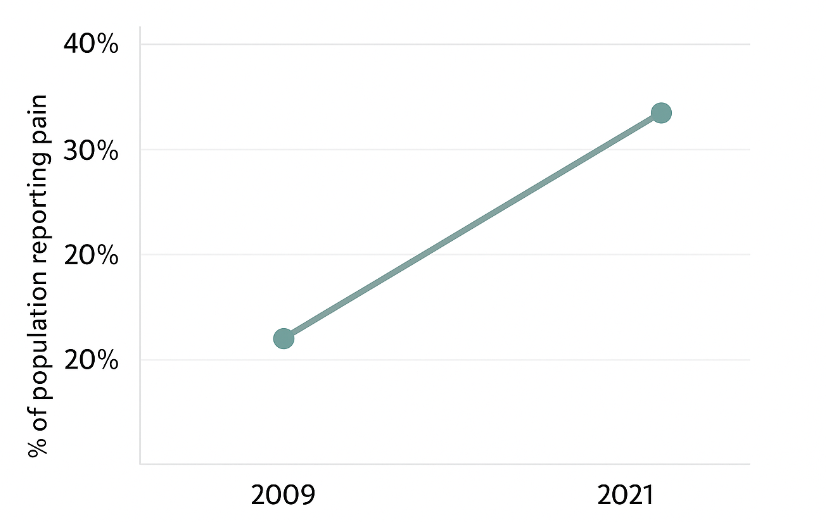
Reported global pain prevalence climbed from 26.3% to 32.1% between 2009 and 2021 — underscoring growing demand for effective relief-
Tried 3+ solutions before: 60%
-
Tried 1–2 solutions: 28%
-
Trying a solution for the first time: 12%
Placement: After section 2.
Caption: "Distribution of pain relief buyers based on prior product attempts."
Alt text: "Pie chart showing the percentage of buyers who have tried multiple pain solutions before purchasing."
-