Creative fatigue rarely shows up as a sudden collapse. In most accounts, performance starts drifting before anyone reacts — CPM rises slightly, CTR softens, and delivery becomes inconsistent.
By the time results clearly drop, the system has already reduced your auction priority.
What Creative Fatigue Actually Is (From the Algorithm’s Perspective)
Fatigue is not about your audience “getting bored.”
It’s about declining predicted action rates.
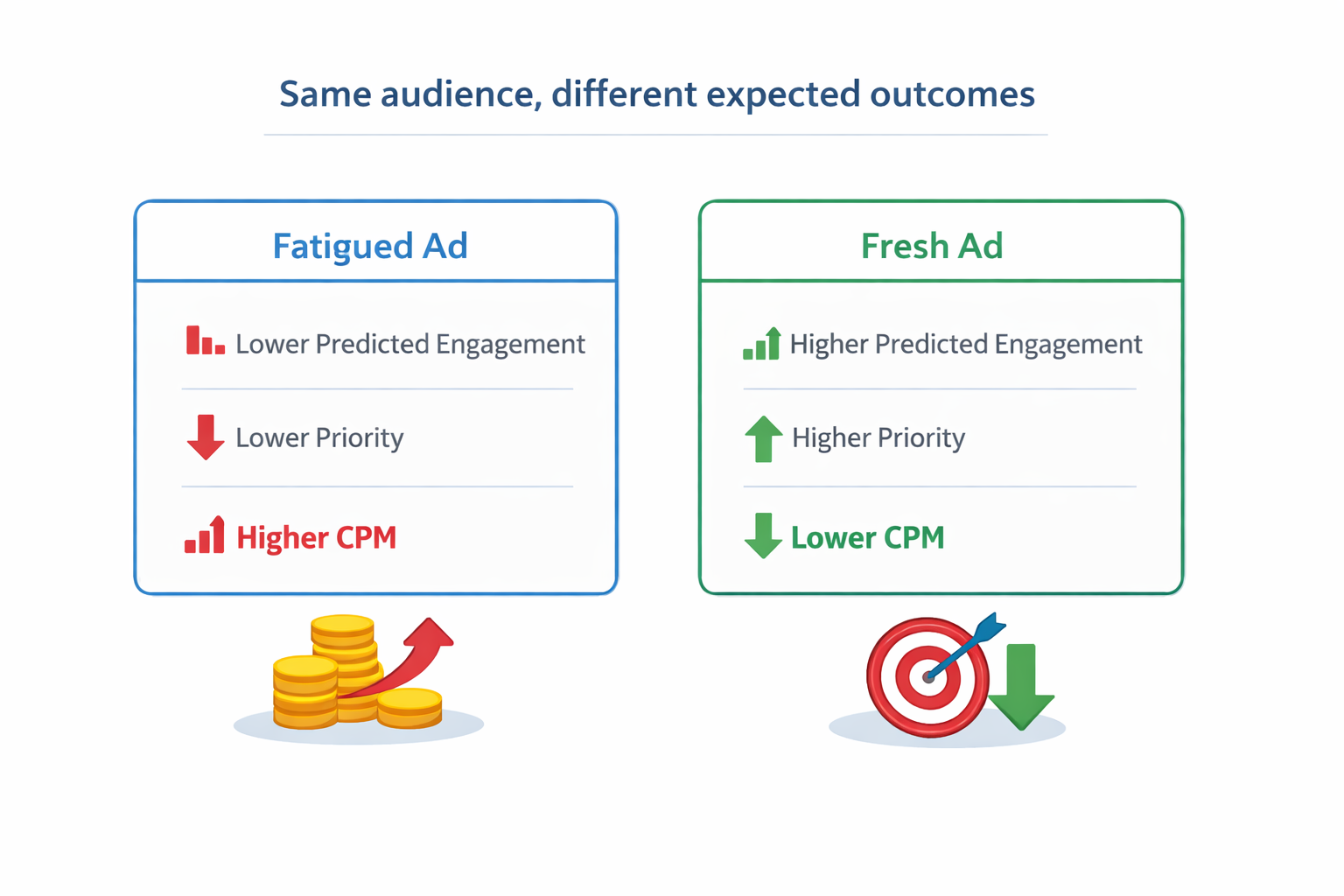
Meta evaluates every impression based on expected outcomes:
-
likelihood of click;
-
likelihood of conversion;
-
competitive strength vs other ads.
As the same creative is repeatedly shown to the same behavioral clusters:
-
engagement probability drops;
-
the system lowers its confidence in future performance.
That directly reduces your ability to win auctions.
This is why CPM often rises before conversion metrics move — explained in Factors That Influence the Cost of Facebook Ads.
The First Signals Appear Before Results Drop
Most advertisers wait for CPL to increase. That’s already late.
Fatigue shows up earlier in delivery behavior:
-
CTR decay with stable impressions;
Example: CTR drops from 1.9% to 1.3% while spend holds — the audience has seen the message too many times. -
Frequency rising without performance lift;
When frequency crosses ~2.3 and CVR doesn’t improve, repetition is no longer productive. -
CPM increasing in the same audience;
This indicates declining competitiveness, not targeting issues. -
Uneven spend distribution;
The system starts probing for pockets of performance because the main signal is weakening.
For deeper diagnostics, see How to Analyze Facebook Ad Performance Beyond CTR and CPC.
Why Strong Creatives Fatigue Faster
The better your creative performs, the faster it burns out.
This is how scaling actually works:
-
Meta pushes high-performing ads into more auctions;
-
the same users (or similar ones) see the creative more often;
-
saturation happens quickly in high-intent segments.
Typical pattern:
-
strong early results;
-
short stability window;
-
then sharp decline.
This is why scaling must be controlled, as explained in The Science of Scaling Facebook Ads Without Killing Performance.
The Hidden Role of Audience Overlap
Fatigue is rarely isolated to one ad.
When ad sets overlap:
-
users see similar creatives across campaigns;
-
frequency compounds;
-
signals degrade faster.
Common signs:
-
synchronized CTR drop;
-
similar CPM increase across ad sets;
-
performance decline at the same time.
This is covered in The Role of Audience Overlap in Facebook Ads Performance.
How to Diagnose Creative Fatigue Properly
You need to connect signals, not just read metrics.
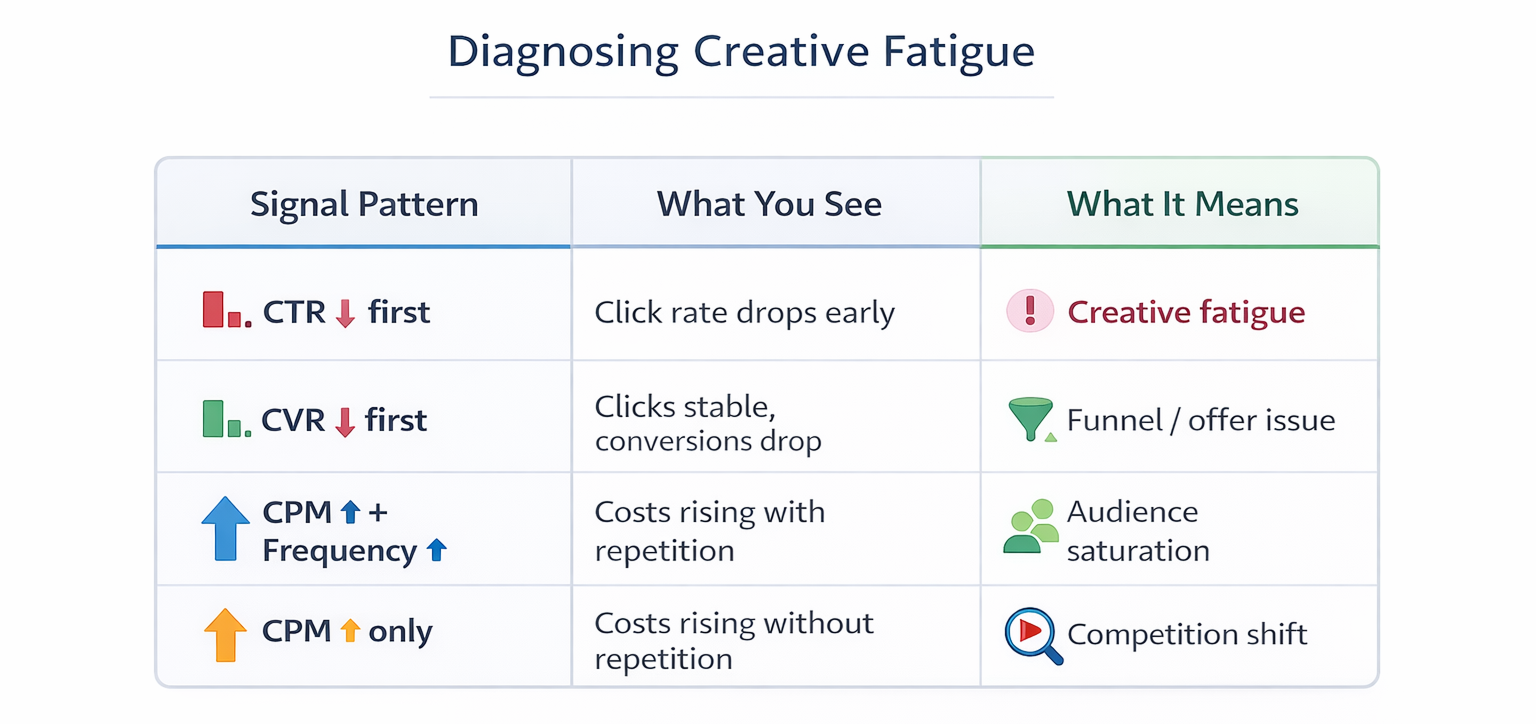
A practical approach:
-
CTR vs CVR sequencing;
CTR drops first → creative fatigue.
CVR drops first → funnel or offer issue. -
CPM vs frequency;
Rising CPM + rising frequency → saturation.
Rising CPM alone → competition shift. -
New vs repeat users;
Strong new-user conversions + weak repeat engagement confirms fatigue. -
Placement breakdown;
Fatigue appears in feeds first, then spreads.
Why “Refreshing Creatives” Often Fails
Most updates are superficial.
If these don’t change:
-
hook;
-
positioning;
-
audience alignment;
…the system treats it as the same signal.
Result:
-
no meaningful reset;
-
performance keeps declining.
What Actually Resets Performance
You need structural variation:
-
new hook angle;
-
different offer framing;
-
new audience entry point;
-
changed first 3 seconds;
-
expanded audience cluster.
These change how the algorithm evaluates your ad — not just how it looks.
Preventing Fatigue Before It Happens
Fatigue is easier to prevent than fix.
Use this system:
-
rotate before saturation;
-
stagger launches;
-
reduce overlap;
-
maintain creative pipeline;
-
track CTR and CPM daily.
For rotation strategies, see Creative Rotation Tips to Keep Impressions High Without Fatigue.
Final Takeaway
Performance never drops suddenly.
It shows up earlier in:
-
CTR movement;
-
CPM changes;
-
frequency patterns.
The difference is execution:
-
reactive teams replace creatives too late;
-
structured teams manage fatigue before it hits.
That’s what keeps campaigns stable at scale.