Always-on advertising delivers steady traffic and conversions, but its long-term success depends heavily on how frequently you refresh your creatives. As audiences repeatedly see the same ads, performance begins to erode. Fatigue increases cost per result, while new concepts often trigger fresh engagement.
Data shows that ad fatigue can decrease CTR by up to 35% after the same creative has been shown for several weeks. Without a structured refresh cadence, even high-performing campaigns plateau.
Optimal Refresh Frequency
There is no one-size-fits-all cadence, but industry performance averages point to clear benchmarks:
-
Every 7–10 days for high-frequency audiences (remarketing, small niche groups).
-
Every 2–3 weeks for broad prospecting audiences.
-
Every 4–6 weeks for evergreen creative themes.
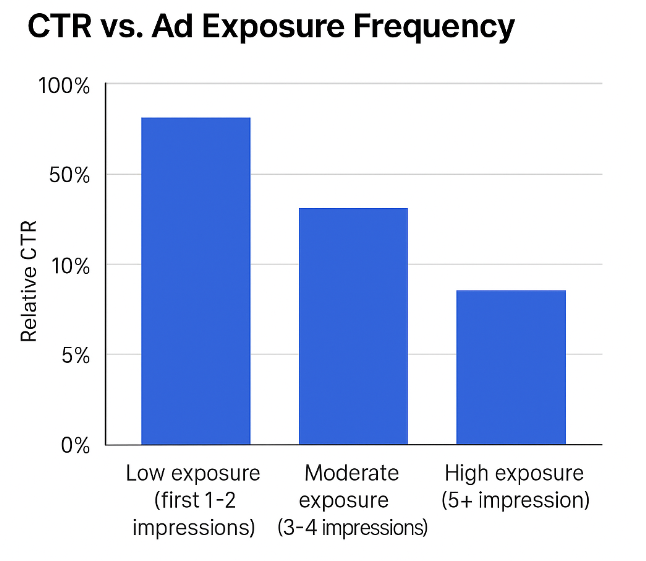
CTR drop as ad exposure frequency increases
On average, campaigns begin to show measurable fatigue once frequency surpasses 3.5–4.0. CPMs often rise 18–22% at this stage, while conversion rates fall.
The Signs Your Creatives Need Refreshing
You should refresh creatives when one or more of the following appears:
-
Drop in CTR of 20% or more compared to the first week.
-
Frequency above 4, especially for retargeting.
-
CPR/CAC increase of 15–25% without reductions in audience size.
-
Comments signaling ad repetitiveness, such as "I keep seeing this ad".
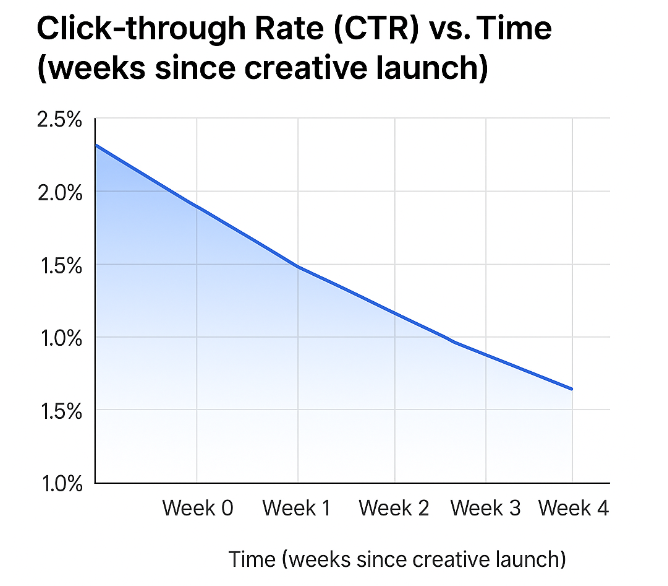
CTR decline over four weeks as a creative ages
These symptoms signal that the audience has exhausted interest in the current visual and messaging combinations.
Creative Types That Extend Lifespan
Some formats statistically sustain performance longer:
-
UGC-style videos typically retain engagement 30–40% longer than polished studio ads.
-
Static ads built around bold, simple value props often deliver consistent CTR for 3+ weeks.
-
Carousel formats refresh themselves by offering multiple frames, often delaying fatigue by 20–25%.
While no creative lasts forever, using these formats strategically can reduce production pressure.
A/B Testing Plays a Key Role
Continuous testing prevents creative stagnation. Running small always-on A/B tests helps you identify:
-
Top-performing angles
-
Winning messages
-
Creative formats that offer longevity
Statistically, advertisers who run ongoing creative tests achieve 27% lower cost per result and 34% higher conversion stability across quarterly cycles.
Establishing a Refresh System
To maintain peak efficiency, build a predictable rotation system:
-
Create a 3–5 creative backlog per ad set.
-
Rotate 1–2 new assets weekly for retargeting.
-
Replace winning creatives only when performance declines, not by date.
-
Evaluate performance weekly, refresh biweekly.
-
Document learnings in a creative log with hooks, angles, and formats.
Systems outperform sporadic uploads because they preserve momentum, optimize time, and ensure consistent insights.
Related Articles You May Find Useful
Final Thoughts
Creative refresh cadence is one of the most overlooked levers in always-on performance. With a rhythm of testing, monitoring, and timely updates, advertisers maintain strong CTR, stable costs, and higher conversion rates over time. A predictable rotation process ensures that campaigns never stagnate and always stay competitive.