
Messy ad accounts don’t just look bad — they quietly bleed your budget, confuse your data, and slow down your marketing team. Worse, many advertisers mistake these hidden costs for “bad performance,” when the real issue is poor structure.
If you’ve ever wondered why your ads aren’t converting like they should, or why your CPMs keep rising despite clean creative, the problem may not be your content — it might be your account setup.
Let’s unpack the invisible ways a cluttered ad account sabotages results, and how to fix it before it gets out of control.
1. Budget Drain You Can’t Detect
Hidden budget waste is one of the most expensive outcomes of disorganized ad accounts.
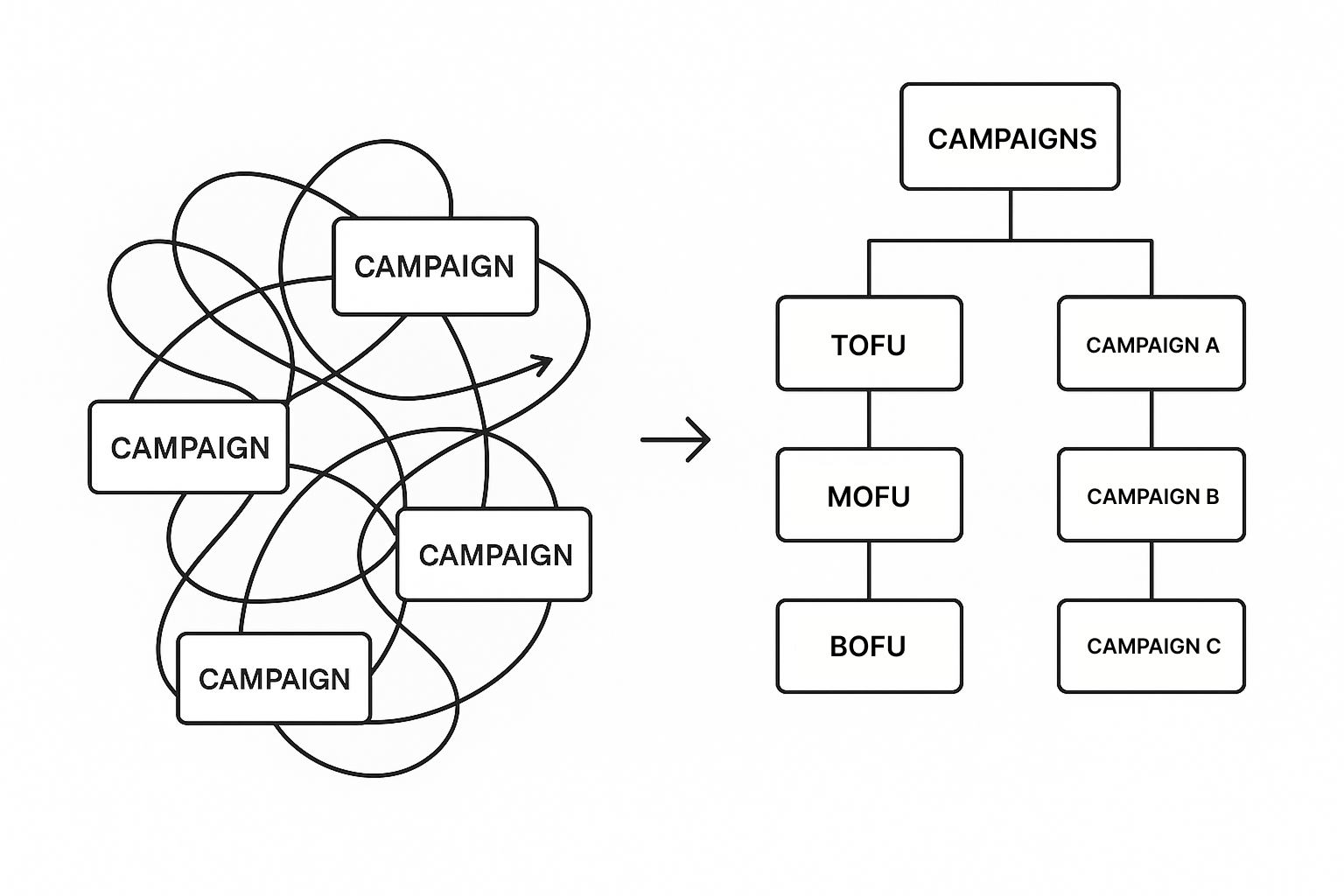
Here’s how it happens:
-
Overlapping audiences drive up CPMs and create self-competition.
-
Old, unpaused campaigns continue spending even though they’re irrelevant.
-
Low-budget fragmentation across dozens of ad sets weakens algorithmic learning.
Let’s say you’re running three prospecting campaigns — all targeting similar lookalike audiences. Without realizing it, you’re bidding against yourself. That’s audience cannibalization in action, and it drives costs up with zero performance lift.
When campaigns aren’t clearly labeled or grouped logically, you may not even notice this overlap. It becomes harder to identify and stop spend leakage.
Learn more in The Role of Audience Overlap in Facebook Ads Performance.
2. Muddled Attribution and Confusing Data
Data is only useful when it’s clean and easy to interpret.
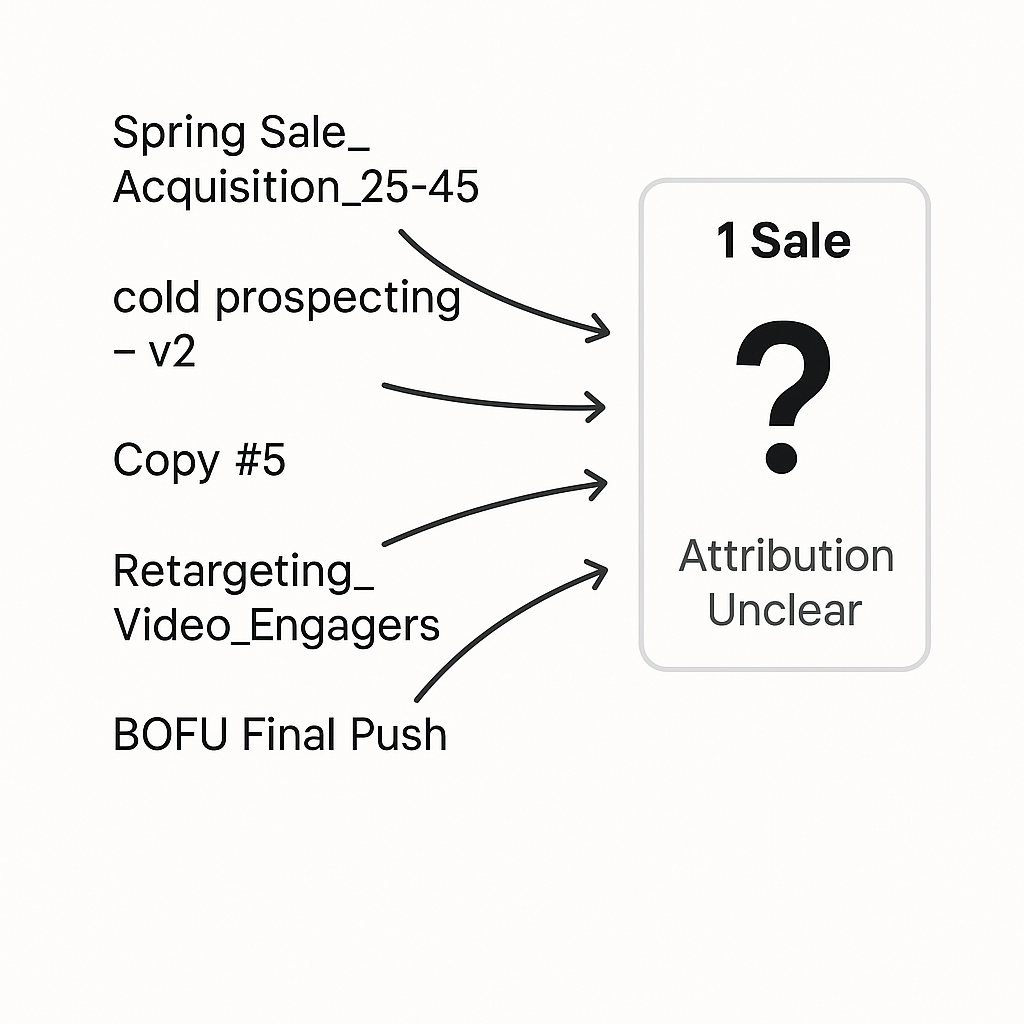
A messy ad account leads to:
-
Inaccurate attribution between campaigns.
-
Unreliable reporting due to inconsistent naming conventions.
-
Incomplete data caused by missing UTM parameters or duplicated events.
If your retargeting campaigns are mixed into your awareness campaigns, how can you know which is doing the heavy lifting? And without standardized naming, performance reports turn into detective work.
Let’s say one campaign is labeled “Spring Sale_Acquisition_25-45” and another “cold prospecting – v2”. Are they doing the same thing? Serving the same audience? Unless you memorize naming quirks, your data loses its meaning.
For smarter structuring, read Meta Ad Campaign Objectives Explained: How to Choose the Right One.
3. Slower Workflow, Weaker Decisions
When your ad account is a mess, your team spends more time finding things than improving them.
-
Digging through inconsistent naming wastes hours.
-
Reporting takes longer and becomes less reliable.
-
Collaboration suffers when no one knows which campaign does what.
This affects your bottom line. The longer it takes to assess and adjust campaigns, the slower your optimization cycles become. That delay costs you revenue — especially during high-stakes sales periods.
Clean accounts help teams work faster and more confidently. Everyone knows what campaigns are active, where to pull reports, and what to tweak.
Need a better framework? Check out Facebook Ads Funnel Strategy: From Audience Identification to Conversion.
4. Missed Optimization Opportunities
Your best-performing creative might already exist — but you won’t see it if your account hides it in clutter.
-
Tests run across inconsistent structures (wrong audiences, mixed objectives).
-
High-performing segments get buried inside poorly separated campaigns.
-
You can’t isolate variables to identify winners and scale them.
For example, if you're testing a headline variation across multiple campaigns with mixed audiences, how will you know if the copy worked — or if it just hit a good audience? You can’t optimize what you can’t isolate.
A clean structure allows for clean insights. Segmenting by audience and funnel stage gives you the clarity you need to identify trends and scale confidently.
Want to brush up on best practices? Start with Facebook Ad Targeting 101: How to Reach the Right Audience.
5. Higher CPMs, Lower ROAS
Platforms like Meta reward campaigns that deliver clear, consistent learning signals. Disorganized campaigns:
-
Confuse algorithms with unclear intent.
-
Underperform during learning phases.
-
Often trigger delivery issues or warnings.
Ever seen “Ad Set May Get Zero” or “Learning Limited” alerts in your dashboard? These are often symptoms of poor campaign structure, not bad creative. When ad sets are too fragmented, the algorithm can’t gather enough data to optimize.
And that means higher CPMs, weaker placements, and lost conversions.
Here’s what to do if you’ve hit a dead zone: Why You See 'Ad Set May Get Zero' on Facebook and How to Fix It.
How to Fix a Messy Ad Account (Without Starting Over)
You don’t need to rebuild your account — you just need structure. Follow these steps to regain control and improve performance fast:
1. Audit Your Naming Conventions
Use a clear, consistent format such as: [FunnelStage]_[Objective]_[Audience]_[CreativeType]_[Version/Date].
Example: TOF_Leads_Lookalike_Video_v2
Why it matters:
-
Helps you analyze performance quickly;
-
Speeds up reporting and team collaboration;
-
Prevents confusion when scaling or revisiting old campaigns.
Tip: Maintain a shared doc with naming rules and require everyone to follow it.
2. Map Your Funnel
Assign each campaign to a specific stage:
-
TOF – New audience awareness;
-
MOF – Engagement or content views;
-
BOF – Retargeting warm leads or past site visitors.
Avoid mixing stages in one campaign. For example, don’t target cold leads and cart abandoners with the same ad set — you’ll confuse the algorithm and skew your data.
Need a structure? Read Facebook Ads Funnel Strategy.
3. Consolidate Where It Counts
Don’t spread your budget too thin. Consolidate campaigns or ad sets when:
-
Audiences are similar (e.g., 1% and 2% lookalikes);
-
Goals are identical (e.g., all for purchases);
-
Budgets are too low to exit the learning phase.
But avoid merging campaigns with different objectives or funnel roles. Let the algorithm learn efficiently — not with mixed signals.
4. Clean Up Audience Overlap
Overlapping audiences = wasted budget.
Run audience overlap checks and take action:
-
Exclude purchasers from TOF ads;
-
Suppress warm leads in prospecting campaigns;
-
Use custom audiences with strict exclusions.
Example: Exclude email subscribers from top-funnel ads to avoid paying to reach people you already own.
5. Set a Maintenance Schedule
Make cleanup routine — not reactive.
Weekly:
-
Pause weak performers;
-
Reallocate budget based on ROAS.
Monthly:
-
Archive inactive assets;
-
Rename or relabel sloppy campaign names.
Quarterly:
-
Audit campaign structure, funnel coverage, and exclusions;
-
Refresh creative and retargeting pools.
Assign ownership. Someone on your team should be responsible for ad account hygiene — not “everyone.”
Final Thoughts
Disorganized ad accounts are like leaky pipes — you don’t always see the damage until it’s too late. But the signs are there: rising costs, unclear data, wasted time, and frustrated teams.
Fixing your structure isn’t a glamorous job. But it’s one of the most powerful levers you can pull to unlock better performance and scale efficiently.
If your ad account feels more like a junk drawer than a well-oiled machine, it might be time to clean house.