Most paid campaigns struggle not because of targeting, but because the CRM behind them sends mixed signals. When all leads are treated the same, ad platforms cannot distinguish between low- and high-intent users.
CRM segmentation solves this by controlling how data enters the optimization system — and what the algorithm learns from it.
Why CRM Segmentation Impacts Performance
When you upload audiences or conversion events, platforms like Meta use them to model behavioral patterns.
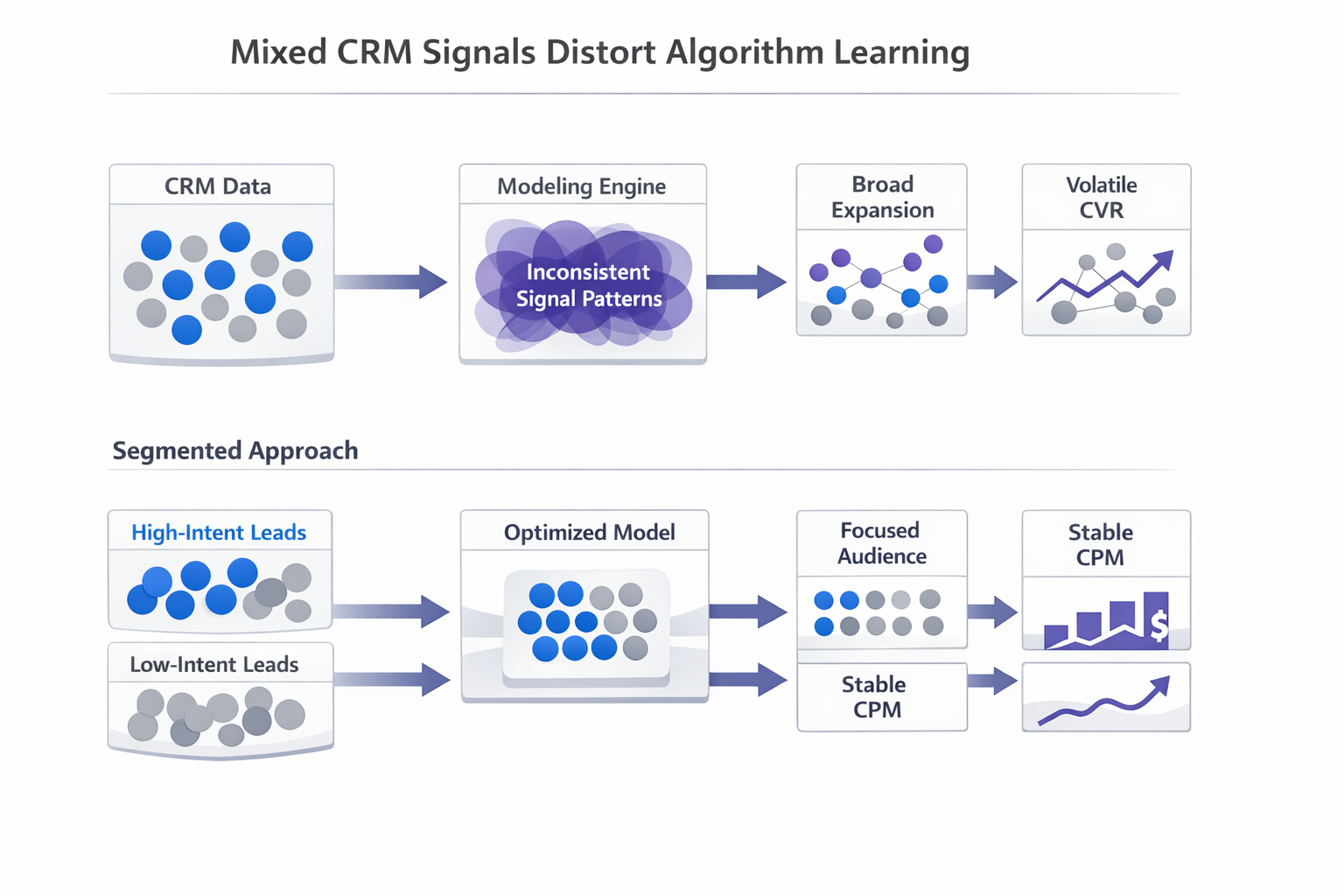
If your CRM is unstructured:
-
High- and low-quality leads are grouped together.
-
Conversion signals represent different intent levels.
-
The algorithm expands into inconsistent audiences.
This usually shows up as:
-
Rising CPM due to broader auction competition.
-
Volatile conversion rates.
-
Frequent learning instability.
Segmentation reduces this noise and sharpens optimization. If performance looks stable on the surface but results decline, you’re likely facing the same issue explained in Ad Metrics That Lie: When Good Numbers Hide Bad Performance.
The Core Issue: Lifecycle Compression
Most teams segment by attributes like industry or company size. That helps with messaging, but not with performance.
The real issue is treating all leads as if they are at the same stage.
In reality, your CRM contains distinct states:
-
New leads.
-
Qualified leads.
-
Sales-accepted leads.
-
Opportunities.
-
Customers.
If these are not separated, campaigns optimize toward lead volume, not pipeline progression.
This connects directly to the problem outlined in Lead Quality vs Lead Volume: What Facebook Advertisers Need to Know, where cheap leads reduce real business outcomes.
Segment by Funnel Stage First
Start with lifecycle-based segmentation. This aligns your CRM with how the algorithm evaluates value.
A practical structure:
-
Raw Leads
High volume, low signal quality. Optimizing here often lowers CPL but weakens downstream results. -
MQLs
Filtered by basic qualification criteria. A more stable base for lookalikes. -
Sales Accepted Leads (SALs)
Validated by sales. These signals tend to produce more consistent performance. -
Opportunities
Strong intent, lower volume. Useful for scaling mature campaigns. -
Customers
Highest signal quality. Ideal for lookalike modeling.
If your CPL improves but pipeline metrics decline, you’re likely optimizing at the wrong stage.
For a deeper structural view, see How to Map Audiences to Funnel Stages.
Refine with Behavioral Signals
Within each stage, behavior varies — and that’s what the algorithm actually learns from.
Useful segmentation layers:
-
Speed of progression
Leads that qualify within 1–2 days tend to convert better than slow-moving ones. -
Engagement depth
Example:-
Demo attended vs. no-show.
-
Email replies vs. no interaction.
-
-
Drop-off point
Where leads disengage often reveals intent quality or offer mismatch.
The more behaviorally consistent your segments are, the more stable your campaign performance becomes.
This is closely aligned with How to Use Behavioral Data to Improve Ad Performance.
Don’t Ignore Negative Segmentation
Exclusions are just as important as targeting.
Without them, campaigns waste spend on low-probability users and distort performance data.
Key exclusions:
-
Disqualified leads (wrong fit, low budget).
-
Stalled opportunities.
-
Recently contacted leads.
-
Existing customers in acquisition campaigns.
If frequency rises while performance drops, weak exclusions are often the cause.
A deeper breakdown of this inefficiency is covered in Audience Exclusions: Stop Paying Twice.
Align Segments with Campaign Structure
Segmentation should define how campaigns are built, not just audiences.
A simple mapping:
-
Top funnel
Broad or MQL-based audiences. Focus on generating qualified demand. -
Mid funnel
Engaged leads. Focus on moving users toward qualification. -
Bottom funnel
Opportunities. Focus on conversion and deal progression.
Combining all stages in one campaign reduces signal clarity and weakens optimization.
Lookalikes: Quality Beats Size
Large audiences don’t guarantee strong performance.
For example:
-
10,000 raw leads → inconsistent behavior.
-
1,000 opportunities → clear, high-intent patterns.
Smaller, higher-quality segments often produce better results because the algorithm can model them more accurately.
Build and test lookalikes separately for each stage instead of merging them.
Keep Data Fresh
Segmentation loses effectiveness when data is outdated.
Common issues:
-
Delayed CRM updates.
-
Static audience lists.
Best practices:
-
Sync events as close to real time as possible.
-
Refresh audiences frequently.
-
Remove outdated users from high-intent segments.
Fresh signals lead to more stable delivery and faster optimization.
Final Takeaway
CRM segmentation determines what your ad platform learns.
If your data is mixed, campaigns optimize for volume.
If your segments reflect real behavior and progression, campaigns optimize for outcomes.
The difference isn’t in targeting settings — it’s in the structure of your CRM.