As the final month of Q4 unfolds, many advertisers shift into passive mode. Budgets are depleted, teams begin to disengage, and campaign strategies often go unchanged from Black Friday through New Year’s.
But December isn’t a time to coast. On the contrary — it’s a dynamic, high-impact period where ad performance can swing dramatically from week to week. Brands that understand the nuances of December behavior can capture significant late-quarter revenue, reduce wasted ad spend, and set the stage for strong Q1 performance.
Here’s how to refine your December advertising strategy to maintain — and even improve — results as the year closes.
1. Plan for Weekly Behavioral Shifts, Not a Single Holiday Strategy
Treating December as one continuous “holiday season” is a common mistake. In reality, the month breaks into four distinct behavioral phases, each requiring different tactics:
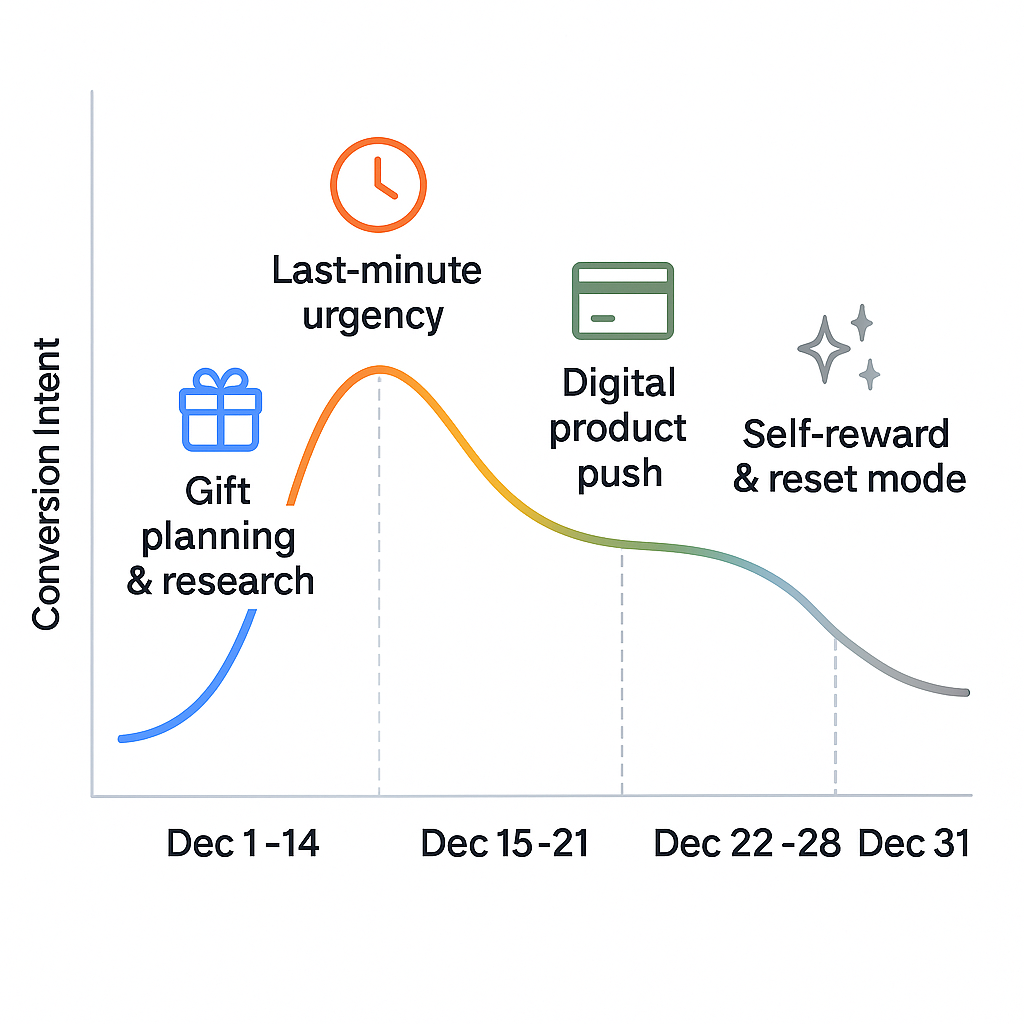
Consumer behavior shifts dramatically across December — from early gift research to last-minute urgency, then toward digital offers and self-purchases post-holiday. Use this curve to align your creative and targeting with each phase.
Week 1–2 (Dec 1–14):
-
Consumers are still in high-intent mode after Cyber Week.
-
They’re researching, comparing options, and finalizing gift lists.
-
Competition remains high, and CPMs are elevated — but conversion rates can be strong with the right offer.
Week 3 (Dec 15–21):
-
Urgency takes over. Shoppers are highly motivated by last-minute shipping deadlines.
-
Product availability, delivery speed, and “giftable” positioning become central to purchase decisions.
-
Creative should lean heavily on direct response — clear CTAs, countdowns to shipping cutoffs, and language focused on time sensitivity.
Week 4 (Dec 22–28):
-
Most physical product sales taper off as shipping cutoffs pass.
-
However, this is an overlooked opportunity for brands with digital goods, gift cards, subscriptions, or services.
-
CPMs often drop due to reduced competition, while users remain highly engaged.
Post-Christmas to New Year (Dec 26–31):
-
Consumers shift from gifting to self-purchase and planning for the year ahead.
-
This is prime time for “reset” messaging — think personal transformation, restocking essentials, or trying something new.
To align your campaign setup with these shifts, make sure you're choosing the right objective at each phase. Here's a helpful breakdown of Meta Ad Campaign Objectives and how to align them with funnel stages.
2. Retargeting Should Evolve Throughout December
Retargeting isn’t just a year-round best practice — it’s especially powerful in December, when Q4 traffic peaks and your audiences are already primed for conversion. But the way you retarget needs to reflect the buyer journey.
Here’s how to approach it with greater sophistication:
-
Segment by behavior: Treat “site visitors” as different from “add-to-cart” users. Someone who viewed a product multiple times should receive a more urgent and direct message than a first-time blog reader.
-
Differentiate new vs. existing customers: Serve new audiences retargeting with trust-building content (e.g., testimonials, press coverage, unboxing videos). Show loyal customers bundled offers, exclusive discounts, or early access to post-holiday products.
-
Adjust frequency caps weekly: In early December, higher frequency may help break through noise. By late December, consumers may be saturated — pull back to avoid fatigue.
-
Refresh creative: Don’t rely on the same retargeting ad from November. Update your messaging based on the current date, urgency, and likely consumer mindset.
If you're new to retargeting, this guide to Facebook retargeting setup will help you build better-performing custom audiences.
3. Creative Must Align with Shifting Intent
What worked for Black Friday will not work on December 20th — even if the product is the same.

Intent changes throughout the month:
-
Early December: Emotional storytelling, gift inspiration, and value messaging work well.
-
Mid-December: Clear urgency, shipping cutoffs, and social proof become vital.
-
Post-holiday: People want to buy for themselves, upgrade routines, or start fresh.
Creative also needs to account for attention span and context. Static product images may underperform when urgency is high. Use bold CTAs, clear visuals, and copy that aligns with the buyer’s state of mind.
If you’re seeing low CTR or poor engagement, revisit your creative strategy. In some cases, the issue may not be the design itself but audience mismatch. Learn why great creatives often fail without the right targeting.
4. Use Middle Offers to Nurture Cold Audiences
For top-of-funnel audiences, pushing direct product offers in December can lead to inefficient spend. Many of these users aren’t ready to convert — especially when ad competition is driving up costs.
To improve cold audience performance, introduce mid-funnel offers that create engagement and build trust:
-
Holiday gift finders or quizzes: Personalized journeys that recommend products based on preferences can boost session time and pixel quality.
-
Lead generation with seasonal value: Use checklists, calendars, or content downloads tied to the season — such as “Top 10 Gift Ideas for Tech Enthusiasts.”
-
Bundle offers: These are particularly effective for gifting. Grouping complementary products increases AOV and simplifies purchase decisions.
-
Free shipping unlocks: For colder audiences, eliminating friction is essential.
Want to map the full funnel from cold prospect to customer? This Facebook ads funnel strategy guide covers structure, segmentation, and creative by funnel stage.
5. Don't Overlook the Post-Christmas Window
The final week of the year is one of the most underutilized advertising periods — but it’s rich with opportunity.
-
Traffic remains high: Many people are off work, using new devices, browsing social media, and shopping with gift cards.
-
Competition drops: Advertisers pull back, assuming the season is over. This often results in lower CPMs and cheaper impressions.
-
Consumer intent shifts: The audience is no longer looking for gifts. They’re thinking about goals, improvements, and investing in themselves.
Here's the strategic angle: If your ad set suddenly underdelivers during this period, it may not be a creative issue. It could be the audience shrinking due to misaligned targeting. Learn how to troubleshoot "Ad Set May Get Zero" errors before they derail your final week performance.
Final Thoughts: Strategic Agility Wins December
Too many brands waste December’s potential by treating it like an extended version of November — or worse, by stepping back entirely after mid-month.
The key to strong year-end ad performance isn’t spending more. It’s spending smarter — with precision, responsiveness, and a clear understanding of weekly shifts in consumer behavior.
Stay agile. Refresh creative frequently. Segment audiences by behavior and intent. And above all, avoid running your Q4 playbook on autopilot.
Because December isn’t just the end of the year — it’s a launchpad for the next one.