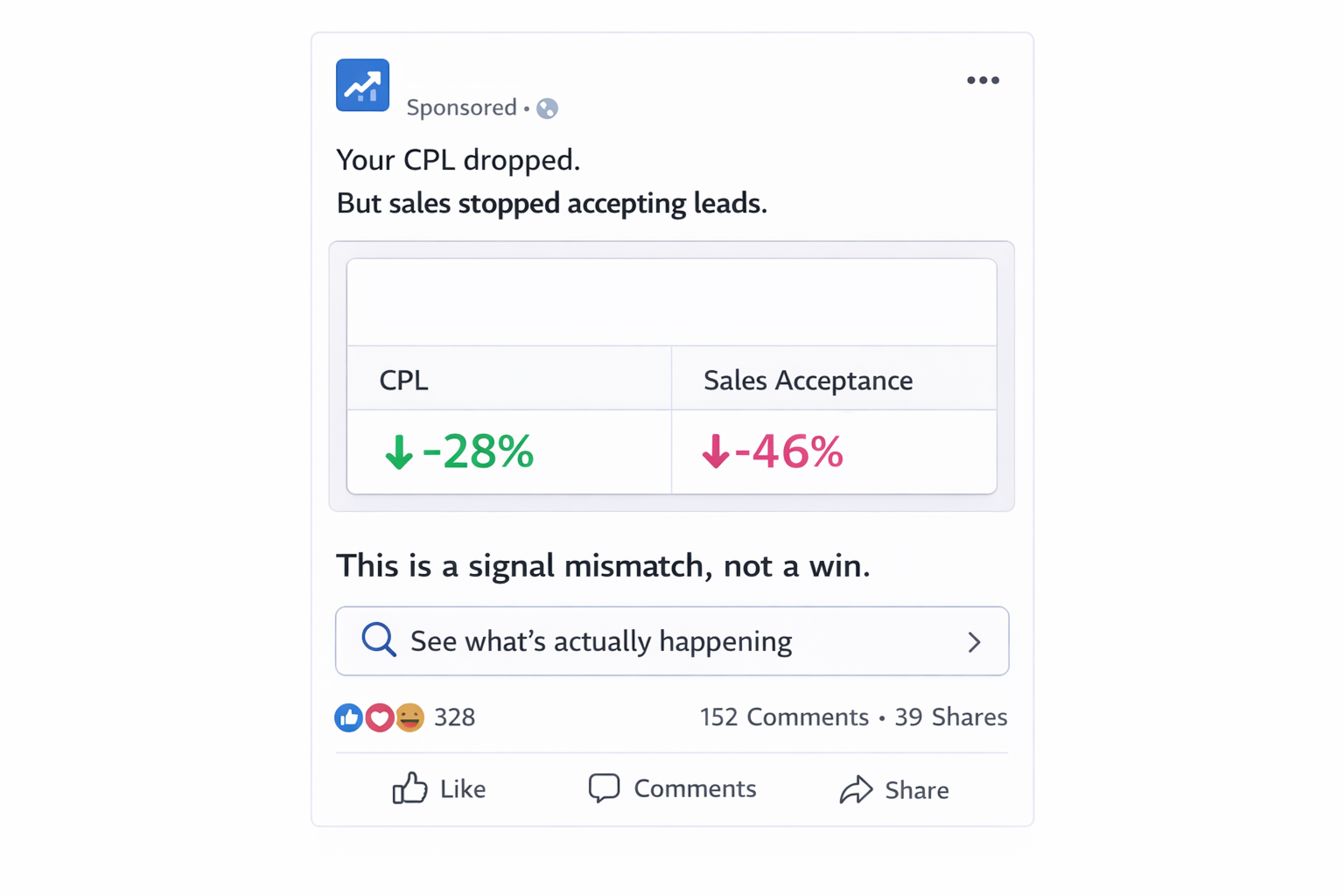
You can reduce CPL, increase volume, and still end up with a pipeline that doesn’t move.
A typical pattern: one campaign starts scaling, cost per lead drops, and engagement looks stable inside Meta Ads Manager. But inside the CRM, something shifts. Sales rejects more leads, follow-ups slow down, and close rates fall.
At that point, the issue isn’t delivery.
It’s attention quality.
Where Attention Breaks in Real Campaigns
This doesn’t happen all at once. It builds gradually.
You’ll usually see a sequence like this:
-
One ad set starts taking most of the spend, which concentrates delivery into a narrow behavioral cluster.
-
Frequency increases beyond ~2.5–3.0, meaning the same type of users are being reached repeatedly.
-
CTR remains stable or even improves, giving the impression that performance is strong.
-
Cost per lead decreases, reinforcing the idea that optimization is working.
Then the downstream signals change:
-
Fewer leads turn into sales conversations.
-
Sales feedback becomes inconsistent or negative.
-
Opportunity rate drops despite higher volume.
This is the same misalignment described in Why Your Ads Get Clicks But No Sales: Fixing the Audience Misalignment.The system is optimizing for interaction — not for buyer intent.
How Decision-Makers Actually Evaluate Ads
Decision-makers don’t read ads the way most creatives assume.
They filter them in seconds.
On feeds like Facebook and Instagram, the evaluation process is simple:
-
First, they check relevance — does this apply to my role or responsibility?
-
Then, they assess clarity — can I understand this immediately without effort?
-
Only after that do they consider the message itself.
If the ad fails at the first step, nothing else matters.
This is why broad messaging often drives clicks but fails to generate qualified demand.
What Actually Captures High-Intent Attention
The ads that stop decision-makers aren’t more creative. They’re more precise.
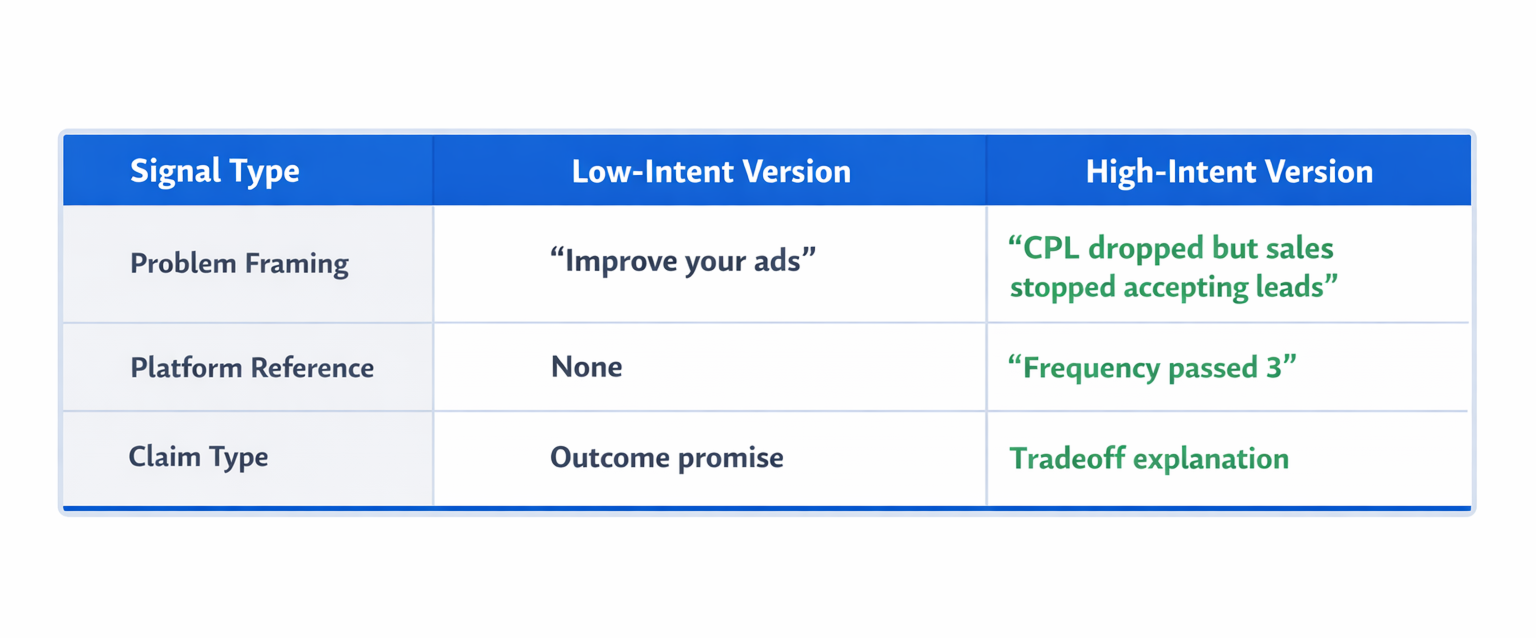
They typically rely on three types of signals:
-
Recognizable problems.
For example, “your CPL dropped, but sales stopped accepting leads.” This mirrors a real scenario the reader has already seen. -
Platform-specific behavior.
Statements like “performance dropped after frequency passed 3” connect directly to what’s visible in Ads Manager. -
Clear tradeoffs.
Instead of promising results, they highlight tension — such as volume increasing while quality declines.
This approach works because it removes interpretation. The reader doesn’t need to guess whether it applies.
A deeper breakdown of how to read these signals is covered in How to Analyze Facebook Ad Performance Beyond CTR and CPC.
Why Strong Creatives Still Attract the Wrong People
High-performing creatives often fail for a simple reason: they’re too easy to engage with.
When messaging removes friction:
-
more users convert quickly;
-
the algorithm receives strong early signals;
-
delivery expands into lower-intent audiences.
The result looks positive at first:
-
higher volume;
-
lower CPL;
-
stable engagement.
But over time, lead quality drops.
This is why many teams struggle to balance performance and quality. The system rewards ease of conversion, not depth of intent.
It also explains why simpler creatives frequently outperform polished ones. They reduce noise and make the message easier to process.
That dynamic is explored in Simple vs. Polished: Why Basic Facebook Ads Often Win.
Copy That Filters Instead of Attracts
Most ads try to maximize appeal. Strong ads narrow it.
The difference starts with the opening line.
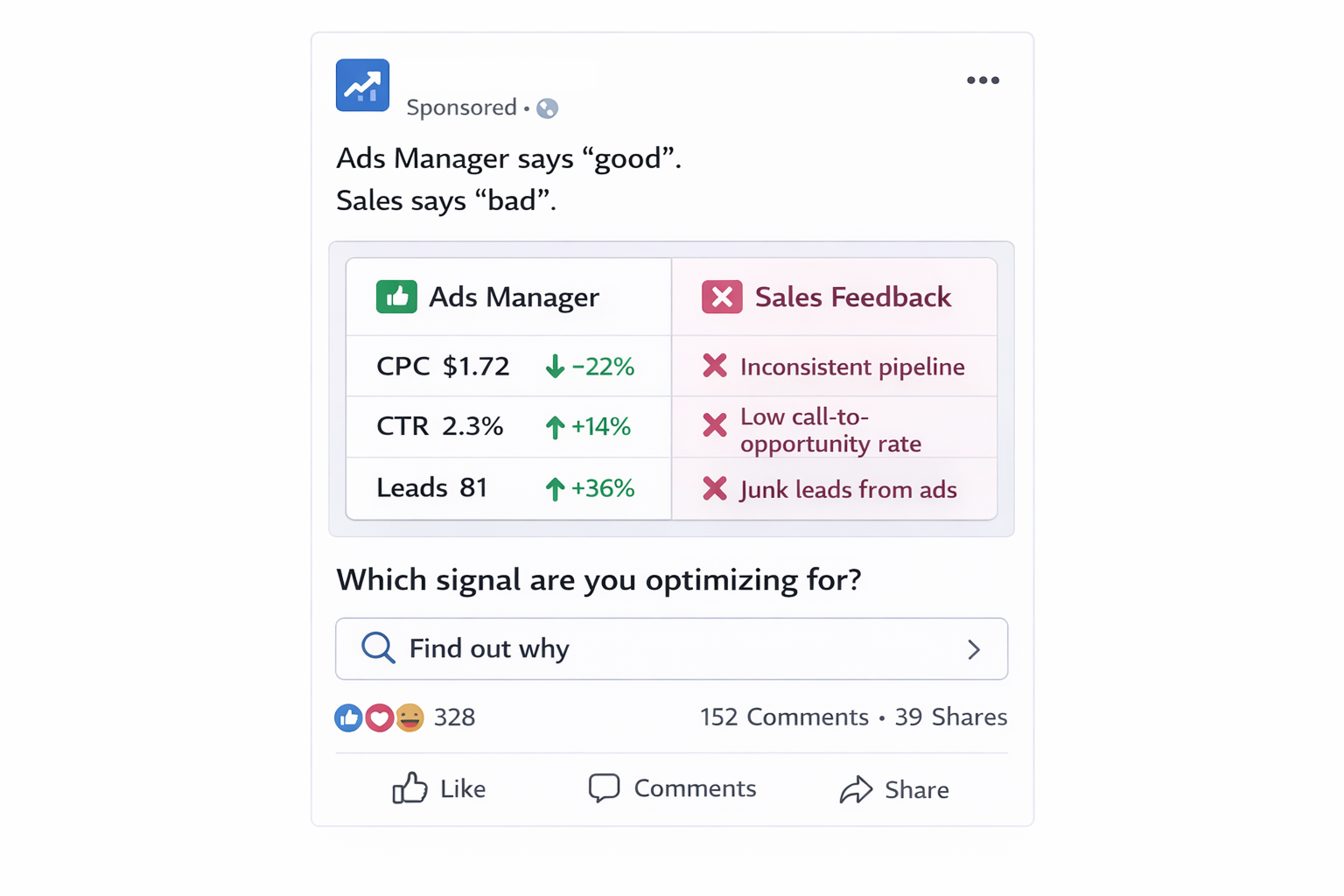
Instead of introducing a topic, it introduces a situation: “If your sales team ignores half your leads, the problem isn’t targeting.”
This works because it immediately filters the audience.
From there, the body should explain what’s happening, not just suggest improvements. For example:
-
how Meta expands delivery after clustered conversions;
-
why low-friction forms inflate conversion signals;
-
how optimization favors short-term volume over long-term value.
This is where credibility is built.
Finally, the CTA should match the problem introduced earlier. A vague “learn more” breaks alignment. A specific next step keeps intent consistent.
A Practical Way to Check Your Ads
Before scaling any creative, it helps to validate the type of attention it attracts.
You can do that with a few checks:
-
Does performance improve when you add friction? If yes, your current leads are too low-intent.
-
Do breakdowns show most conversions coming from one ad set? That often signals narrow clustering.
-
Does sales feedback contradict Ads Manager metrics? That indicates a signal mismatch.
-
Would a junior marketer immediately understand the ad? If yes, it’s probably too broad.
You can also compare your patterns against How to Spot Low-Quality Leads Before They Hurt Your Funnel.
Final Takeaway
Designing ads for decision-makers is not about increasing attention.
It’s about filtering it.
When your ads:
-
reflect real campaign behavior;
-
anchor claims in observable signals;
-
and exclude low-intent users early;
you stop optimizing for clicks and start optimizing for buyers.
That’s what improves pipeline quality — not just metrics.