A campaign can generate cheap leads and still fail to produce pipeline. In many cases, the issue isn’t targeting or budget — it’s how the message shapes the type of signal entering the system.
Emotional and rational messaging don’t just influence perception. They determine who clicks, how delivery expands, and whether downstream conversion signals remain stable.
Most teams treat this as a creative decision. In practice, it’s a signal quality and funnel alignment problem — closely related to concepts explained in Why Clicks Don’t Equal Demand and CTR vs Conversions: Why High CTR Doesn’t Always Mean More Sales.
When Messaging Starts Breaking Performance
You’ll often notice the shift within the first few days after launching new creatives.
A typical pattern looks like this:
-
CTR increases within 24–48 hours, often by 20–40% compared to previous ads.
-
CPC drops as engagement improves and auctions become easier to win.
-
Lead volume increases quickly, sometimes doubling without budget changes.
-
Within a few days, CPQL rises and sales teams start rejecting more leads.
Nothing in targeting or bidding changed. Only the message did.
What’s happening is that the new messaging attracts a broader group of users. The system interprets higher engagement as relevance and begins expanding delivery into adjacent behavioral clusters.
The problem is simple: engagement is easier to generate than intent.
What Emotional Messaging Actually Does
Emotional messaging reduces friction at the moment of decision.
It works because it allows users to react quickly without evaluating details. In B2B feeds, where most ads look similar, this creates a clear advantage.
In execution, this usually takes a few forms:
-
Problem compression.
The ad surfaces a recognizable issue without explaining its complexity. This mirrors how attention works in fast-scrolling environments. -
Role-based triggers.
Messaging speaks directly to a specific operator or team. When someone recognizes their situation, they click before fully evaluating the solution. -
Outcome suggestion without mechanism.
The ad implies improvement but delays explanation. This reduces cognitive load and increases interaction rates.
These patterns increase engagement signals quickly. As a result, delivery expands and costs often decrease in the short term.
Where Emotional Messaging Breaks Down
The breakdown appears after the click, when the user is forced to evaluate reality.
You’ll typically see:
-
Strong CTR paired with high bounce rates.
-
A visible drop between clicks and form starts.
-
Increasing lead volume with declining qualification rates.
This is the same post-click failure dynamic described in Optimizing for Post-Click Experience: What Happens After.
The root cause is expectation mismatch.
The ad simplifies the problem to trigger a reaction. The landing page introduces detail — pricing, process, requirements. Users who clicked based on recognition, not intent, disengage at this stage.
If enough low-intent users convert, the system starts reinforcing that pattern. It learns that these users are easier to acquire and continues optimizing toward them.
What Rational Messaging Changes
Rational messaging increases friction — but in a useful way.
Instead of maximizing clicks, it filters for users willing to evaluate a claim before engaging.
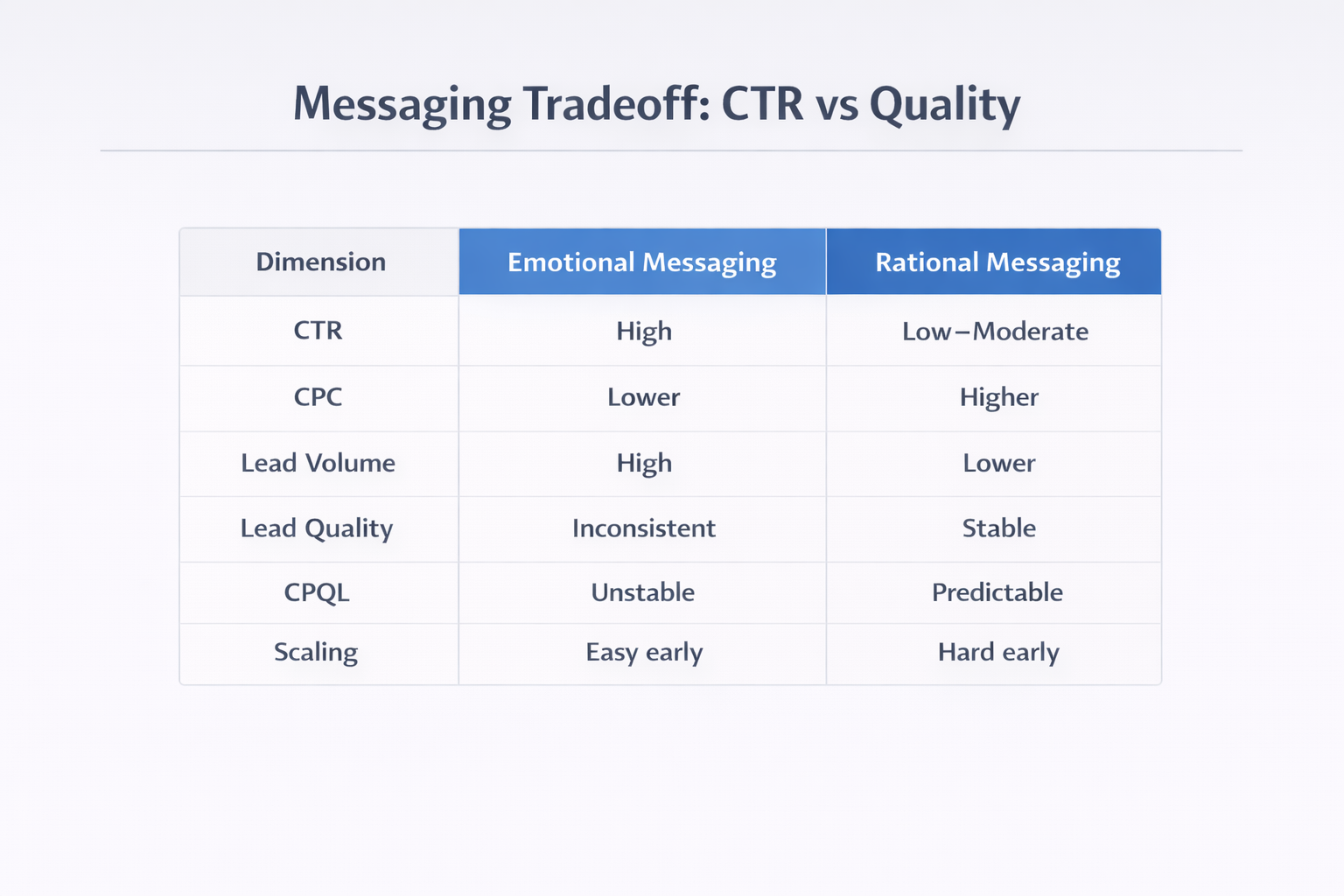
In practice, this includes:
-
Specific outcomes tied to measurable metrics.
Claims are concrete and testable, reducing ambiguity early. -
Mechanism visibility.
The message explains how results are achieved, not just what is promised. -
Explicit constraints.
Messaging signals who the solution is for and who it isn’t, reducing irrelevant clicks. -
Proof elements.
Data points or operational details that users can evaluate before converting.
This reduces click volume, but it improves alignment across the funnel.
Why Rational Messaging Limits Scale
The downside appears at the top of the funnel.
With higher cognitive load:
-
Fewer users click, even if they are qualified.
-
Engagement signals accumulate more slowly.
-
The system has less data to expand delivery.
You’ll often observe:
-
Lower CTR and higher CPC.
-
Slower learning stabilization.
-
Consistent but capped lead volume.
This is not a messaging failure. It’s a signal density issue.
The Core Issue: Message–Stage Misalignment
Most campaigns don’t fail because they choose the wrong type of messaging. They fail because they apply it at the wrong stage.
Common patterns include:
-
Emotional ad → highly detailed landing page.
Users click easily, then disengage when forced to process complexity. -
Rational ad → vague landing page.
Users expect clarity but encounter generic claims, reducing trust. -
Same messaging across all stages.
Either weak attraction or weak qualification.
This aligns with how funnel structure impacts performance, as explained in From Awareness to Conversion: Full Facebook Funnel Strategy.
A Structure That Maintains Both Volume and Quality
The goal is not to choose between emotional and rational messaging. It’s to control when each influences behavior.
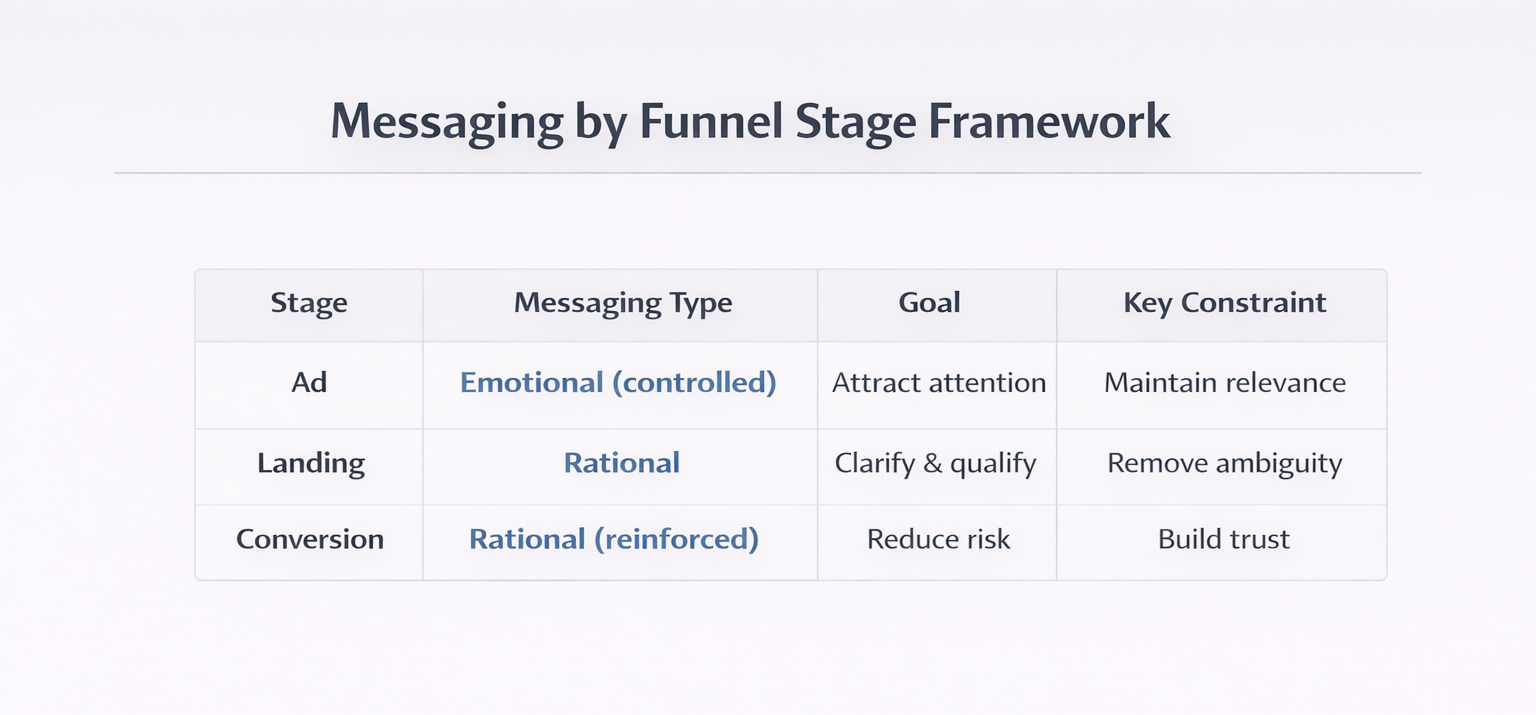
Ad Level — Controlled Emotional Entry
The ad should create recognition without opening the funnel to low-intent traffic.
In execution:
-
Frame a specific problem, not a general frustration.
-
Include qualifiers such as role, industry, or context.
-
Avoid claims that apply to everyone.
This keeps engagement high while maintaining intent.
Landing Page — Immediate Rational Clarification
After the click, ambiguity must be removed quickly.
The landing page should:
-
Explain how the solution works in concrete terms.
-
Define who qualifies and who doesn’t.
-
Align expectations with what happens next.
When this is done correctly, key signals improve:
-
Higher form start rates.
-
More stable time on page.
-
Better lead-to-qualified ratios.
Conversion Stage — Risk Reduction
At the final step, users are evaluating commitment.
This stage should:
-
Clarify next steps and timelines.
-
Reduce uncertainty about the process.
-
Reinforce credibility with specifics.
If this layer is weak, even qualified users hesitate.
Diagnosing Messaging Imbalance
Performance patterns reveal where the issue sits.
Over-Emotional Signal
-
CTR increases while CPQL worsens.
-
Lead volume grows but acceptance rate declines.
-
Spend scales without pipeline growth.
Interpretation: the system is optimizing for accessibility, not intent.
Over-Rational Signal
-
CTR remains low despite relevant targeting.
-
CPC increases and delivery slows.
-
Conversion rate is stable but volume is limited.
Interpretation: the system lacks enough early interaction signals.
Balanced Signal
-
CTR is moderate and consistent.
-
Conversion rate holds as spend increases.
-
CPQL remains stable.
Interpretation: attraction and qualification are aligned.
Final Takeaway
Messaging determines more than how your ads look. It shapes the signals that drive delivery and optimization.
Emotional messaging increases signal volume but risks lowering quality. Rational messaging improves signal quality but can restrict volume.
Performance improves when these are sequenced correctly.
Use emotional messaging to create entry — but keep it specific. Use rational messaging to qualify — but introduce it at the right moment.
When both are aligned, campaigns don’t just perform better — they become predictable.