Most Facebook campaigns underperform not because of targeting or creatives, but because the sales cycle is misaligned with how the algorithm learns.
If you run the same campaign structure for a product that converts in 24 hours and a service that closes in 60 days, the system will interpret performance signals very differently. That mismatch shows up quickly in unstable CPL, inconsistent delivery, and poor lead quality.
Understanding how sales cycle length changes optimization logic is critical if you want predictable results.
Why Sales Cycle Length Changes Everything
You can often spot a mismatch within a few days in Ads Manager.
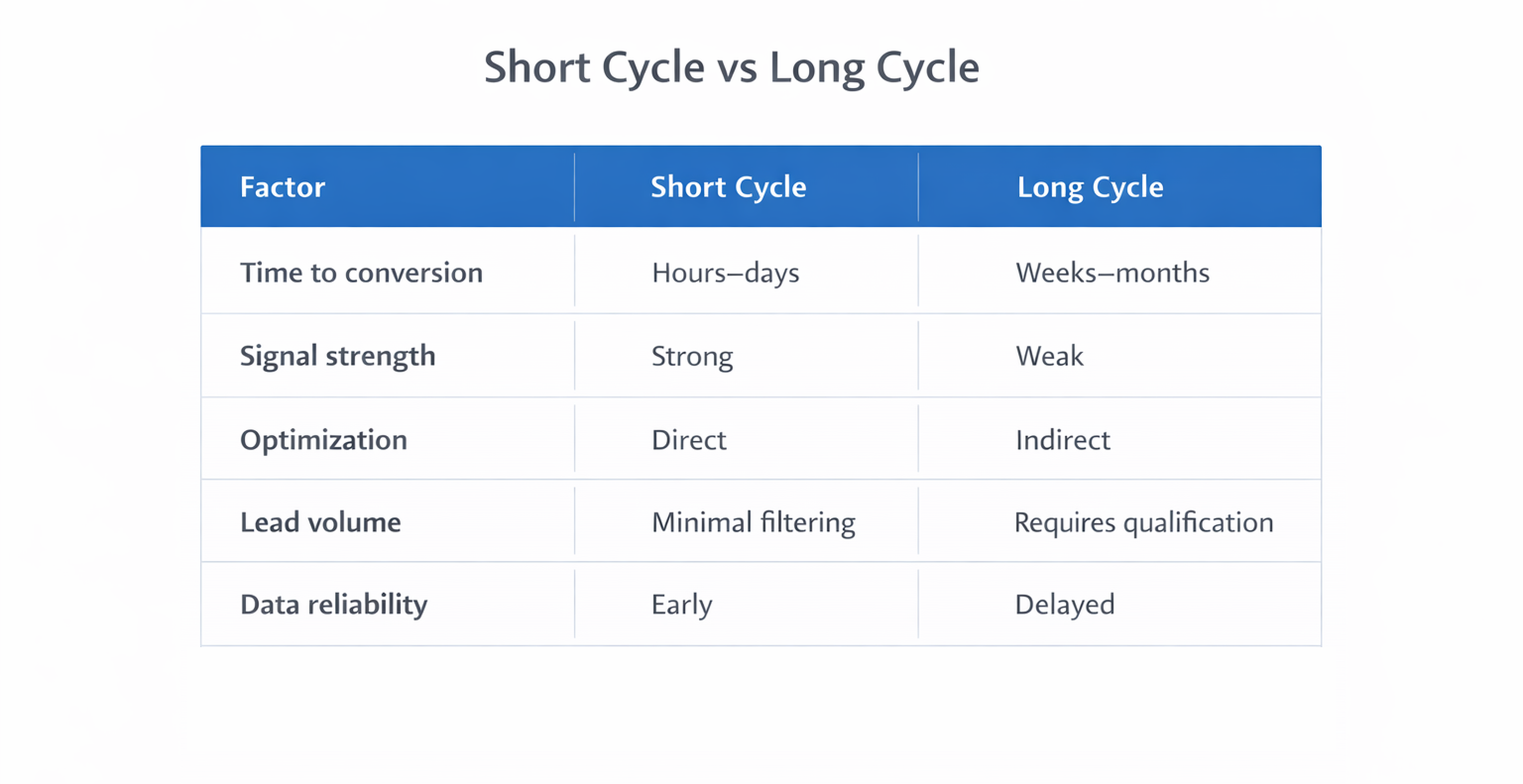
For short-cycle offers, performance stabilizes quickly. You see consistent cost per result, steady delivery, and fast learning phase exits. If you want to better understand how this process works, see How to Finish the Facebook Learning Phase Quickly.
For long-cycle offers, the opposite happens:
-
Delayed conversion signals. Purchases or qualified actions don’t occur within the first few days, so the algorithm lacks feedback.
-
Volatile CPL. Early optimization relies on weaker signals like clicks or form fills, which fluctuate heavily.
-
Misleading early winners. Campaigns that generate cheap leads initially often degrade in quality over time.
The underlying mechanism is simple: Meta optimizes based on the signals it receives within its learning window. When those signals don’t reflect actual business outcomes, optimization drifts.
How Short Sales Cycles Work in Practice
Short sales cycles typically include:
-
low-ticket products,
-
impulse-driven purchases,
-
simple signup flows with immediate value.
In these cases, the feedback loop is tight. The algorithm can connect user behavior to outcomes within hours or days.
What the Algorithm Actually Sees
When someone clicks an ad and converts shortly after, Meta can:
-
match that conversion to a specific audience segment,
-
increase bids for similar users in upcoming auctions,
-
deprioritize segments that don’t convert quickly.
This creates a fast reinforcement loop.
What to Optimize For
In short-cycle campaigns, you can optimize directly for bottom-of-funnel events:
-
Purchase or qualified conversion event — the cleanest signal for scaling.
-
Value-based optimization — useful when order values vary.
-
High-frequency testing — faster validation cycles.
If you’re pushing spend, it’s worth reviewing The Science of Scaling Facebook Ads Without Killing Performance to avoid breaking efficiency.
Because the system receives real outcomes quickly, early performance data is usually reliable.
Where Short Cycles Still Go Wrong
Even in fast cycles, issues appear when signals get diluted.
Common problems include:
-
Over-optimization for volume. Scaling too aggressively pushes delivery into lower-quality segments.
-
Creative fatigue masked by stable CPL. Costs stay flat while conversion efficiency drops.
-
Shallow funnel tracking. Optimizing for clicks instead of purchases introduces noise.
A useful diagnostic: if frequency rises while conversion rate drops, the algorithm is exhausting high-quality users. This is often tied to ad fatigue — explained in Ad Fatigue on Facebook: How to Spot It Early and Fix It Fast.
How Long Sales Cycles Break Standard Optimization
Long sales cycles include:
-
B2B services,
-
high-ticket products,
-
complex decision processes.
Here, the algorithm struggles because the outcome signal arrives too late.
What Happens Inside the System
During the first days of a campaign, Meta has to optimize using proxy signals:
-
link clicks,
-
landing page views,
-
form submissions.
But these signals often have weak correlation with final outcomes like closed deals.
This creates a structural problem:
-
The algorithm finds users who complete the early action, not those who convert later in the pipeline.
-
Over time, lead quality declines even if CPL improves.
Observable Symptoms
You can verify this directly:
-
CPL decreases while sales team rejection rate increases.
-
High lead volume but weak pipeline contribution.
-
Campaign scales smoothly but revenue does not follow.
If this sounds familiar, see Why Your Facebook Ads Aren’t Generating Leads and How to Fix It.
This is not a targeting issue. It’s a signal quality problem.
Adjusting Strategy for Long Sales Cycles
You can’t force the algorithm to learn from delayed outcomes, but you can reshape the signals it receives.
Strengthen the Input Signal
Instead of optimizing for raw leads, introduce friction that filters intent:
-
Use longer forms with qualifying questions — budget, timeline, company size.
-
Gate the offer — shift from generic downloads to demos or consultations.
-
Add pre-conversion steps — require engagement before submission.
This reduces volume but improves signal quality.
Use Mid-Funnel Conversion Events
If purchase data is delayed, create intermediate events:
-
booked calls,
-
demo attendance,
-
verified actions.
These events shorten the feedback loop while staying relevant.
Align CRM Feedback with Campaigns
A critical but often missing step:
-
send offline conversion data (qualified leads, deals) back into Meta,
-
segment leads by quality in your CRM,
-
build audiences based on actual outcomes.
This allows the algorithm to learn from real business results over time.
Structural Differences in Campaign Setup
The differences between short and long cycles should be reflected in your campaign architecture.
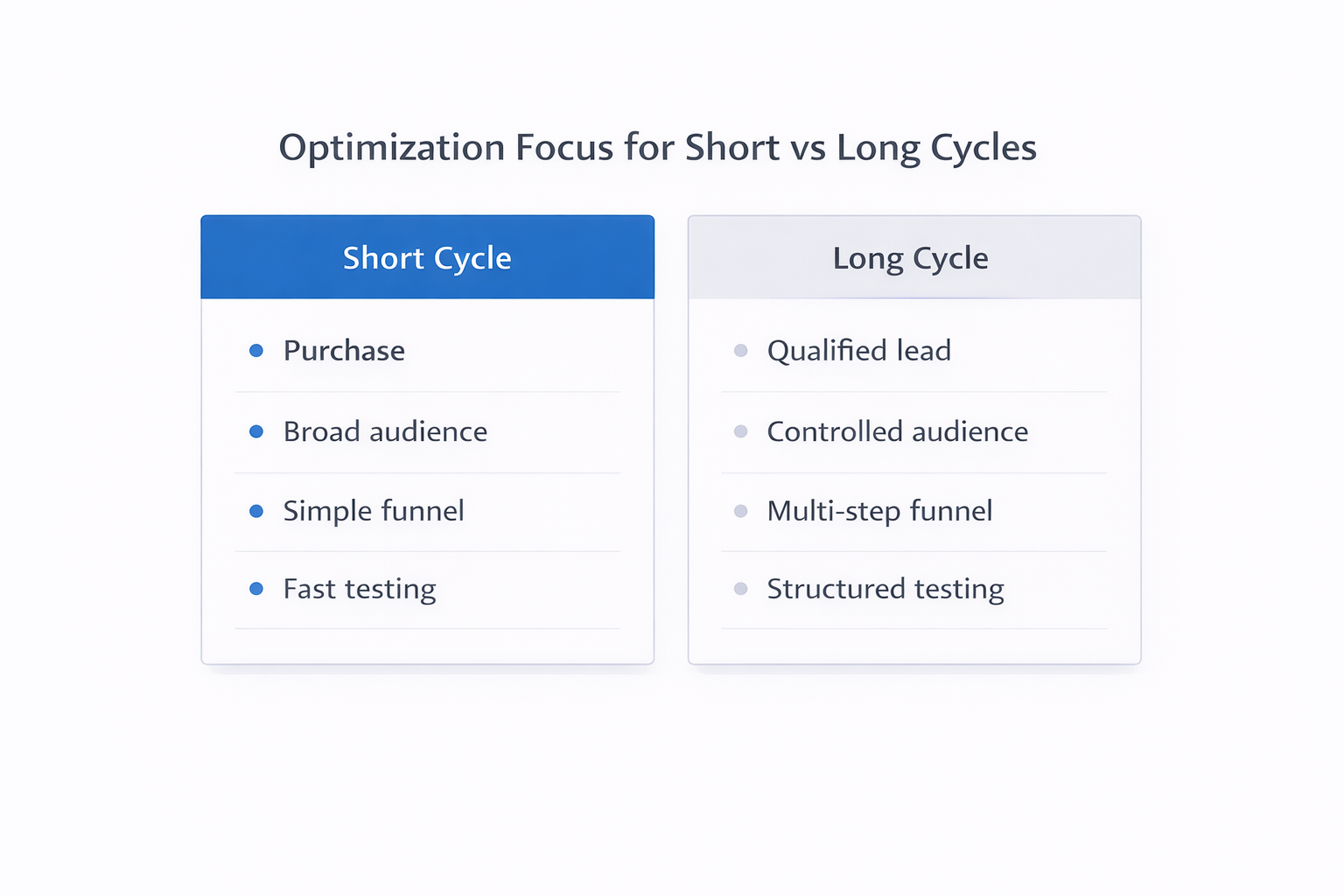
Short Sales Cycle Setup
-
Optimize for purchase or immediate conversions.
-
Use broader audiences to accelerate learning.
-
Focus on creative testing speed.
Long Sales Cycle Setup
-
Optimize for qualified lead proxies, not raw volume.
-
Use controlled segmentation when signal quality is uncertain.
-
Build multi-step funnels that filter intent before conversion.
Most underperformance comes from applying the first structure to the second.
A Practical Way to Diagnose Your Setup
If you’re unsure whether your setup matches your sales cycle, check:
-
Time-to-conversion vs optimization window. If conversions happen after 7+ days, your signal is too delayed.
-
Lead-to-opportunity ratio. If it declines as you scale, optimization is drifting.
-
CPL vs revenue trend. If costs improve but revenue stalls, your signals are misaligned.
These are visible in Ads Manager — you just need to interpret them correctly.
Final Takeaway
Facebook’s algorithm doesn’t optimize for your business outcome. It optimizes for the signals you provide within a limited window.
Short sales cycles naturally align with that system, which is why they scale faster and more predictably.
Long sales cycles require deliberate signal design. If you don’t control what the algorithm learns from, it will optimize for the easiest action, not the most valuable one.
The shift is simple: stop asking how to generate more leads, and start asking whether your signals reflect real buying intent.