For a new business, Facebook Ads can either accelerate traction quickly or drain budget without producing usable data. The difference usually isn’t creative quality or targeting tactics — it’s whether your setup aligns with how the ad system learns and optimizes.
This article breaks down when Facebook Ads work well early, and when they don’t.
Why Early Results Often Look Unstable
In the first 1–2 weeks, performance rarely looks clean. That’s because the system is still testing where your ads fit.
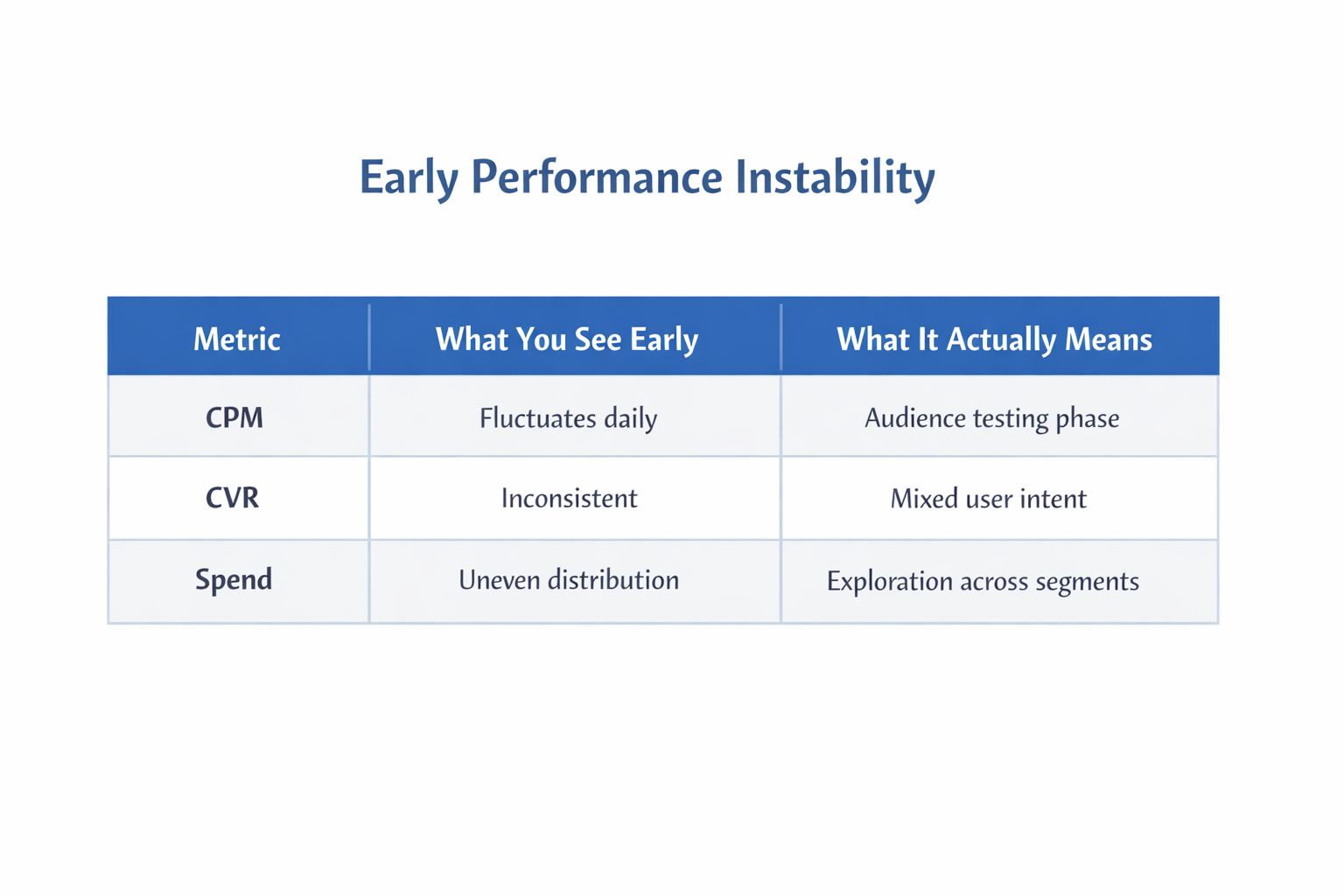
You’ll usually notice:
-
CPM fluctuations as your ads enter different auctions.
-
Conversion rate swings depending on which audience segments are reached.
-
Uneven spend distribution across ad sets or time windows.
This phase is often misunderstood. Many advertisers react too quickly, which resets learning and delays stabilization. If you want a deeper breakdown of timing expectations, see How Long Facebook Ads Should Run Before Judging Results.
The Real Limitation: Signal Density
Most early-stage issues come down to signal — not budget, not creatives.
If your campaigns don’t generate enough meaningful events:
-
The algorithm can’t identify consistent patterns.
-
Delivery shifts toward cheaper impressions instead of higher-probability users.
-
Surface metrics look acceptable, but business results stay weak.
In practice, once you drop below ~10–15 conversions per week per ad set, performance becomes unstable.
This is why campaigns can generate clicks but still fail to produce revenue.
When Facebook Ads Work Well for New Businesses
Some setups naturally align with how the system learns. These tend to perform well even without historical data.
High-Intent Offers With Immediate Demand
If people already want what you’re offering, the system gets strong signals quickly.
This typically includes:
-
Urgent services (repairs, emergency bookings, legal help).
-
Simple transactional offers (bundles, discounts, entry-level products).
-
Services tied to active decision-making (moving, insurance, home upgrades).
Users don’t need long consideration cycles here. They click, evaluate, and convert — often within the same session.
If you’re unsure whether your offer qualifies as “high intent,” review What Makes an Ad “High Intent”.
Existing Demand Outside Paid Ads
Facebook performs much better when it’s not your only source of demand.
If you already have:
-
organic leads or inbound requests,
-
repeat customers or referrals,
-
consistent conversions without ads,
then you’ve already validated your offer.
At that point, ads are scaling demand — not trying to create it from nothing.
Simple, Direct Conversion Paths
The shorter the journey from click to action, the easier it is for campaigns to stabilize.
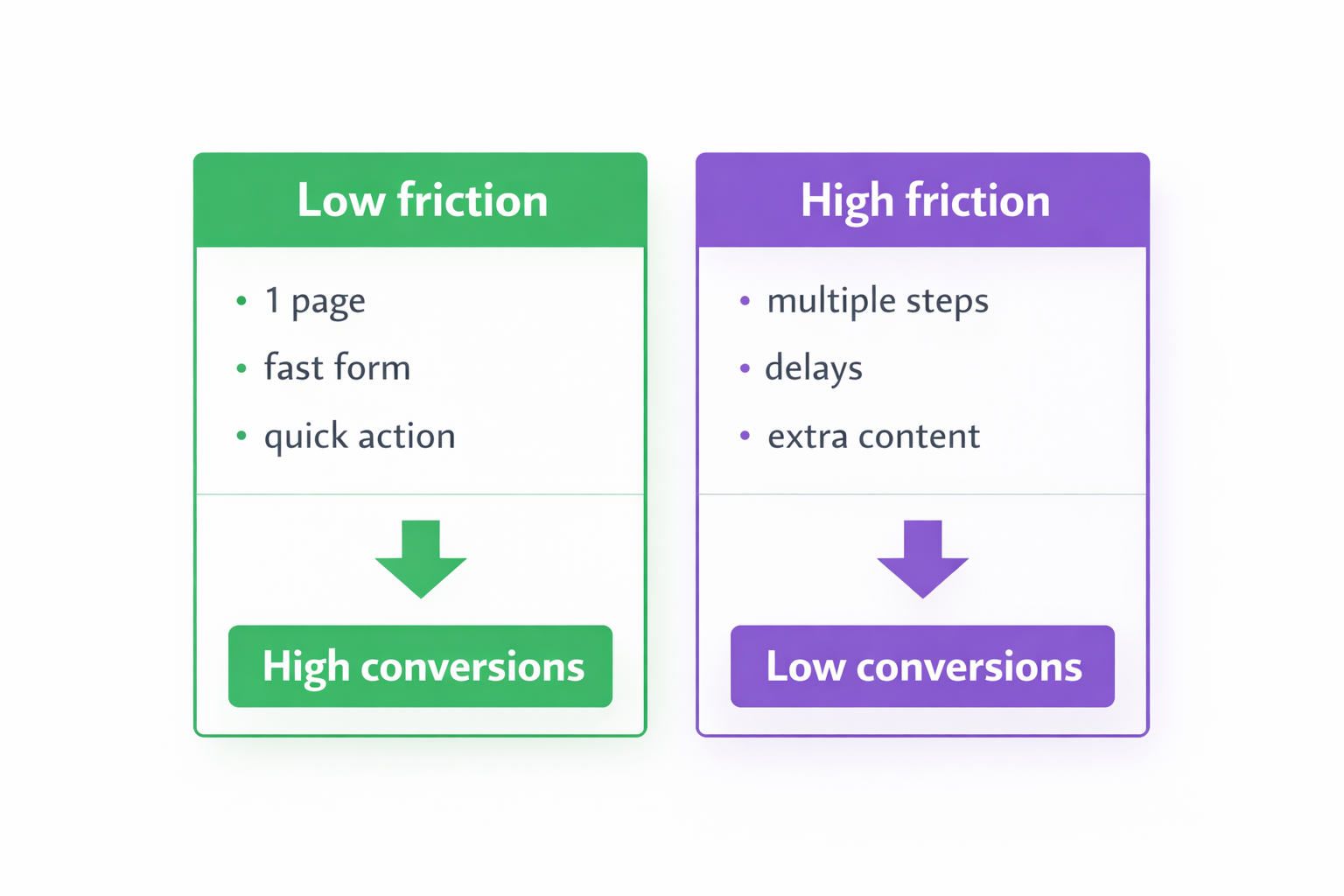
Strong early-stage funnels usually look like:
-
One landing page with one clear action.
-
Forms that are easy to complete but still filter low-quality leads.
-
Immediate follow-up after submission.
More complex funnels reduce conversion volume, which weakens optimization.
If your campaigns are getting clicks but not results, the issue is often post-click — not targeting. A detailed breakdown is in Optimizing for Post-Click Experience: What Happens After.
Ability to Generate Data Quickly
Facebook improves as it gathers data. New businesses that can generate volume early usually stabilize faster.
This typically depends on:
-
broad targeting instead of fragmented audiences,
-
a budget that allows consistent delivery,
-
an offer strong enough to convert cold traffic.
If volume stays low, campaigns remain stuck in testing mode.
When Facebook Ads Tend to Struggle
There are also predictable failure patterns. These aren’t random — they come from structural mismatches.
Long Sales Cycles
If conversions take weeks or months:
-
The system receives delayed feedback.
-
Optimization shifts toward weaker signals like clicks or form fills.
-
Lead quality becomes inconsistent.
This is why long-cycle businesses often see “good” metrics but poor revenue outcomes.
Unproven Offers
If your offer hasn’t worked anywhere else, ads won’t fix it.
You’ll usually see:
-
low CTR even with multiple creatives,
-
high bounce rates after clicks,
-
minimal conversions despite traffic.
This often ties back to a deeper issue explained in Are Your Ads the Issue — or Is the Offer the Real Problem?
Overcomplicated Campaign Structure
Splitting campaigns into too many audiences early spreads data too thin.
Instead of improving performance, this:
-
resets learning across ad sets,
-
slows down optimization,
-
creates inconsistent delivery patterns.
A simpler structure — often one broader ad set — performs better in early stages.
Weak Post-Click Experience
Even strong ads fail if the landing experience breaks momentum.
Typical issues include:
-
slow load speed, especially on mobile,
-
layouts that make forms difficult to complete,
-
mismatch between ad message and landing page.
These problems don’t show directly in Ads Manager, but you’ll see indirect signals like low conversion rate and rising CPC.
How to Tell If You’re Ready to Scale
Before increasing spend, check whether your setup supports optimization.
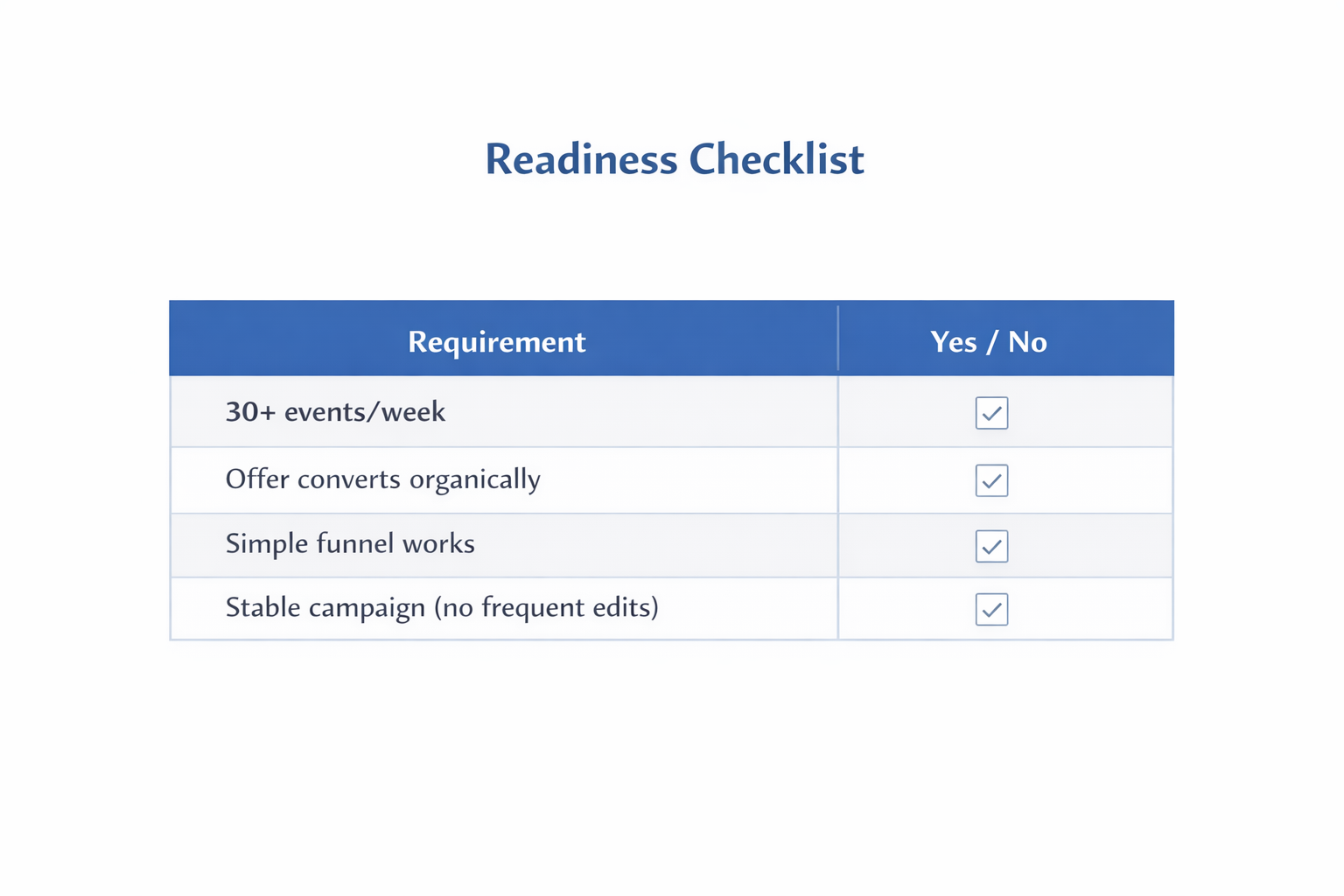
You’re likely ready if:
-
you can generate ~30 meaningful events per week,
-
your offer already converts outside paid traffic,
-
your funnel works for cold users,
-
you can run campaigns without constant edits for 2–3 weeks.
If these conditions aren’t met, scaling usually amplifies inefficiencies instead of fixing them.
What to Do If You’re Not There Yet
If performance isn’t stable, the goal isn’t to “optimize harder.” It’s to improve signal quality.
Focus on:
-
strengthening your offer to attract higher-intent users,
-
simplifying your funnel to increase conversion volume,
-
consolidating campaign structure to concentrate data,
-
using ads to validate demand before scaling.
At this stage, Facebook Ads work best as a feedback system — not just an acquisition channel.
Final Takeaway
Facebook Ads work best for new businesses when the system receives clear, fast feedback.
That usually comes from:
-
short conversion cycles,
-
real demand for the offer,
-
and enough event volume to support learning.
Without those, performance will feel inconsistent — not because the platform is unpredictable, but because it lacks the signal needed to optimize effectively.