In competitive Facebook ad markets, the weakest link shows up fast. CPMs climb. Conversion rates drop. And when pressure hits, most advertisers double down on the wrong levers — creative, budgets, or targeting — without examining the underlying systems that break first.
But in these high-stakes environments, the first thing to collapse isn’t tactical. It’s strategic. Assumptions you relied on in easier markets — benchmarks, funnel logic, creative structure — fail faster when every impression is fought over. This article explores what breaks first in tough niches and how to proactively build ad systems that hold under pressure.
Why assumptions collapse in saturated markets
Advertisers often enter competitive niches with frameworks that worked elsewhere. Those models usually break down within days.
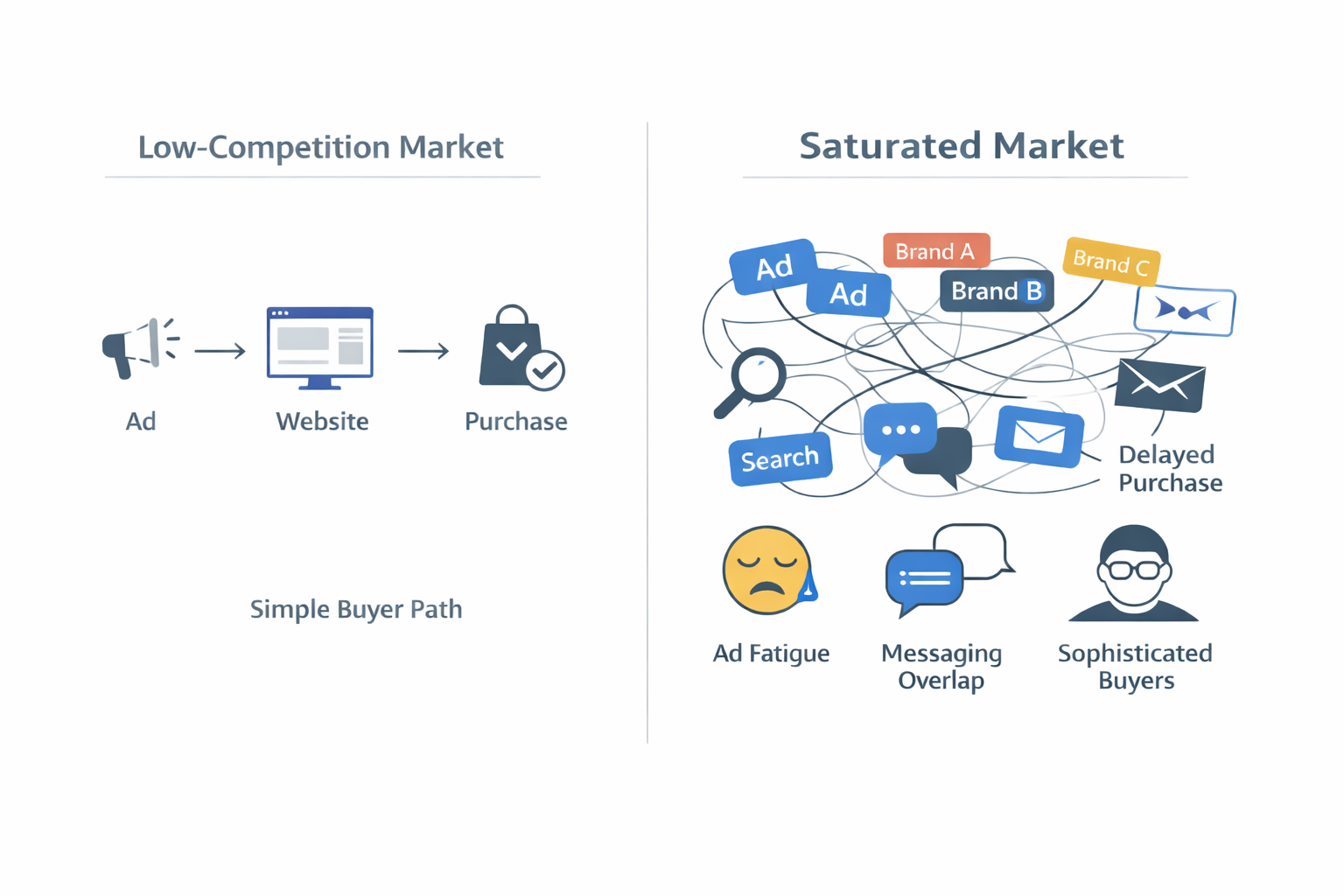
Two dynamics cause this collapse:
-
High advertiser density: Dozens of brands are competing for the same eyeballs, often with similar messaging, formats, and hooks.
-
Market sophistication: Buyers in high-consideration or trend-heavy categories (e.g., fitness, skincare, coaching, SaaS) have seen it all. They scroll past predictable content and spot “template ads” instantly.
Once saturation hits, surface-level optimization won’t fix performance drops. The problem isn’t just what you’re running — it’s how your ad system was built to operate.
This is especially true in categories where brands race to the bottom with pricing or churn out lookalike creatives with no unique positioning. Surviving here requires deeper shifts, especially in how you interpret performance data and attribution signals.
A deeper breakdown of this issue is covered in Meta ads attribution: what to know about windows, delays, and data accuracy.
1. Your benchmarks
Why they break
Benchmarks are only useful when they're market-specific. If your blended CAC was $30 in a niche wellness product, that doesn’t mean it will hold in skincare or weight loss. CPAs can jump by 2–3x, and early ROAS will look dismal — even if you’re doing everything right.
What to do
-
Use blended metrics (e.g., CAC across Facebook, Google, email) to understand real customer acquisition cost.
-
Track profit per customer, not just front-end ROAS. Many products become profitable only after upsells or retention.
-
Account for conversion lag — especially on iOS. Wait 5–7 days before judging performance. Some purchases show up later in Meta's reporting.
Benchmarks from low-competition campaigns are often misleading. In competitive niches, you’re playing a different game. Instead of chasing a static ROAS target, shift your tracking to time-adjusted metrics like 7-day or 28-day CAC and contribution margin.
This approach aligns closely with the idea of blended ROAS explained in Blended ROAS vs Channel ROAS: What You Should Track.
2. Your funnel logic
Why it breaks
You assume people will click and buy, or at least sign up. But most don’t. Competitive buyers bounce, compare, and come back later — if at all. Your clean funnel flow becomes a jagged, multi-session path that doesn't fit standard retargeting logic.
What to do
-
Study delayed conversions by using UTM data combined with post-purchase attribution surveys or CRM-level tracking.
-
Expand retargeting windows to match real behavior — many buyers convert on Day 5–10, not Day 1–3.
-
Broaden your retargeting creative: Instead of “You left something in your cart,” try “Still weighing your options?” or “Need more info before deciding?”
Most advertisers over-index on short-term attribution. But in high-intent verticals, purchases are rarely impulsive. Conversion paths involve multiple visits, channels, and moments of reconsideration. This is why retargeting strategy needs to reflect buyer timing, not platform defaults.
A practical framework for this is outlined in The ultimate guide to Facebook retargeting.
3. Your creative assumptions
Why they break
Polished, formulaic creative looks professional — but in saturated feeds, it also looks familiar. The “perfect” DTC ad formula (hook, product demo, testimonial, CTA) becomes predictable. Your audience has seen 50 of those this week.
What to do
-
Use native-feeling formats that don’t feel like ads: raw UGC, demo snippets, real screenshots, messy overlays.
-
Replace vague claims with numbers and specifics: "Backed by 120,000 hours of usage data" beats "Built for busy teams."
-
Build modular creative systems where hooks, formats, and offers can be swapped quickly based on early data.
In competitive markets, creative fatigue hits in weeks — not months. That’s why having 1–2 winning videos is not enough. You need a creative infrastructure that supports constant iteration.
A deeper look at why this happens, and how to spot it early, is covered in How to avoid ad fatigue and keep optimal ads conversion rate.
4. Your audience logic
Why it breaks
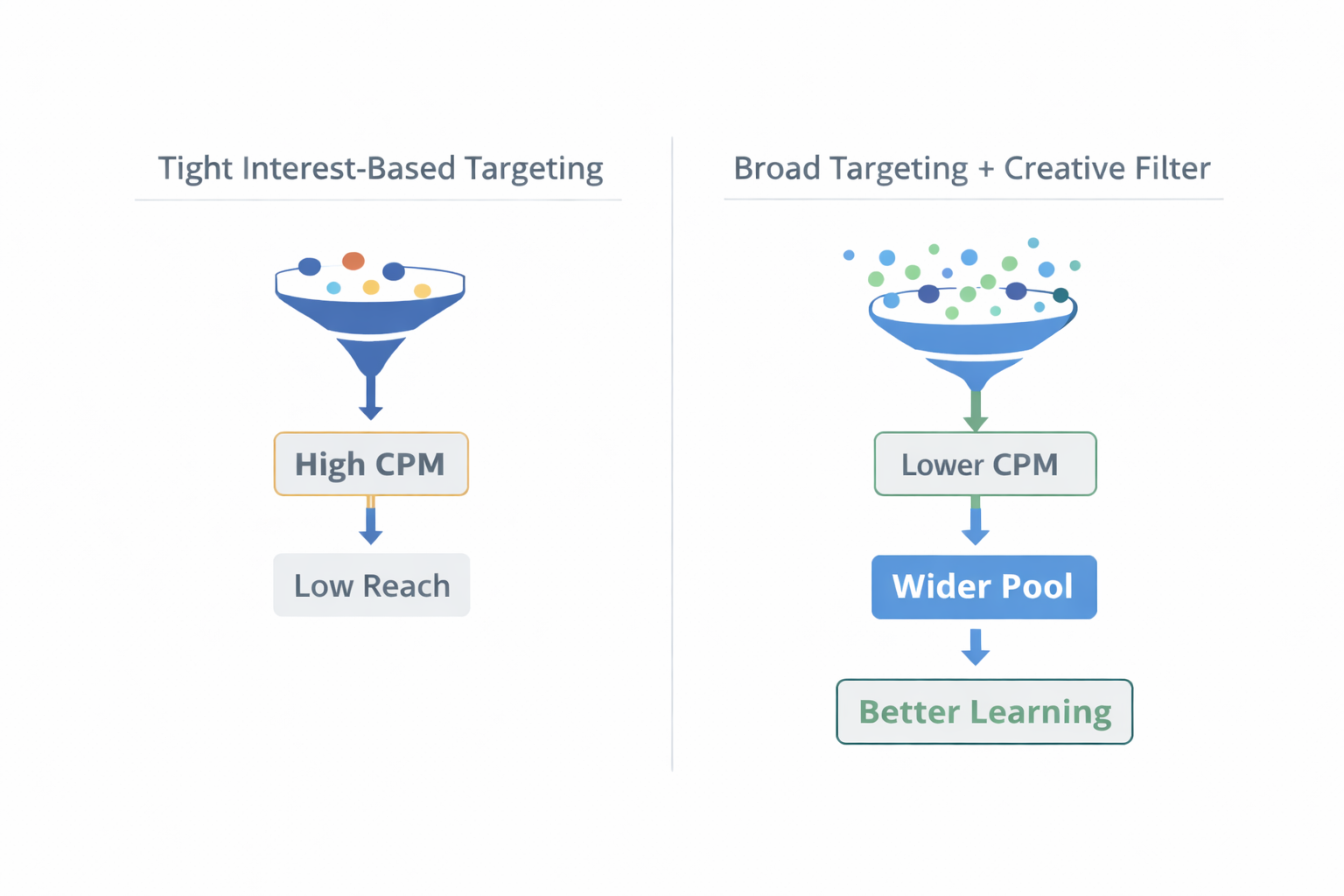
The classic belief: tighter targeting equals better performance. In saturated niches, the opposite often happens. Micro-targeting increases CPMs and reduces scale. Worse, Facebook's machine learning can’t optimize if you restrict it too much.
What to do
-
Use broad targeting or Advantage+ Shopping campaigns when account history is strong. Let the algorithm optimize.
-
Tailor creative to act as the filter, not the audience settings. Let ad content attract the right buyer within broad segments.
-
Avoid shrinking audiences too soon. Interest stacking and exclusions often hurt scale and learning.
Your ad doesn’t just reach the audience you choose — it reaches the audience your creative resonates with.
This principle is explored in more detail in Broad targeting: when it beats narrow, which explains why looser targeting often performs better in competitive environments.
5. Your feedback loop
Why it breaks
You’re optimizing ads based on what Meta reports in-platform. But platform data is delayed, sampled, or even missing on iOS. Meanwhile, real business outcomes — profit, churn, LTV — exist outside the ad account.
What to do
-
Connect Meta with post-purchase data using Conversions API or offline event uploads.
-
Track ad elements, not just whole creatives: Which hooks consistently perform? Which offer formats hold up across time?
-
Use dashboards that blend ad data with product metrics: LTV, churn, cohort-level CAC.
Your goal isn’t to improve CTR. It’s to scale profitable acquisition. That requires seeing the full performance picture — not just the ad platform’s version of it.
This same idea is expanded in Ad metrics that lie: when good numbers hide bad performance, which explains why surface-level metrics often mislead.
Rethink your first 30 days
Advertisers often launch with a fixed strategy — single campaign, standard retargeting, one offer. In competitive niches, that rigidity is fatal. Your first 30 days should be structured like a stress test.
Launch with multiple campaign types
-
Broad or Advantage+ campaigns to capture volume and maximize machine learning.
-
Interest-based testing to validate positioning and uncover niche audiences.
-
Warm audience segments from lead-gen or existing traffic to stabilize early data.
Run parallel offer tests
-
Risk-reversal offers: Free trial, pay-later, no-questions refund.
-
Bundled value: Product + bonus item, exclusive content, or support.
-
Urgency-based: Deadline-based offers, batch shipping, or restock notices.
Treat this launch phase as a diagnostic, not a sprint. Your goal is to identify which combinations of offer, creative, and structure get real traction — not to extract profit on Day 1.
What scales in saturated categories
Winning once is easy. Scaling is harder. To grow in saturated verticals, you need compounding systems — not just isolated ad wins.
Focus on these elements:
-
Creative velocity: Build a team or process that generates and tests 5–10 variants per week.
-
Offer depth: Layer cold offers, mid-funnel incentives, and returning buyer promotions.
-
Attribution clarity: Use server-side tools to track profit accurately, not just Meta-reported events.
-
Cross-channel synergy: Align campaigns with lifecycle marketing, organic content, and high-intent channels (like search).
Scaling isn’t about throwing more budget at what’s working. It’s about reinforcing the system behind what’s working — creative engines, offer testing pipelines, data feedback loops, and aligned marketing touchpoints.
Final takeaway
In Facebook’s most competitive ad markets, things don’t break randomly. They break in predictable ways — and most advertisers miss the signs. Benchmarks collapse. Funnels stall. Creatives tire. Data misleads.
The ones who survive (and grow) are the ones who stop optimizing symptoms and start rebuilding foundations. The difference between $80 CAC and $30 CAC isn’t a better hook — it’s a better system.