Automation in Facebook Ads can save time and make scaling easier. But when it’s used without a clear plan, it often hides issues instead of fixing them.
Meta’s ad platform now pushes automation at almost every level. Budgets, placements, targeting expansion, and even creative delivery can all run on autopilot. Some of these tools are genuinely helpful. Others only work once your fundamentals are already solid.
This article explains what you should automate, what you should keep manual, and how experienced advertisers use automation without losing control.
Why Automation Helps — and When It Stops Working
Automation works best when your inputs are strong. Clear conversion signals, stable creatives, and well-defined goals give Meta something reliable to optimize.
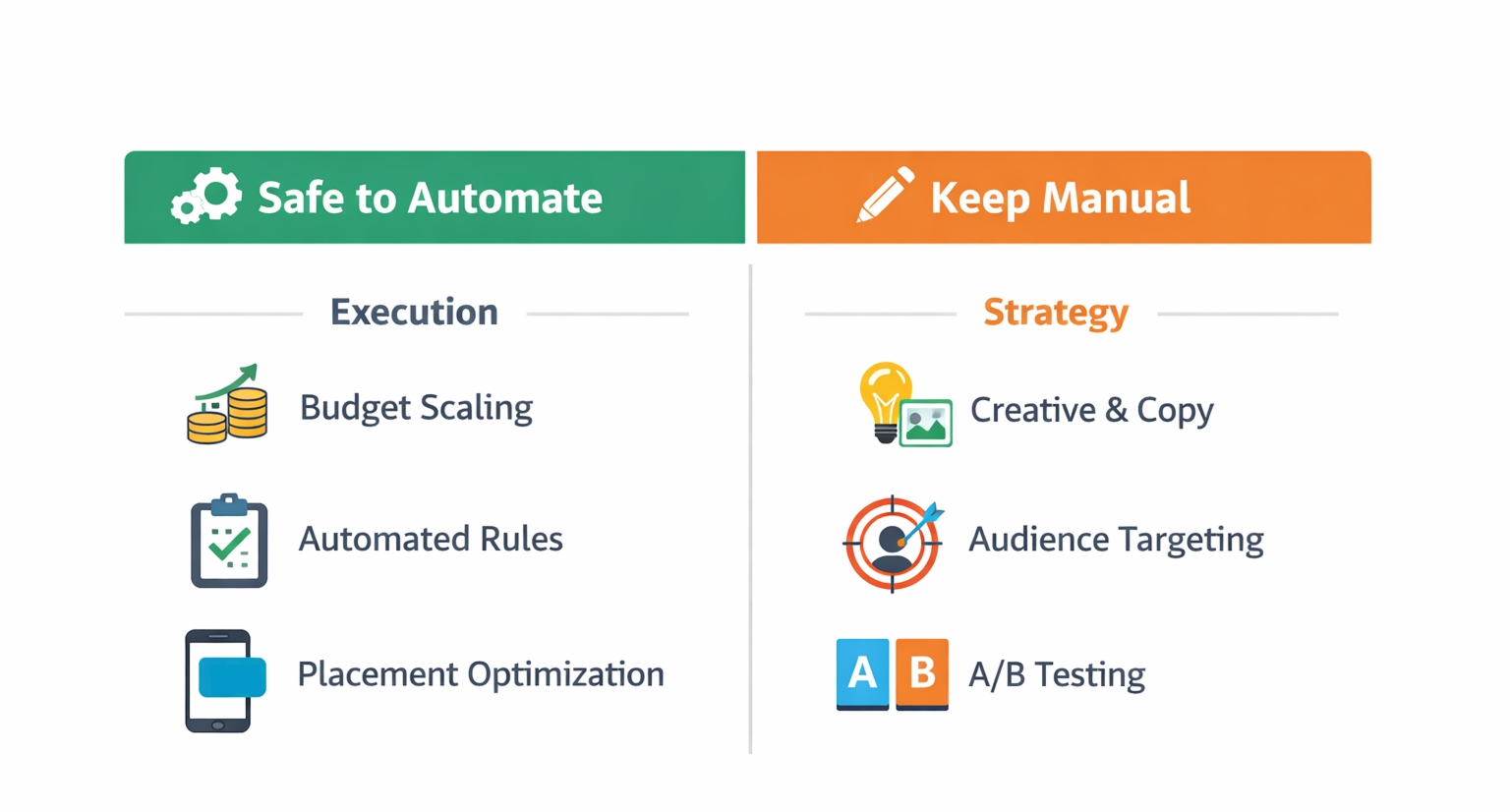
Automation breaks down during testing and strategy work. In those phases, the system focuses on speed and volume, not learning or intent. That’s when results become harder to explain and harder to improve.
The goal isn’t full automation. The goal is using automation only where it makes sense.
What to Automate in Facebook Ads
1. Budget Allocation (For Scaling, Not Testing)
Use Advantage Campaign Budget only after a campaign has proven itself.
This works best when:
-
Your ad sets have already been tested.
-
Performance is consistent across audiences.
-
You’re optimizing for a clear result, like purchases or leads.
Avoid using it during early tests. Meta often pushes spend toward early winners, which makes fair comparisons difficult.
If you want a deeper look at this process, see Scaling Facebook Campaigns with Advantage+ Budget Allocation.
2. Automated Rules for Cost Control
Automated rules are one of the safest ways to use automation. They help you control risk without watching campaigns all day.
Useful rules include:
-
Pausing ad sets when cost per result gets too high.
-
Increasing budgets slowly after several days of strong ROAS.
-
Sending alerts when CPM or CTR changes sharply.
Think of rules as guardrails, not optimization tools. Keep them simple and avoid stacking too many conditions.
For a step-by-step guide, read How to Use Automated Rules to Improve Facebook Campaign Efficiency.
3. Placement Optimization (With Regular Checks)
Use Advantage+ Placements when running broad or retargeting campaigns with proven creatives.
This lets Meta test placements like Feed, Stories, and Reels more efficiently than manual setups. Still, placement automation should never be ignored.
Review placement performance regularly:
-
Look for placements spending heavily without results.
-
Turn off placements that consistently underperform.
-
Adjust creative formats to match how each placement behaves.
Automation explores faster. You decide what stays live.
4. A/B Test Delivery
Meta’s A/B testing tools are helpful for splitting traffic evenly and avoiding overlap.
Use them to test:
-
Creative formats.
-
Copy angles.
-
Landing pages or offers.
Don’t let the platform decide what “won.” Always check sample size, test duration, and real outcomes like lead quality or sales.
What Not to Automate in Facebook Ads
1. Creative Strategy and Messaging
Creative decisions should stay manual. Dynamic Creative often combines elements that were never meant to work together.
Keep control over:
-
Matching messages to funnel stage.
-
Refreshing ads when frequency rises and engagement drops.
-
How your story unfolds across campaigns.
Automation can scale creatives. It can’t understand tone or context.
2. Audience Targeting for Niche or B2B Campaigns
Advantage+ Audiences can work for large B2C brands. They usually fall short for niche or B2B offers.
Manual targeting matters when:
-
You’re targeting specific roles or industries.
-
You rely on CRM or first-party data.
-
You’re running high-ticket or account-based campaigns.
Audience selection is a strategic choice, not an optimization shortcut.
3. Campaign Objectives and Funnel Setup
Meta often suggests objectives that don’t match your funnel.
Choose objectives manually:
-
Use Landing Page Views or Video Views at the top of the funnel.
-
Use Leads for gated content and signups.
-
Use Conversions only when you have enough event volume.
Campaign structure shapes how Meta optimizes delivery. Defaults often push ads in the wrong direction.
For a clearer framework, see Meta Campaigns Explained: How to Structure High-Performance Campaigns.
4. Fixing Learning Phase Problems
If a campaign is stuck in the learning phase, automation won’t fix it.
What helps instead:
-
Merging overlapping ad sets.
-
Reducing audience fragmentation.
-
Keeping budgets stable before scaling.
Automation assumes the setup is sound. If it isn’t, problems grow faster.
Use Automation When: A Simple Checklist
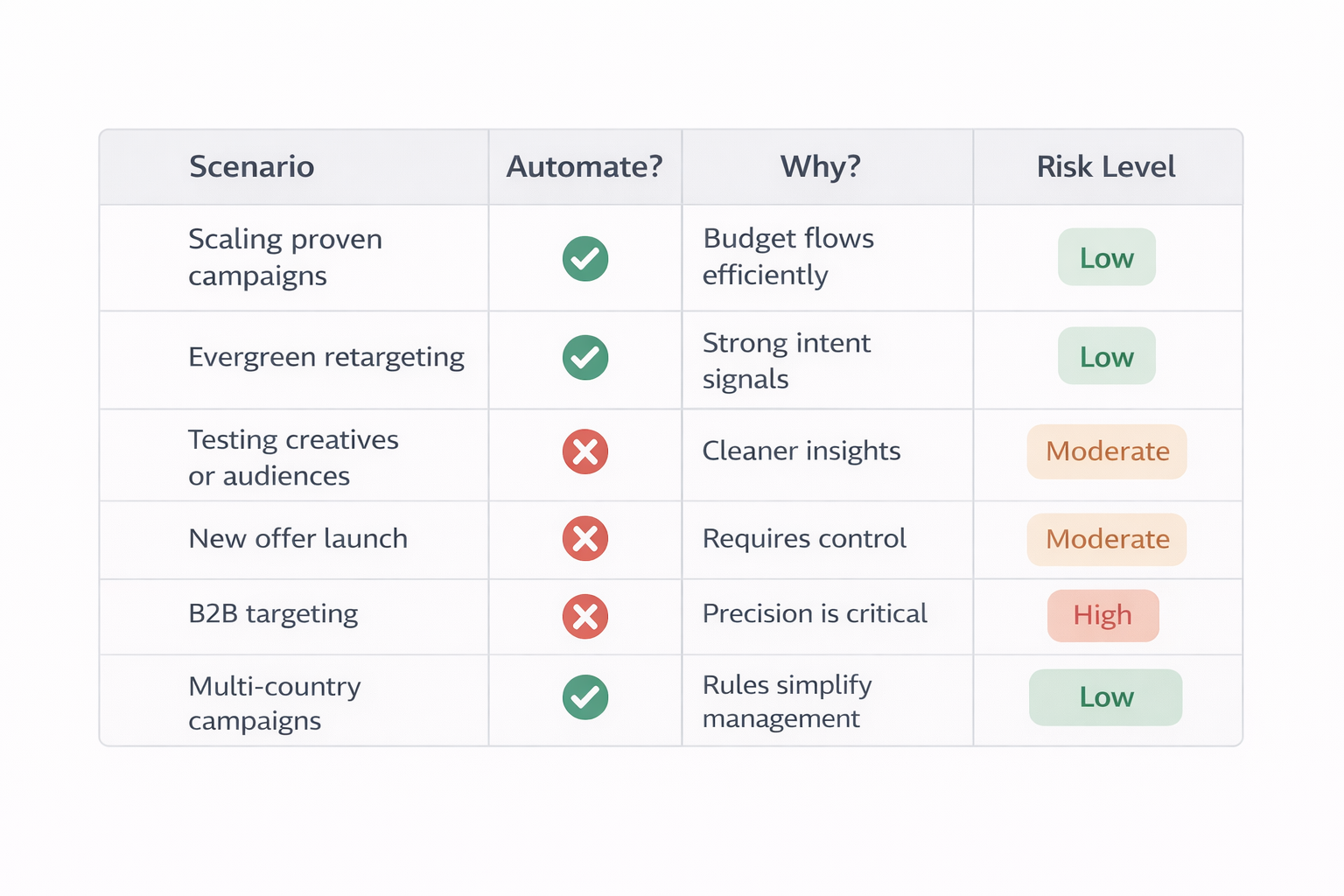
Use automation once your foundation is solid.
- Scaling proven campaigns
Results are stable and testing is complete. - Running evergreen retargeting
Audiences refresh naturally and intent is strong. - Managing multiple regions
Rules and budget automation reduce manual work. - Protecting performance
Clear limits exist for cost, ROAS, or engagement drops.
Here, automation improves efficiency without hiding insight.
Avoid Automation When: A Simple Checklist
Stay manual during strategy and discovery.
- Launching a new offer
You need clean data and even delivery. - Targeting niche or B2B audiences
Precision matters more than reach. - Testing creative angles or messaging
Automation blurs results and slows learning. - Working with tight margins
Automation may scale volume instead of profit. - Fixing unstable campaigns
Structure comes before automation.
Final Thoughts
Automation in Facebook Ads is a tool, not a strategy.
Use it to handle execution. Keep strategy and testing manual. Scale only after learning is complete.
Advertisers who automate with intent get clarity and control. Those who automate too early usually lose both.