Most advertisers optimize Meta campaigns for more leads or more purchases. That approach often ignores what actually matters, which is profit. Volume feels good inside Ads Manager. Profit shows up in the bank account.
Facebook Ads optimization for profit requires different decisions than optimization for volume. The algorithm follows the signal you feed it. If you optimize for cheap conversions, you will get cheap conversions, not necessarily profitable ones.
Profit vs Volume: What You Are Really Optimizing For
Volume optimization focuses on increasing the number of conversions at the lowest possible cost. The primary metric is cost per result. Budgets scale when cost per result stays within target.
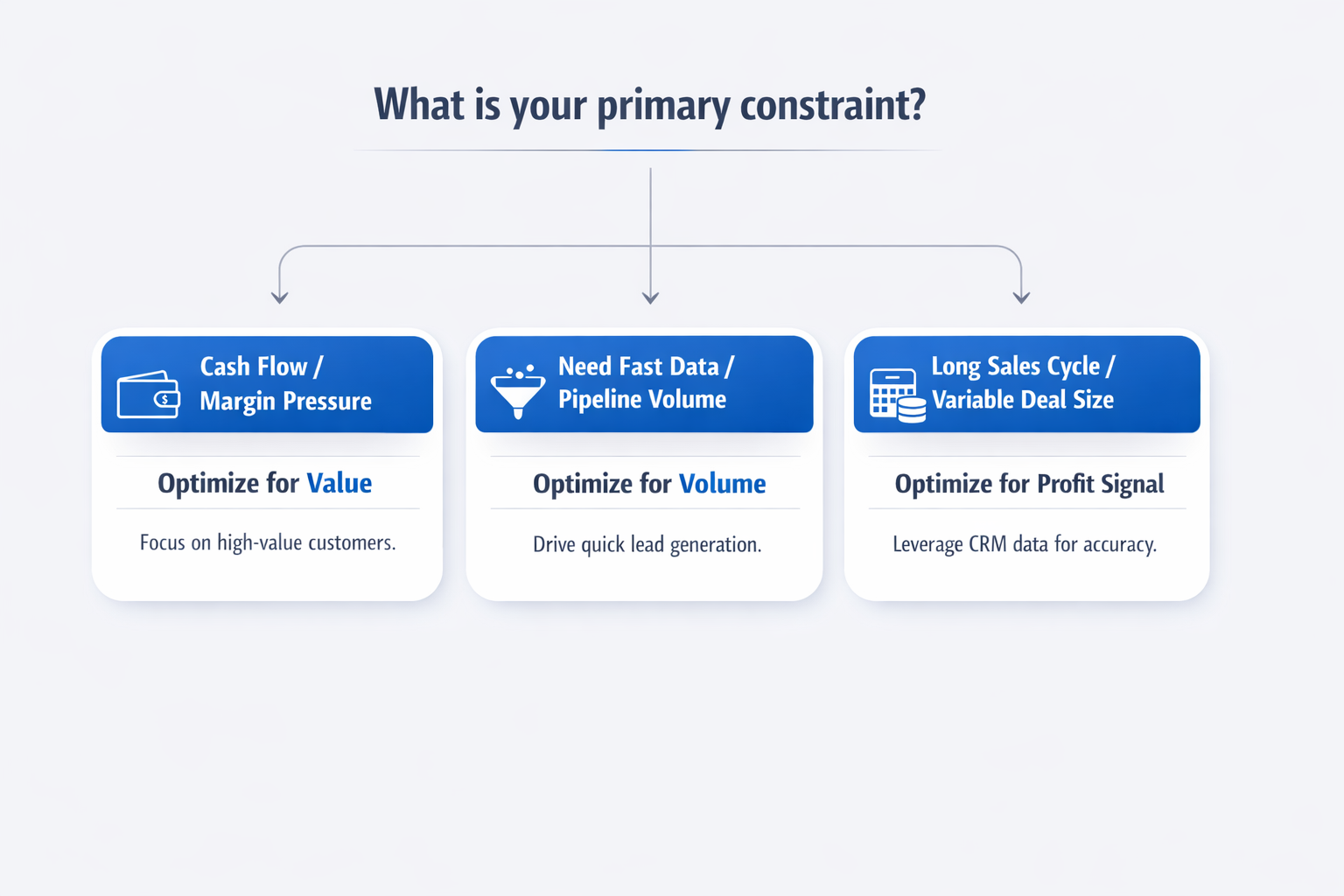
Profit optimization focuses on contribution margin after ad spend. The key metric is revenue minus ad cost and fulfillment cost. A campaign with higher cost per lead can still generate more net profit.
The tension appears when scale starts to reduce efficiency. Many accounts increase spend, celebrate growth, and then discover margins have collapsed.
For a deeper breakdown of how revenue metrics can mislead, review why high ROAS isn’t always profitable.
How Volume Optimization Behaves in Meta
When you optimize for volume, Meta looks for the largest pool of users likely to convert. The system prioritizes conversion probability, not customer value. It does not understand your margins unless you tell it.
Volume-focused setups usually include:
-
Broad targeting with lowest cost bidding; the algorithm hunts for inexpensive conversions, often from lower-intent users.
-
Optimization for leads or purchases without value rules; all conversions are treated equally.
-
Aggressive budget scaling once cost per result stabilizes; this often increases reach into weaker segments.
This structure works well for list building or top-of-funnel growth. It often breaks when downstream quality varies.
How Profit Optimization Behaves in Meta
Profit optimization narrows the signal toward higher-value outcomes. It uses data that reflects actual revenue or margin. The system then searches for users likely to produce higher economic value.
Profit-focused setups often include:
-
Conversion value optimization; campaigns optimize for purchase value instead of purchase count.
-
Offline conversion imports; CRM revenue data feeds back into Meta.
-
Custom conversion rules; low-value events are excluded from optimization.
This approach usually produces fewer conversions. The average order value or lifetime value increases.
Why Meta Defaults to Volume
Meta is built to maximize the selected event within the available audience. If the chosen event is leads, the algorithm will generate more leads. It will not filter for sales readiness unless you encode that signal.
Most advertisers choose volume because it is easier to measure. Cost per lead updates in real time. Profit requires backend integration and clean attribution.
There is also psychological bias. Teams prefer visible growth over controlled margins. Volume looks like progress on weekly reports.
When Volume Optimization Makes Sense
Volume optimization is useful in specific scenarios. The key is to define the purpose clearly.
It works best when:
-
You are launching a new offer and need rapid data; more conversions generate faster learning.
-
Your funnel has strong qualification later; low-quality leads are filtered by sales or automation.
-
Customer lifetime value is predictable; even lower-quality entries convert over time.
In these cases, higher lead volume feeds the pipeline. Profit emerges at scale if downstream conversion rates stay consistent.
When Profit Optimization Is Critical
Profit optimization becomes necessary when acquisition costs rise. It is also essential when fulfillment costs vary by customer type.
You should shift to profit focus when:
-
Lead quality differs significantly by source; cheap leads rarely close.
-
Average order value varies widely; some buyers generate three times more revenue.
-
Sales cycles are long; early lead metrics misrepresent real value.
In these conditions, volume misleads decision-making. You may scale unprofitable segments.
If you want to see how lead volume and lead quality diverge in practice, read lead quality vs lead volume in Facebook advertising.
The Role of Signal Quality
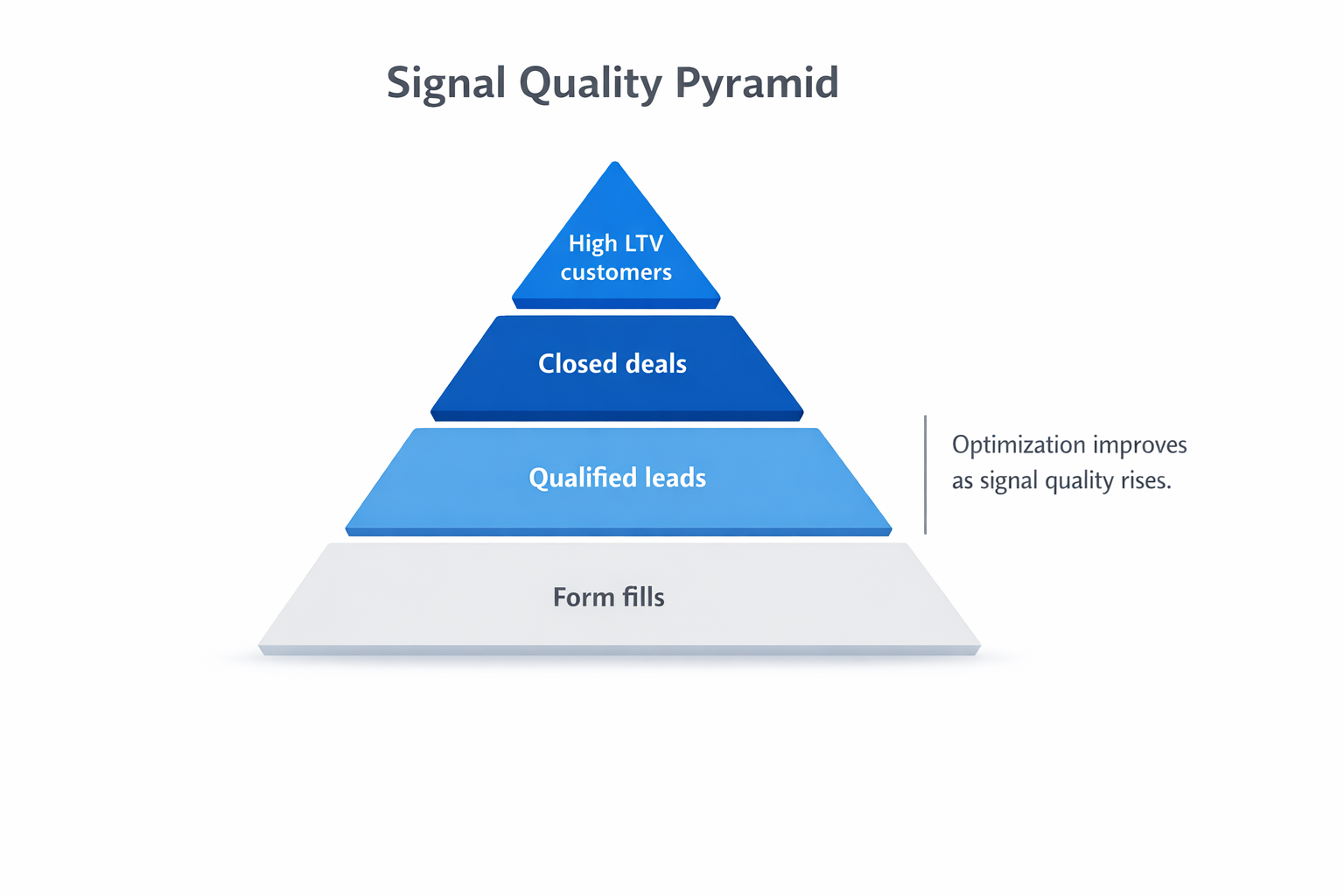
Meta’s algorithm depends on signal density and clarity. If your conversion event mixes high and low value customers, optimization skews toward frequency. The system will chase easier wins.
You improve profit outcomes by tightening the signal. That means sending cleaner data.
Consider these adjustments:
-
Use value-based lookalikes built from top 20 percent customers; this shifts prospecting toward higher spenders.
-
Apply minimum purchase value thresholds in custom conversions; small transactions no longer drive optimization.
-
Feed back closed-won revenue instead of initial form fills; the algorithm learns from real sales.
Each adjustment reduces noise. Cleaner signals increase economic efficiency.
Budget Scaling: Profit Compression vs Revenue Expansion
Scaling volume is simple. Increase budget by 20 percent and monitor cost per result. The problem appears after several increments.
As budgets grow, Meta expands into colder segments. Conversion probability drops. Cost per result rises or quality declines.
Profit compression often follows this pattern:
-
Initial scale increases revenue faster than cost.
-
Further scale increases cost faster than revenue.
-
Margins shrink while top-line numbers grow.
Profit-oriented scaling requires guardrails. Set maximum allowable cost per acquisition based on contribution margin, not comfort level.
If you are struggling with unstable scaling, review why most brands fail at scaling Facebook ads.
Using Contribution Margin as a Control Metric
Return on ad spend alone can mislead. A product with 80 percent margin can tolerate lower ROAS than one with 30 percent margin. Margin defines the real ceiling.
Calculate allowable CPA with this logic:
-
Average order value.
-
Gross margin percentage.
-
Desired profit per order.
The resulting CPA target should govern scaling decisions. If performance exceeds that threshold, reduce spend or refine targeting.
Creative Strategy Differences
Creative strategy shifts when optimizing for profit. Volume campaigns often rely on broad appeal messaging. Profit campaigns require sharper positioning.
Volume creatives usually:
-
Emphasize general benefits; they attract a wide range of prospects.
-
Use short-form hooks; they lower friction and increase clicks.
-
Avoid strong qualifiers; this keeps audience size large.
Profit-focused creatives:
-
Highlight price tiers or premium positioning; this filters low-budget buyers.
-
Include specific use cases; niche relevance increases order value.
-
Introduce mild friction; serious buyers remain while casual browsers exit.
Intentional friction improves economic performance. Fewer but stronger buyers convert.
Bidding and Optimization Settings
Meta provides several bidding options. Each affects profit differently.
Lowest cost bidding maximizes conversion count within budget. It suits volume objectives.
Cost cap bidding introduces efficiency control. It limits average cost but may reduce delivery.
Value optimization aligns best with profit goals. It prioritizes higher revenue events, not just more events.
You must align bidding with economic intent. Mismatched settings create distorted results. For a structured breakdown, see which Facebook ad metrics predict profitability best.
Blended Strategy: Segmenting for Control
The most stable accounts separate volume and profit objectives. They do not force one campaign to do both.
A practical structure includes:
-
Prospecting for volume; broad targeting optimized for conversion count.
-
Prospecting for value; narrower audiences optimized for purchase value.
-
Retargeting for margin; high-intent users receive premium positioning.
This segmentation isolates signals. Each campaign learns within a defined objective.
Measuring the Right Metrics
Campaign dashboards often hide profit insight. You need deeper analysis.
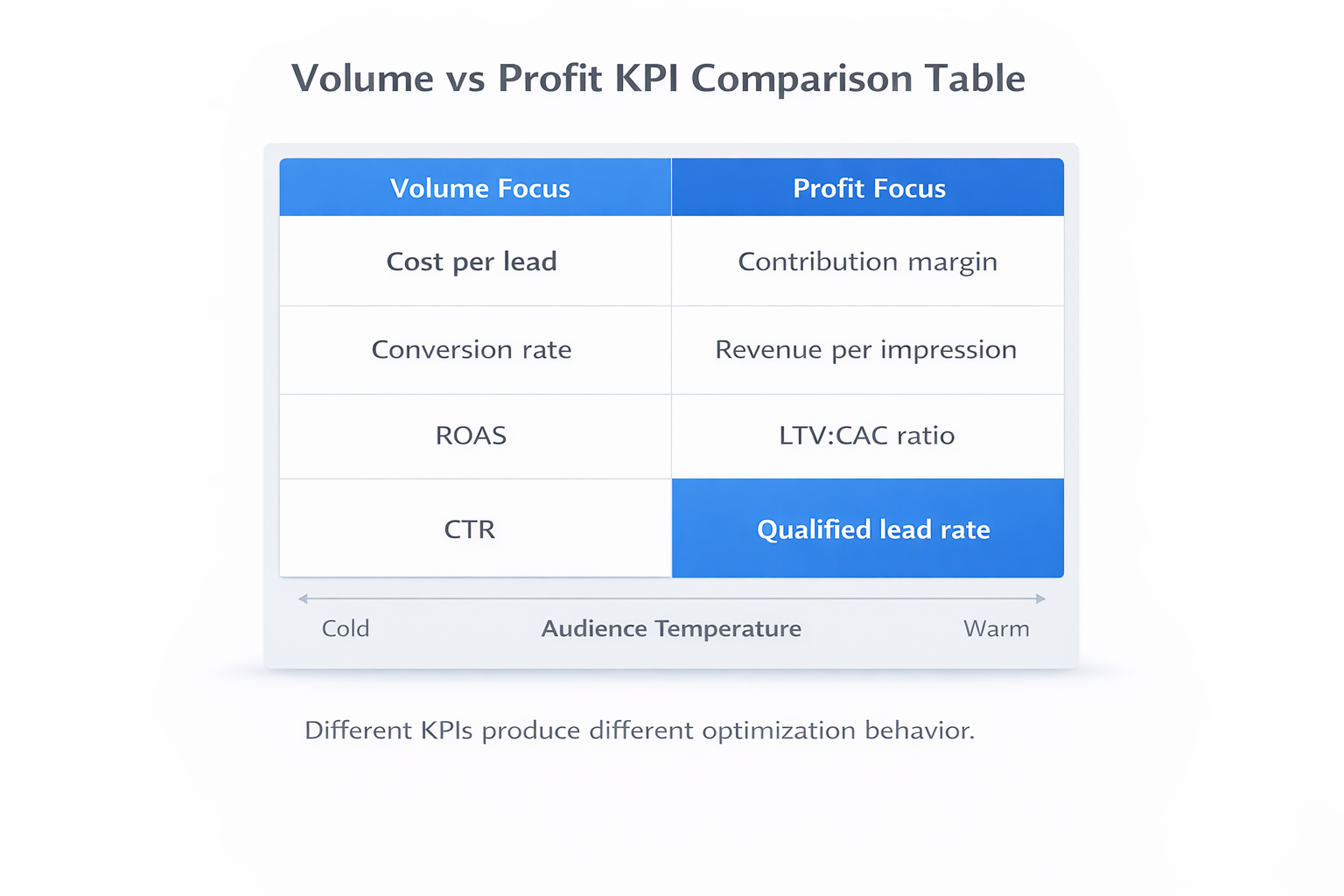
Track these metrics consistently:
-
Revenue per impression; this reveals economic efficiency at scale.
-
Contribution margin per purchase; it exposes unprofitable growth.
-
Customer lifetime value by campaign; long-term profit may differ from initial ROAS.
Weekly reporting should include margin analysis. Otherwise, volume dominates decision-making.
Choosing the Right Objective for Your Business Model
Subscription businesses often benefit from volume if churn is low. E-commerce brands with diverse product margins require value-based optimization. High-ticket services must prioritize lead quality over count.
There is no universal answer. The correct strategy depends on margin structure and sales process.
Final Perspective
Facebook Ads optimization is not about more conversions. It is about profitable conversions. Volume increases activity. Profit builds sustainability.
If your account grows but cash flow tightens, you are optimizing the wrong signal. Adjust the event, refine the data, and let the algorithm learn what actually matters.