If your LinkedIn outreach campaigns are underperforming, the issue is rarely the channel—it is the depth and reliability of the data behind it. This article explains how LinkedIn data enrichment improves segmentation, personalization, and conversion rates, and outlines a practical framework for implementing it effectively.
Why LinkedIn Data Alone Is Not Enough
LinkedIn is one of the most powerful B2B databases in the world, with more than 1 billion members globally and over 65 million decision-makers. However, raw profile data is often incomplete, outdated, or inconsistent.
Common data gaps include:
-
Missing direct work emails
-
Outdated job titles
-
Inaccurate company size data
-
No firmographic segmentation
-
No buying-intent signals
According to industry research, B2B databases decay at a rate of 2–3% per month. That means up to 30% of your records can become inaccurate within a year if not refreshed.
Targeting based on incomplete or stale data leads to:
-
Lower connection acceptance rates
-
Reduced reply rates
-
Higher bounce rates in multichannel campaigns
-
Wasted ad spend
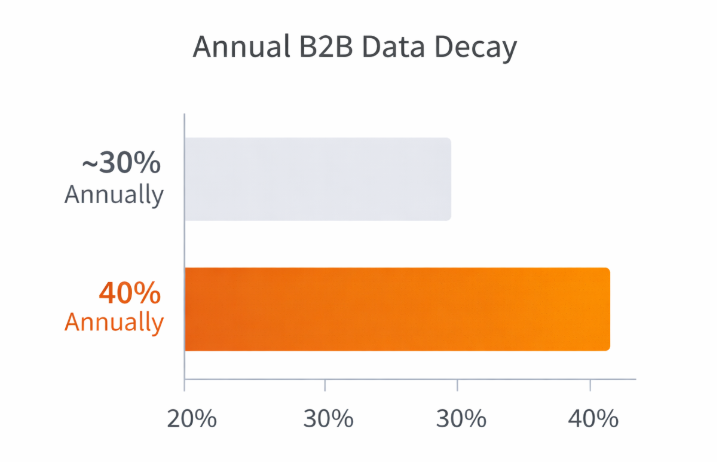
Annual B2B data decay illustrates how quickly contact information becomes outdated without continuous validation
To solve this, you need structured data enrichment.
What Is LinkedIn Data Enrichment?
LinkedIn data enrichment is the process of enhancing existing LinkedIn profile data with additional verified attributes, including:
-
Verified business emails
-
Company firmographics (revenue, employee count, growth rate)
-
Industry classification
-
Seniority normalization
-
Technology stack data
-
Geographic standardization
Enrichment transforms a basic profile list into a structured targeting asset that can power outbound sales, ABM campaigns, and paid advertising.
The Business Impact of Data Enrichment
Data-driven targeting has measurable results.
Organizations using enriched segmentation report:
-
Up to 50% higher email open rates
-
30–40% improvement in response rates
-
20% lower customer acquisition costs
-
15–25% increase in marketing ROI
More precise targeting reduces irrelevant outreach and increases message relevance, which directly improves engagement metrics.
Step-by-Step Framework to Enrich LinkedIn Data
1. Start with Structured Profile Extraction
Export LinkedIn search results based on clearly defined filters:
-
Industry
-
Company headcount
-
Geography
-
Seniority level
-
Job function
Avoid broad searches. Precision at this stage reduces noise later.
2. Standardize Job Titles and Seniority
LinkedIn titles vary widely. For example:
-
"Head of Growth"
-
"VP Growth"
-
"Growth Lead"
All may represent similar decision-making authority. Normalizing these titles into consistent seniority categories improves segmentation and messaging alignment.
3. Append Verified Business Emails
Email verification is critical for multichannel campaigns. Invalid emails can damage domain reputation and reduce deliverability.
High-quality enrichment includes:
-
SMTP verification
-
Domain validation
-
Catch-all detection
This ensures bounce rates stay below 5%, which protects sending infrastructure.
4. Add Firmographic Intelligence
Firmographic enrichment allows targeting based on:
-
Company revenue brackets
-
Employee count growth
-
Funding stage
-
Industry vertical
For example, messaging to a 50-person startup differs significantly from messaging to a 5,000-employee enterprise organization.
5. Layer Intent and Behavioral Signals
Advanced enrichment includes indicators such as:
-
Recent hiring activity
-
Technology adoption
-
Expansion signals
-
Market growth trends
These signals help prioritize accounts that are more likely to convert.
Segmentation Strategies Enabled by Enriched Data
Once enrichment is complete, you can build high-performance segments such as:
-
SaaS companies hiring SDRs in the past 90 days
-
E-commerce brands with 50–200 employees in North America
-
B2B companies with recent Series A funding
-
Enterprises using specific CRM platforms
Instead of generic outreach, campaigns become hypothesis-driven and data-backed.
Data Hygiene and Ongoing Maintenance
Enrichment is not a one-time process.
Best practices include:
-
Quarterly database refresh
-
Automatic email re-verification
-
Removing inactive LinkedIn profiles
-
Monitoring bounce and reply rates
Consistent data hygiene maintains campaign performance over time.
Measuring Success
After implementing enriched targeting, track:
-
Connection acceptance rate
-
Email deliverability rate
-
Reply rate
-
Meeting booking rate
-
Pipeline contribution
Compare performance before and after enrichment to quantify ROI.
If enrichment is done correctly, improvements should be visible within one to two campaign cycles.
Conclusion
LinkedIn remains one of the most valuable B2B prospecting ecosystems, but raw profile data is not enough for competitive targeting.
Data enrichment bridges the gap between visibility and precision. By appending verified emails, firmographics, and intent signals, organizations can significantly improve targeting accuracy, personalization depth, and overall campaign performance.
In a landscape where inbox competition is increasing and attention spans are shrinking, enriched data is no longer optional—it is a core growth asset.