Audience Expansion in Meta Ads does more than increase reach. It changes how your campaign behaves inside the auction. Many advertisers enable it to scale faster, assuming it simply widens the audience while preserving their targeting logic.
That is not what actually happens.
When you turn on expansion, control shifts from your selected audience to the system’s probability model. If your campaign structure or optimization signal is weak, expansion will amplify that weakness. That is why some accounts scale efficiently with it, while others become unstable.
How Audience Expansion Actually Works
When Audience Expansion is enabled, your targeting becomes flexible. The system can go beyond your selected interests or lookalikes if it predicts better results elsewhere.
The model evaluates users based on two factors: the likelihood of completing your chosen optimization event and the cost of reaching them. If someone outside your selected audience appears just as likely to convert but costs less to reach, the system will prioritize them.
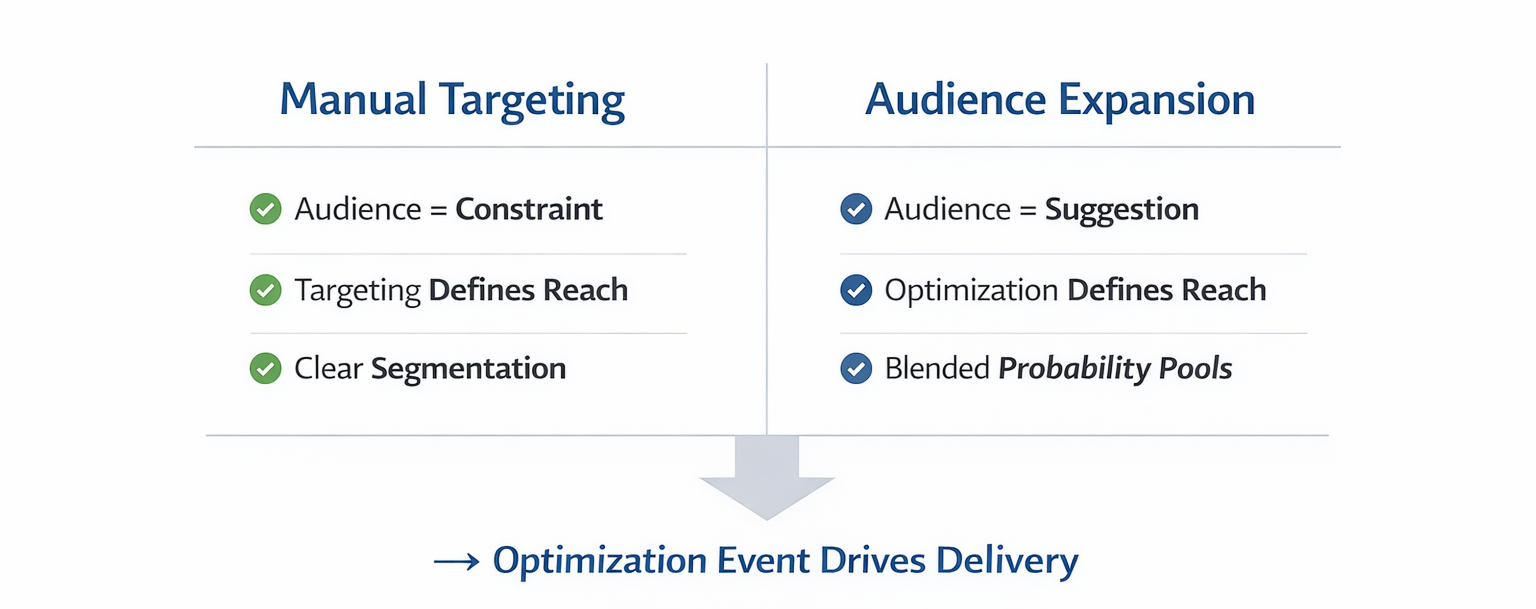
At that point, your campaign is no longer strictly defined by your targeting inputs. It is defined by predicted probability and auction efficiency.
For a deeper breakdown of delivery logic, see How Facebook’s Algorithm Decides Who Sees Your Ads.
Problem 1: Audience Overlap and Internal Competition
Many advertisers separate audiences into multiple ad sets. One targets interests, another targets lookalikes, another runs broad.
The assumption is that each ad set reaches a distinct group.
When expansion is active, that separation weakens. Ad sets begin reaching similar users, even if their original targeting was different. This creates internal competition and weakens learning.
You will usually see:
-
Overlap between ad sets.
Two ad sets can end up bidding for the same users. Instead of scaling cleanly, they compete in the auction and push up costs. -
Lower signal density per ad set.
Conversions get split across multiple learning containers. Instead of one ad set receiving enough volume to stabilize, several receive partial signals, which slows optimization. -
Higher volatility in CPA.
With fragmented learning and internal competition, performance becomes less predictable week to week.
This dynamic is closely related to ad set cannibalization. For more detail, see Ad Set Cannibalization: When Your Facebook Campaigns Compete Against Each Other.
How to fix it
Expansion performs best inside simple structures. Before enabling it, reduce fragmentation.
-
Merge overlapping ad sets to concentrate signals.
-
Separate by objective, not minor targeting differences.
-
Let creative handle segmentation instead of multiplying audiences.
Consolidation increases stability. Stability makes expansion safer.
Problem 2: Loss of Diagnostic Clarity
When expansion blends your defined audience with additional users, it becomes harder to interpret results.
If performance improves, was it your targeting logic? Or expanded delivery? If performance declines, is your core audience fatigued, or is lower-quality traffic entering through expansion?
This uncertainty leads to reactive decision-making.
Advertisers often:
-
Change creative too quickly.
-
Shift budgets repeatedly.
-
Scale based on short-term spikes.
If you are unsure where the issue lies, use a structured review process like How to Conduct a 15-Minute Facebook Ads Audit for Faster Fixes.
How to fix it
Test expansion under controlled conditions.
Duplicate the campaign, keep budget and creative identical, disable expansion in one version, and compare performance over time. Focus on stability and downstream metrics, not just short-term CPA.
If expansion does not deliver incremental, high-quality volume, it is not improving the structure.
Problem 3: Optimizing for the Wrong Signal
Audience Expansion aggressively optimizes for the event you choose. The system does not understand revenue unless revenue is part of the feedback loop.
If you optimize for leads, it finds people likely to submit forms. That does not guarantee purchase intent.
When expansion is active, this effect becomes stronger. The system searches more broadly for easy conversions.
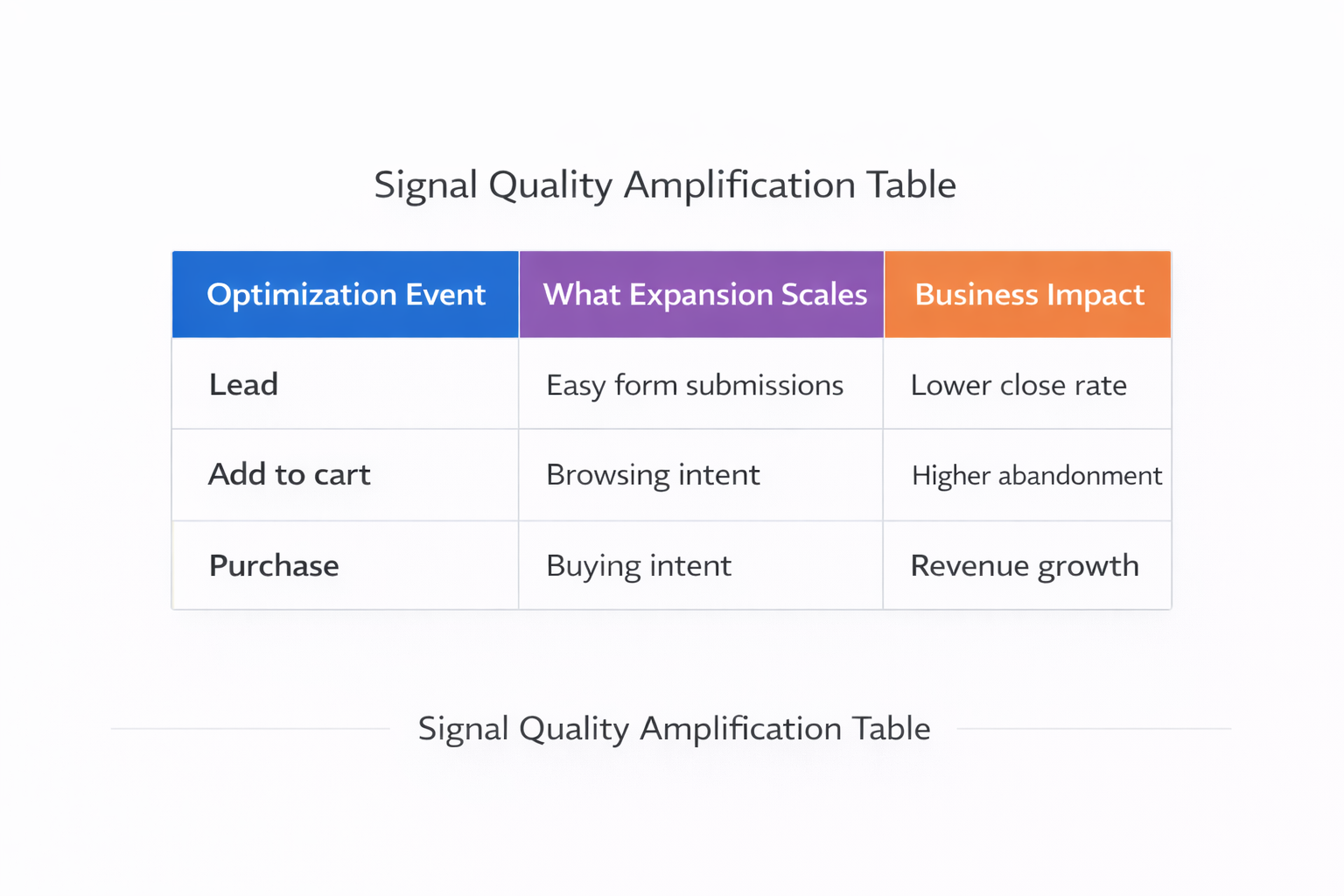
You may observe:
-
Lower cost per lead.
Expansion can surface users who convert cheaply but are less qualified. This improves platform metrics without improving sales results. -
Higher lead volume.
More conversions look like growth, but if qualification drops, your sales efficiency declines. -
Stable ad account metrics with weaker business results.
CPL looks good, but close rates or revenue per lead decline.
This usually signals objective misalignment. For a deeper explanation, see The Best Campaign Objectives for Each Stage of the Buyer Journey.
How to fix it
Strengthen your signal before expanding reach.
-
Optimize for deeper events when possible.
-
Import offline sales data.
-
Improve qualification inside your forms.
Expansion multiplies the signal you provide. If that signal is shallow, scale will amplify shallow outcomes.
Problem 4: Budget Drift Toward Lower-Intent Users
The auction rewards cost efficiency. When two users look similar in predicted conversion probability, the cheaper impression usually wins.
Over time, expansion can shift spend toward lower-cost but lower-intent inventory. This often happens gradually.
Common warning signs include:
-
Revenue per lead declining.
-
Close rates weakening.
-
Sales feedback becoming less positive.
Because CPA may remain stable, this drift can go unnoticed.
How to fix it
Evaluate beyond surface metrics.
Track revenue per lead, compare close rates by campaign, and limit placements that consistently produce poor-quality outcomes. The goal is not to restrict expansion blindly, but to ensure it supports profitable growth.
When Audience Expansion Works Well
Expansion performs best when the foundation is strong.
It works well when:
-
You generate consistent weekly conversion volume.
-
Your optimization event reflects real revenue.
-
Your structure is simple and consolidated.
-
Your creative filters intent clearly.
In these conditions, expansion helps find adjacent demand. In unstable structures, it amplifies instability.
The Structural Shift Most Advertisers Miss
Audience Expansion is not just a targeting feature. It is an optimization override.
Once enabled, your campaign is defined less by who you selected and more by how well your event predicts profitable behavior.
Instead of asking whether you should expand your audience, ask whether your structure and signal are strong enough to support expansion.
If they are not, fix those first. Then let the system scale what is already working.