Low-intent traffic is one of the most common problems in paid social. You see clicks, sessions, even leads — but revenue stays flat. Costs increase, sales teams question lead quality, and scaling becomes unpredictable.
If you’re running campaigns on Meta platforms such as Facebook Ads or Instagram Ads, one principle matters most: the system optimizes for the event you choose. If that event does not represent real buying intent, the algorithm will still deliver results — just not the ones that grow your business.
Let’s break down why low-intent traffic happens and how to correct it structurally.
What Low-Intent Traffic Actually Means
Low intent is not about demographics. It is about probability.
You typically notice low-intent traffic when:
-
Click-through rate is strong, but conversion rate is weak.
Users are curious enough to click, but not motivated enough to move forward. -
Lead volume is high, but qualification rate is low.
Many people complete the form, yet only a small percentage fit your ideal customer profile. -
Website traffic grows, but revenue does not increase.
Sessions rise without meaningful downstream action. -
Leads stall early in the CRM pipeline.
If most prospects never move past the first stage, the issue is intent quality rather than follow-up timing.
These patterns indicate that your optimization signal does not closely match real purchase behavior.
Why the Algorithm Delivers Low-Intent Users
Meta’s system learns from behavior. It identifies users who complete your selected event and then finds more people who behave similarly.
If the selected event reflects curiosity instead of commitment, the system becomes efficient at finding curious users. Over time, traffic looks active but converts poorly.
Three structural causes explain most intent problems.
1. You Are Optimizing for a Weak Event
This is the most frequent issue.
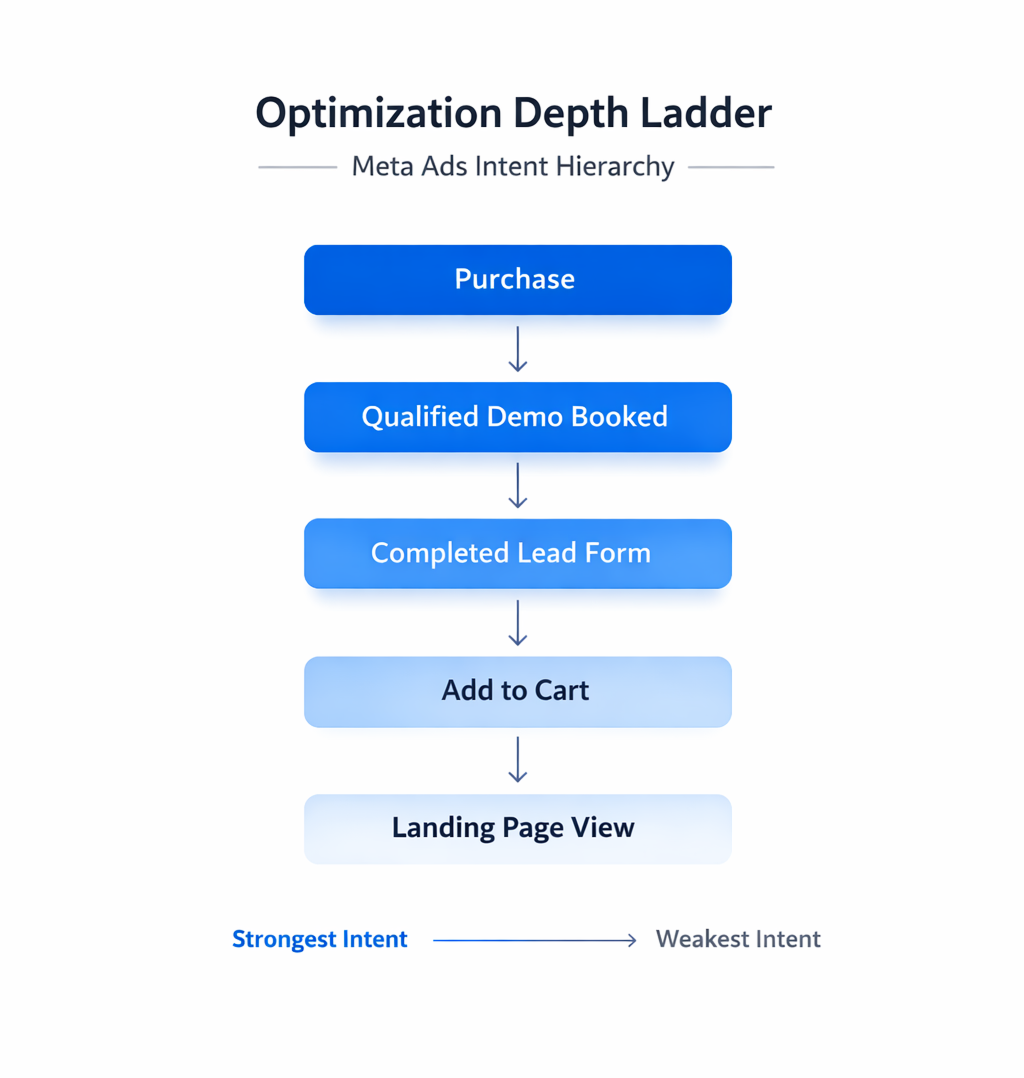
For example:
-
Optimizing for generic lead form submissions.
Short instant forms with minimal fields create volume, but not necessarily quality. -
Optimizing for “Add to Cart” instead of purchase.
Adding to cart shows interest, but many cart users never complete checkout. -
Optimizing for page views in long sales cycles.
A page visit does not indicate buying readiness.
The algorithm does not understand your margins or sales cycle. It understands only the event you define.
What to do instead
Move your optimization closer to economic value.
-
Optimize for purchases whenever volume allows.
Purchase events give the strongest intent signal because they directly reflect revenue. -
Use deeper lead events instead of generic submissions.
Demo bookings or qualified applications are stronger signals than simple form fills. If you run lead campaigns, review How to Create High-Intent Custom Audiences for Facebook Lead Ads to structure higher-quality intent pools. -
Build custom audiences from meaningful behavioral actions.
For example, segment users who visited pricing pages, returned multiple times, or completed detailed forms. A full structural breakdown is covered in The Complete Guide to Warm, Cold, and Custom Audiences in Meta Ads.
The closer your optimization event is to real revenue, the more stable your traffic quality becomes.
2. Your Conversion Data Is Noisy
Even strong events lose effectiveness if the signal is unclear.
This typically happens when:
-
Test or internal submissions are counted as conversions.
These distort learning because they do not represent actual customers. -
All leads are treated equally in reporting.
If qualified and unqualified leads are grouped together, the system cannot distinguish value. -
Offline revenue is not sent back to the ad account.
Without post-lead revenue data, Meta cannot refine toward higher-value user profiles. -
Audience sources are poorly segmented.
Uploading large CRM exports without separating high-value customers from low-quality contacts weakens seed quality.
If you rely on CRM or email data, it is important to structure it correctly. See How to Turn CRM and Email Lists into High-Quality Facebook Audiences for a practical breakdown of how to improve audience quality from first-party data.
Cleaner signals allow the algorithm to learn from real buyers instead of from noise.
3. Your Campaign Structure Is Too Fragmented
Intent declines when conversion data is spread too thin.
Common structural issues include:
-
Too many ad sets with low weekly conversions.
If each ad set gathers only a few conversions, the algorithm cannot identify stable patterns. -
Heavy audience overlap.
When multiple ad sets compete for similar users, signal clarity weakens. -
Micro-segmentation without meaningful strategic differences.
Splitting audiences based on small interest variations often reduces data density without improving performance control.
When signal per ad set is weak, the system broadens delivery to maintain volume. That broadening often appears as declining intent.
How to fix it
Simplify and consolidate your structure.
-
Combine similar audiences to increase conversion volume per learning unit.
-
Remove unnecessary splits that do not correspond to different messaging or offers.
-
Ensure each ad set receives stable weekly event volume.
If your account lacks a clear audience architecture, revisit Why Custom Audiences Should Be the Core of Your Ad Strategy to understand how strong audience foundations improve performance stability.
Higher event density per ad set usually improves intent alignment without aggressively narrowing targeting.
Creative Can Attract the Wrong Users
Creative influences who engages with your ads.
If your messaging focuses on:
-
Broad curiosity hooks.
These attract attention from users outside your ideal customer profile. -
Heavy discounts without qualification.
Price-sensitive users often convert poorly long term. -
Very low-commitment offers.
The easier the action, the wider the behavioral pool.
The algorithm scales engagement patterns. If low-fit users engage most, delivery shifts toward them.
A more controlled approach is to use creative as a filter:
-
Mention pricing ranges where appropriate.
-
Specify company size or use case.
-
Clearly state who the solution is designed for.
You may reduce total clicks, but the quality of those clicks improves.
Broad Targeting Is Not the Core Problem
Broad targeting often gets blamed for low-intent traffic. In reality, broad targeting performs well when signals are strong.
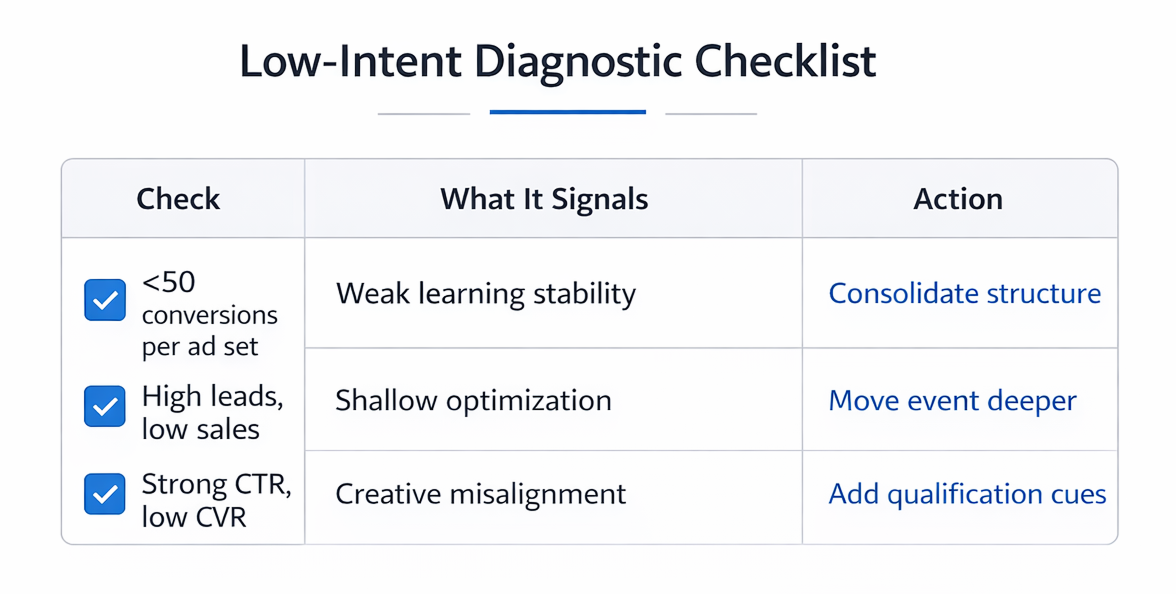
Broad campaigns work best when:
-
Optimization events closely reflect revenue.
-
Conversion data is clean and consistent.
-
Each ad set gathers sufficient weekly events.
-
Creative clearly qualifies users.
If those foundations are weak, broad targeting will expose the weakness. Fix signal design and structure first. Then evaluate targeting scope.
The Core Shift in Perspective
Low-intent traffic is rarely just a targeting problem. It is usually a signal design problem.
Meta predicts who is most likely to complete the event you define. If that event does not represent real buying behavior, performance metrics can look healthy while revenue suffers.
Before narrowing audiences, evaluate what the system is actually optimizing for. When optimization aligns with real business value, intent becomes more stable — and scaling becomes significantly more predictable.