You try to boost a post, and the option isn’t there.
Most advertisers assume it’s a bug. It’s not.
Meta restricts certain post types from being boosted because they don’t translate well into the ad delivery system. These limitations aren’t random. They exist because some post formats break optimization, tracking, or user experience.
If you rely on boosting as a quick scaling tactic, these restrictions expose a bigger issue: not all organic posts are designed to become ads.
Why Some Facebook Posts Can’t Be Boosted
Boosting is essentially a simplified version of running ads. But Meta still needs structured inputs to optimize delivery.
When a post doesn’t meet those structural requirements, the system blocks boosting.
This usually happens when:
- The post lacks a clear destination or conversion path, making optimization impossible.
- The format doesn’t translate into ad placements, such as Stories or Audience Network.
- The content includes elements Meta cannot legally or technically promote, like copyrighted audio.
In Ads Manager terms, these posts cannot generate consistent delivery signals. That means Meta cannot predict outcomes or allocate budget efficiently.
Profile Pictures and Drafts: No Delivery Signals
Profile pictures and draft posts are not eligible for boosting.
Here’s why:
- Profile pictures are treated as Page identity assets, not content units designed for distribution.
- Draft posts are not published, meaning they have no engagement data or visibility.
If you need to promote this content:
- Re-upload the image as a standard post, adding context and caption.
- Publish the post first, ensuring it is visible and eligible for engagement.
Without these steps, Meta has nothing to optimize against.
Albums and Multi-Asset Posts: Too Complex for Boosting
Albums and posts with too many media elements are also restricted.
This includes:
- Static photo albums, which exist outside the standard feed format.
- Posts with multiple images and videos combined, which break format consistency.
- Mixed media layouts that don’t adapt cleanly across placements.
From a delivery perspective, these formats introduce inconsistency.
For example:
- Feed may show one image, while Stories cannot display the same structure.
- Engagement signals become fragmented across assets.
- Meta cannot determine which element drives performance.
Instead of boosting these posts:
- Use a single image or video post, focusing on one clear message.
- Convert multiple assets into a carousel format, allowing structured comparison.
- Use collection ads for product-heavy content, especially in e-commerce.
If you want to scale, you need predictable creative behavior across placements.
App Install Posts: Misaligned With Boosting Logic
Posts with app install buttons cannot be boosted.
This restriction exists because app campaigns require deeper integration with tracking, attribution, and optimization events.
Boosting bypasses these systems.
If you attempt to promote app installs through boosted posts, you lose:
- Proper event tracking.
- Store-level conversion optimization.
- Install quality signals.
Instead, use app promotion campaigns, where Meta can optimize for installs and in-app actions.
Live Videos and Reels: Format and Compliance Limits
Not all video formats are eligible for boosting.
This includes:
- Live videos from unverified Pages, where authenticity cannot be confirmed.
- Scheduled live videos, which are not yet active content.
- Reels with copyrighted music, interactive effects, or third-party elements.
- Remixed or shared reels, where ownership is unclear.
These restrictions are partly technical and partly legal.
For example:
- Copyrighted music limits ad distribution rights.
- Interactive features don’t translate into static ad placements.
- Shared content creates ownership and attribution issues.
If boosting fails, use alternative formats:
- Upload a clean video version without restricted elements.
- Recreate the content using original assets.
- Focus on standard video ads with clear messaging and CTA.
Shared Posts: No Ownership, No Scaling
Shared posts cannot be boosted.
This is one of the most common issues advertisers face.
Meta requires content ownership or direct control to promote it. When you share a post:
- You don’t control the original asset.
- You can’t modify the creative or CTA.
- Meta cannot optimize delivery properly.
To fix this:
- Create a new post using original content instead of sharing.
- Link directly to the original source if needed.
- Use branded content tools when working with partners.
This ensures the ad has a clear origin and optimization path.
What Happens When You Rely on Boosting Instead of Ad Formats
Boosting is convenient, but it limits control.
When you rely on boosting:
- You lose access to structured testing.
- You reduce control over placements and optimization.
- You rely on organic post structure instead of ad design.
This often leads to:
- Inconsistent performance across campaigns.
- Higher CPA due to weak targeting and creative structure.
- Limited scalability beyond small budgets.
If your goal is growth, boosting should not be your primary strategy.
Instead, you need to choose the right Facebook ad formats based on your objective and funnel stage.
How to Turn “Unboostable” Posts Into Scalable Ads
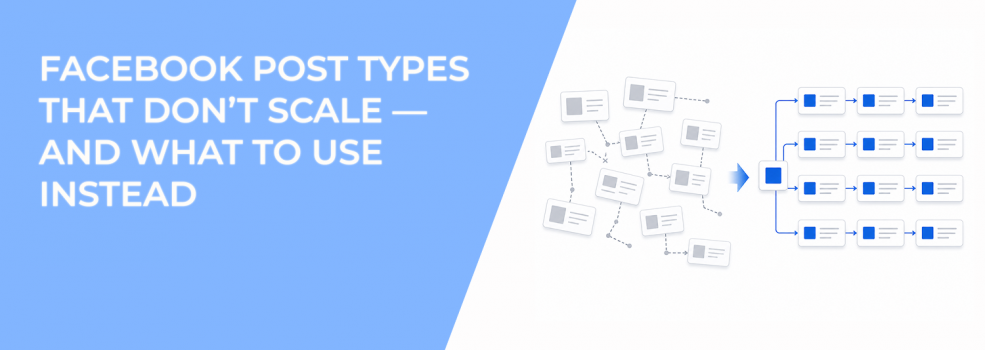
When a post can’t be boosted, don’t abandon it. Rebuild it.
A simple framework:
- Extract the strongest visual or message from the original post.
- Recreate it as a single-format ad, such as image, video, or carousel.
- Add a clear CTA that matches the intended outcome.
- Align the landing page or destination with the ad promise.
This transforms a blocked post into a structured ad unit.
You can then test different ad formats for better performance instead of relying on one version.
Final Takeaway
If a Facebook post can’t be boosted, it’s usually because it wasn’t designed to scale.
Boosting limitations highlight a bigger principle:
Not all content is ad-ready.
Instead of forcing boosts, rebuild your content into structured ad formats. Focus on clarity, ownership, and consistency across placements.
When your content is designed for delivery, scaling becomes predictable.