Launching campaigns without a structured framework often leads to wasted budget, unclear results, and slow time-to-learning. Fast-launch frameworks shorten the path from hypothesis to data-backed decisions, helping you hit performance benchmarks with minimal spend.
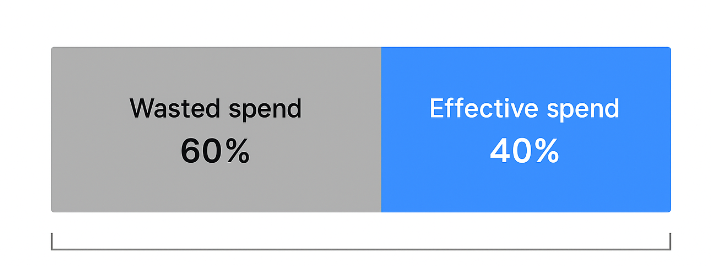
Up to 60% of digital marketing spend is never converted into results
Recent industry data shows that nearly 76% of marketers report overspending during the first two weeks of a new campaign, mostly due to lack of testing structure. Another study found that campaigns with a clearly defined launch framework achieve 34% faster optimization cycles.
Framework 1: The 72-Hour Validation Sprint
When you need to learn fast, the first three days are your most efficient window for low-cost insights.
How it works:
-
Build 2–3 core audiences
-
Launch 3–5 creative variations
-
Cap spend tightly for the first 72 hours
-
Cut the bottom 50% performers based on early indicators
Why it works:
Early engagement signals—CTR, thumb-stop rate, and cost-per-landing-page-view—tend to stabilize within the first 48–72 hours. Marketers who run structured short sprints reduce budget waste by up to 28% in the first week.
Framework 2: The Minimum Viable Funnel (MVF)
Instead of launching an entire funnel at once, MVF focuses on testing only the essential steps needed to confirm demand.
MVF includes:
-
One top-of-funnel creative cluster
-
One mid-funnel retargeting message
-
One conversion-focused landing page
Why it works:
Teams using MVF frameworks often cut launch time by 40% and increase early-stage ROAS, because they avoid the complexity of unnecessary funnel layers.
Framework 3: The Budget-Proportional Scaling Method
Scaling too early or too aggressively is a major cause of wasted spend. This method prevents burn by increasing budget only in proportion to performance stability.
Scaling rules:
-
Increase spend only if your cost-per-result stays within a ±10% range for 3 consecutive days
-
Scale by 15–25% increments, not 50–100%
-
Re-evaluate creative fatigue every 5–7 days
Industry insight:
Advertisers who scale proportionally instead of exponentially see 19% lower volatility in cost-per-action during the first month.
Framework 4: The Three-Layer Creative Matrix
Creative inconsistency at launch is one of the biggest reasons campaigns underperform. The matrix covers all three psychological layers of an effective launch:
-
Rational: product details, benefits, pricing clarity
-
Emotional: storytelling, lifestyle framing, aspirational triggers
-
Proof-based: testimonials, stats, credibility indicators
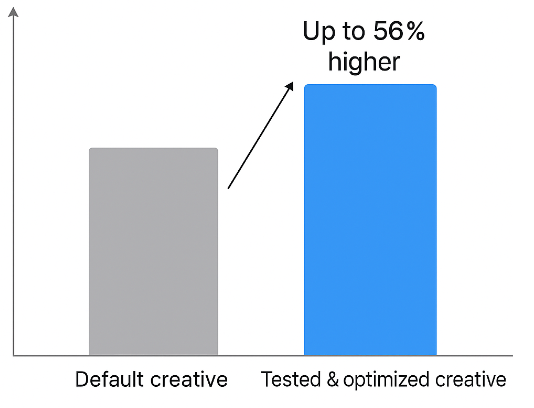
Optimized creative testing can improve campaign performance by up to 46–56% compared to default setups
Running all three layers simultaneously increases the chance that one message resonates early. Studies show that multi-layer creative matrices improve first-week engagement by up to 42%.
Framework 5: The Early-Exit Loss Prevention Rule
Most budget waste happens when underperforming ads run for too long. A strict early-exit rule prevents that.
Early-exit criteria:
-
CPA is 2× your target after 48 hours
-
CTR is below 0.5% for two days
-
CPM is abnormally high with no clear audience fit
Marketers who enforce early-exit rules save 12–18% of launch budget on average.
Bringing It All Together
Fast-launch frameworks allow campaigns to enter the market quickly, gather directional insights, and scale efficiently—without the financial burn typical of unstructured testing. By applying sprints, minimum viable funnels, proportional scaling, creative matrices, and early-exit rules, teams protect their spend while accelerating learning.
Suggested Articles to Read Next
-
How to Use Social Proof in Ad Creatives
-
Landing Page Speed: Cut Load, Boost CR
-
5 Ways to Make People Click Your Ad Thanks to Psychology