Instagram ads can generate plenty of clicks and still fail commercially.
The creative gets attention. The CPC looks acceptable. The campaign appears active. But after users tap the ad, they do not continue. They leave the landing page, ignore the form, fail to start a conversation, or browse the Instagram profile without taking the action the campaign was built to produce.
That is often a destination mismatch problem.
Meta’s own Instagram advertising preparation guidance starts with setting a goal and deciding who you want to reach before launching ads. That matters because the ad destination should not be treated as a default setting. It should be chosen based on the user’s intent after the click.
The Problem
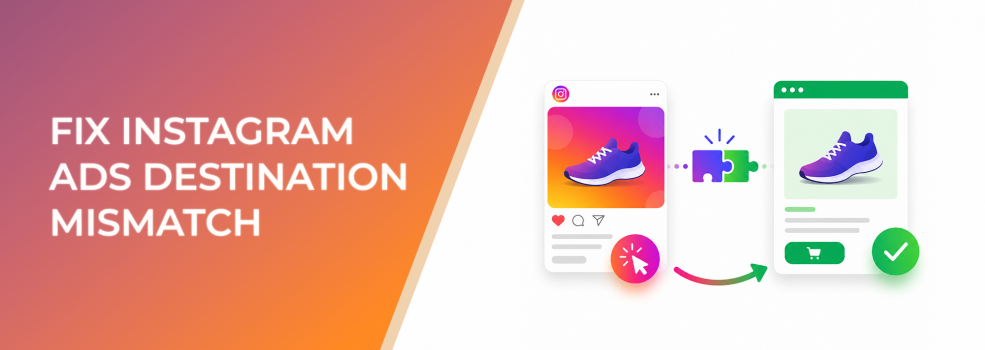
Destination mismatch happens when the ad, CTA, audience, and post-click experience do not point to the same user action.
A user taps because they want to learn more, but the ad sends them straight to a checkout page.
A user is ready to ask a question, but the ad sends them to a generic homepage.
A user wants proof that the brand is credible, but the ad sends them away from Instagram before they can evaluate the profile.
The campaign may still produce clicks, but those clicks do not convert into useful movement.
For performance marketers, the issue is not simply “bad traffic.” The issue is that the campaign is asking the wrong next step from the wrong user at the wrong moment.
Why This Problem Hurts Performance
Instagram ad destination mismatch hurts performance because it creates a gap between attention and action.
When users land somewhere that does not match their intent, several performance problems follow:
CPC may look fine while CPA rises.
CTR may improve while conversion rate falls.
Lead volume may increase while lead quality declines.
ROAS may weaken even when the campaign is getting engagement.
CAC may rise because the campaign keeps paying for users who are not moving deeper into the funnel.
This is especially risky when a campaign is judged too early by surface-level engagement. A cheap click is not valuable if it sends a low-intent user into a destination that they are not ready for.
The wrong destination can also distort optimization. If Meta sees lots of clicks but weak post-click behavior, the campaign may keep finding people who are likely to tap but unlikely to convert.
Common Scenarios Where This Happens
Destination mismatch is common in ecommerce campaigns that send every Instagram click to a product page, even when cold users still need reviews, comparisons, or product education.
It happens in B2B lead-generation campaigns when a broad awareness ad sends users directly to a demo request form before they understand the problem or offer.
It happens in local service campaigns when users want to ask a quick availability or pricing question, but the ad sends them to a slow website with no direct conversation path.
It happens in agency campaigns when every audience segment receives the same landing page, even though founders, marketers, operators, and procurement buyers all need different levels of detail.
It also happens with affiliate campaigns when curiosity-based creatives send traffic to a direct-response page that assumes purchase intent the user has not shown yet.
Why the Problem Happens
This problem usually starts during campaign setup.
Advertisers often choose the destination based on internal preference rather than user behavior. The team wants website traffic, so every ad goes to the website. The sales team wants leads, so every ad goes to the form. The brand wants followers, so every ad points to the profile.
But users do not all click for the same reason.
A cold user may need proof.
A warm user may need a clear offer.
A high-intent user may need a checkout path.
A service buyer may need a conversation.
A B2B buyer may need a case study, webinar, or demo page.
Destination mismatch also happens when the campaign objective is chosen before the buying journey is mapped. Meta destination options and conversion paths vary by objective, so objective selection and destination selection should be decided together rather than separately.
The Solution
The solution is to match each Instagram ad destination to the user intent behind the click.
Start by asking one question before launch:
“What is this user most likely trying to do after tapping?”
Then choose the destination that supports that behavior.
Match low-intent curiosity to education
If the user is early in the journey, do not force a hard conversion immediately.
Send them to content that helps them understand the problem, compare options, or trust the brand. This might be an Instagram profile, a Reel, a product explainer, a blog page, or a lightweight landing page.
The goal is not to avoid conversion. The goal is to create the right bridge toward conversion.
Match evaluation intent to proof
If users are comparing options, send them somewhere that answers objections.
For ecommerce, that might be a product collection, review page, UGC gallery, or detailed product page.
For B2B, it might be a use-case page, case study, webinar, or comparison page.
For agencies and service businesses, it might be a portfolio page, testimonials page, or DM conversation.
Match action intent to the lowest-friction conversion path
If users are already high-intent, reduce friction.
Send them to a product page, booking flow, lead form, checkout page, quote request page, or message thread.
The higher the intent, the more direct the destination can be.
Keep the ad promise consistent
The creative, CTA, headline, offer, and destination should all describe the same next step.
If the ad promises a pricing guide, the destination should deliver the pricing guide.
If the ad invites users to ask a question, the destination should open a conversation.
If the ad promotes a product bundle, the destination should not be a generic homepage.
How LeadEnforce Helps
LeadEnforce helps with the audience side of destination alignment.
Many destination mistakes happen because advertisers are working with broad or unclear audiences. If the audience is too generic, the marketer has to guess what users want after the click.
LeadEnforce helps advertisers build more intentional audiences from Instagram profiles, Instagram followers, Instagram engagers, Facebook groups, LinkedIn professional data, and custom social-profile data.
That makes destination selection more precise.
For example, an ecommerce brand can build an audience from followers of niche product-review Instagram accounts and send them to a comparison or product collection page.
A B2B team can build an audience from LinkedIn-derived professional data and send those users to a demo or industry-specific landing page.
An agency can create separate audience groups from competitor communities, niche Facebook groups, or Instagram engagers and test which destination each segment responds to best.
LeadEnforce does not fix a weak landing page, poor offer, broken tracking, or unclear creative. It helps advertisers reduce targeting guesswork so the destination decision is based on a more relevant audience hypothesis.
Risks and Considerations
Destination alignment does not guarantee better results by itself.
A well-matched destination still needs strong creative, a relevant offer, and enough trust to move users forward.
Advertisers should also watch audience size. Highly specific audiences may produce stronger intent, but they can be harder to scale if they are too small.
Lead quality should be measured beyond the click. For lead-generation campaigns, track qualified leads, booked calls, sales acceptance, and pipeline value. For ecommerce, track conversion rate, AOV, CAC, and ROAS.
Do not overreact to early CPC changes. A more intent-qualified destination may reduce click volume or raise CPC slightly while improving downstream conversion quality.
Prerequisites and Dependencies
To fix destination mismatch properly, you need:
A clear campaign objective.
A defined ICP or audience hypothesis.
A specific user intent behind the click.
A destination that supports the next logical action.
A mobile-friendly landing page, profile, form, or message flow.
A clear offer and CTA.
Reliable measurement for post-click behavior.
Enough budget to test destination performance meaningfully.
If LeadEnforce is part of the workflow, you also need relevant source audiences, such as Instagram profiles, follower groups, engagers, Facebook groups, LinkedIn segments, or custom social-profile sources that truly match the campaign goal.
Practical Recommendations
Start every Instagram campaign by mapping the user’s next step before choosing the destination.
Use profile destinations when users need trust and social proof.
Use DMs when the buyer needs a quick answer or consultative response.
Use landing pages when the offer needs structured explanation.
Use product pages when purchase intent is already strong.
Use lead forms when speed matters and the qualification process is strong enough.
Use destination testing when you are unsure whether users are ready for a hard conversion.
LeadEnforce fits before launch, when you are deciding which audience segments deserve which destination. Use it to create clearer audience groups, then match each group to the destination that best fits its intent.
Final Takeaway
Instagram ad clicks only matter when the destination matches the reason users clicked.
If the campaign sends users to the wrong place, strong engagement can turn into wasted spend. Fix the mismatch by starting with user intent, choosing the destination that supports the next action, and measuring performance beyond CPC.
To build more relevant audiences before your next destination test, join the free 7-day LeadEnforce trial period.
Related LeadEnforce Articles
- How to Choose the Right Meta Ad Destination Without Wasting Clicks — Explains how destination choice affects post-click behavior, conversion quality, and wasted traffic.
- What to Do When Instagram Ads Drive Clicks but Not the Right Actions — Helps diagnose campaigns that generate clicks without meaningful downstream action.
- How Destination Testing Reveals Weak Instagram Ad Intent — Shows how destination tests expose whether click behavior reflects real buying intent.
- Why Sending Every Instagram Ad Click to the Same Destination Wastes Budget — Useful for advertisers who send all Instagram traffic to one page or path.
- The Secret to Finding High-Intent Audiences on Instagram — Connects Instagram behavior signals to stronger audience strategy.