Messy Instagram ads results are frustrating because they create activity without clarity.
The campaign spends. Ads get impressions. Some users click. A few leads or purchases may come in. But the numbers do not tell a clear story. CPC moves one way, CPA moves another, lead quality changes by week, and scaling makes performance less stable.
When this happens, marketers often blame the creative or budget.
Sometimes they are right. But many messy results start with messy audience segmentation.
The Problem
The problem is that Instagram audiences are often grouped too broadly to produce clean performance insights.
A single audience may contain cold prospects, warm engagers, competitor followers, broad interest users, low-intent content consumers, and people who loosely fit the demographic profile. When those groups are blended, the campaign result becomes difficult to interpret.
One segment may be driving good conversions. Another may be producing cheap clicks. Another may be polluting retargeting pools. Another may be increasing frequency without adding revenue.
If all of them sit inside the same audience, the campaign cannot show which group is helping and which group is hurting.
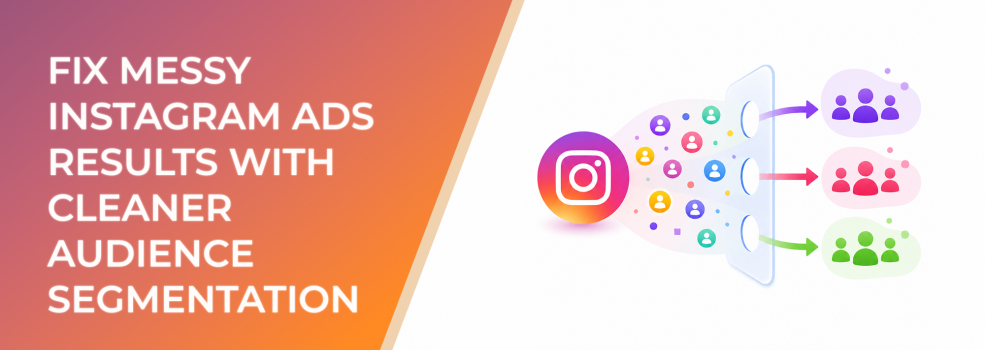
Cleaner audience segmentation fixes this by separating users based on intent, source, and customer fit.
Why This Problem Hurts Performance
Messy segmentation hurts performance because it weakens optimization.
Meta learns from the behavior the campaign generates. If the audience contains many low-intent users, the campaign may collect weak clicks, passive engagement, and poor-quality leads. Those signals can influence delivery and make future optimization less efficient.
The business impact can include rising CPA, higher CAC, weak ROAS, inconsistent lead quality, lower conversion rates, and wasted spend.
Messy segmentation also makes scaling risky. A campaign may look acceptable at low spend because Meta finds a small pocket of strong users. When budget increases, delivery expands into weaker parts of the audience and performance declines.
For marketers under pressure to improve results quickly, messy segmentation creates a cycle of reactive changes: new creative, new budget, new objective, new audience stack. But without cleaner segmentation, the underlying issue remains.
Common Scenarios Where This Happens
An ecommerce brand runs one Instagram prospecting audience that includes broad category interests, competitor followers, and lifestyle content consumers. Purchases happen, but ROAS swings because the audience contains very different intent levels.
A B2B advertiser targets “business owners” broadly and receives leads from freelancers, students, small side projects, and actual decision-makers. CPL looks acceptable, but qualification rate is poor.
A startup uses Instagram engagement audiences without separating passive Reel viewers from users who visited the profile or interacted with product-related posts.
A local business targets an entire city with a general service message. Some users are nearby and ready to buy, but many are too far away or not in the right life stage.
An agency inherits a campaign with several old custom audiences, lookalikes, interests, and retargeting groups combined into one structure. Reporting no longer explains what is working.
Why the Problem Happens
This problem happens because audience segmentation is often treated as a setup task rather than a performance strategy.
Advertisers build the audience once, launch the campaign, and then spend most of their attention on creative edits. Audience quality only becomes a concern after performance declines.
Another cause is overreliance on broad interests. Broad interests can be useful, but they often include users with very different intent levels. Someone interested in “marketing” may be a student, a freelancer, an agency owner, a software buyer, or a casual content consumer.
Messy segmentation also happens when advertisers do not separate funnel stages. Cold prospects, warm engagers, previous visitors, and high-intent users need different measurement expectations. Combining them can make results look better or worse than they really are.
The Solution
The solution is to rebuild Instagram audience segmentation around three practical dimensions: intent, source, and fit.
Segment by intent
Separate users based on how close they appear to a meaningful action.
Low-intent users may consume broad content. Mid-intent users may follow relevant profiles, engage with niche content, or visit your profile. Higher-intent users may interact with offer-related content, revisit pages, submit forms, or engage repeatedly.
Segment by source
Separate audiences by where the signal comes from.
Possible source groups include:
- Instagram followers.
- Instagram engagers.
- Competitor or adjacent-brand followers.
- Niche creator audiences.
- Facebook group communities.
- LinkedIn-derived professional data.
- Website visitors.
- Customer or lead lists.
Segment by customer fit
Separate users based on whether they match the actual buyer profile.
For B2B, that may include role, company type, industry, budget, or authority. For ecommerce, it may include product category behavior, buying context, lifestyle fit, or competitor affinity. For local businesses, it may include service area, urgency, and realistic ability to purchase.
Once segments are clearer, test them under controlled conditions. Keep the campaign objective, creative theme, offer, and landing page consistent enough to compare results.
How LeadEnforce Helps
LeadEnforce helps advertisers create cleaner audience segments from more specific source data.
For Instagram ads, LeadEnforce can help build audiences from Instagram profile followers and engagers. It can also support audience creation from Facebook groups, LinkedIn-derived professional data, and custom social-profile sources.
This helps marketers move away from one large mixed audience and toward a cleaner segmentation workflow.
For example, a B2B team could separate niche Instagram profile audiences from LinkedIn-derived professional audiences. An ecommerce brand could compare competitor followers against influencer-community audiences. A local business could test relevant community-based groups instead of relying only on broad geographic reach.
LeadEnforce is most useful when the problem is audience discovery or audience relevance. It does not fix weak offers, poor tracking, bad landing pages, or creative that fails to communicate value.
Risks and Considerations
Cleaner segmentation can improve readability, but it can also create smaller audiences.
Small audiences may fatigue faster, struggle to deliver, or produce volatile early results. Segmenting too aggressively can also fragment budget and prevent the campaign from collecting enough data.
Another risk is assuming that every segment needs a different campaign immediately. Start with the highest-impact segments first. You do not need to rebuild the entire account in one pass.
Be careful with retargeting pools. If prospecting audiences are low quality, retargeting audiences will also be low quality. Cleaner segmentation should begin before weak traffic enters the funnel.
Also consider compliance and platform policy requirements when using audience data. Audience relevance should never become intrusive messaging.
Prerequisites and Dependencies
You need a clear ICP and a clear definition of quality.
For lead generation, define what makes a lead qualified. For ecommerce, define what makes a purchase valuable. For agencies, align with the client on whether the priority is CPL, CPA, revenue, ROAS, pipeline, or customer quality.
You need a reliable feedback loop. Sales feedback, CRM outcomes, purchase behavior, and funnel metrics should guide audience decisions.
You need enough budget to test meaningful segments. A cleaner structure is only useful if each segment receives enough delivery to evaluate.
If LeadEnforce is used, you need relevant source communities, profiles, professional criteria, or social-profile data that reflect real audience intent.
Practical Recommendations
Start by auditing your current Instagram audiences. Identify which groups are mixed by intent, source, or fit.
Separate cold, warm, and high-intent users. Do not measure all of them against the same expectations.
Build audience names that explain the source and hypothesis. For example, “IG_Competitor_Followers_HighIntent” is more useful than “Audience Test 3.”
Prioritize downstream metrics. Lead quality, conversion rate, CPA, CAC, and ROAS matter more than impressions or cheap clicks.
Use LeadEnforce when you need cleaner audience inputs from Instagram profiles, engagers, Facebook groups, LinkedIn-derived professional data, or custom social-profile sources.
Final Takeaway
Messy Instagram ads results often come from audiences that are too blended to interpret.
Cleaner segmentation helps you see which users are driving value, which users are wasting budget, and which segments deserve more testing. The more clearly you separate intent, source, and fit, the easier it becomes to improve performance.
To create cleaner Instagram audience segments from relevant social and professional sources, join the free 7-day LeadEnforce trial period.
Related LeadEnforce Articles
- Why Instagram Ad Audiences Fail Without Follower And Engagement Data — Explains why broad assumptions often produce weak Instagram audience signals.
- When Existing Follower Insights Don’t Translate Into Better Instagram Ad Audiences — Useful for understanding why follower quantity does not always equal audience quality.
- How To Fix Weak Instagram Ad Targeting With Insights Before Launch — Shows how pre-launch insight review can reduce weak targeting.
- Stop Facebook Ads From Reaching People Who Never Convert — Connects low-quality delivery to wasted spend, poor lead quality, and signal pollution.