Scaling Facebook Ads is often framed as a simple question of budget. In practice, the direction of scaling matters just as much as the amount. The two primary approaches — horizontal and vertical scaling — change how Meta’s delivery system learns from users and distributes impressions.
Because of this, scaling decisions often influence performance more than creative updates or targeting tweaks. When campaigns start slowing down, the issue is frequently structural rather than tactical.
Understanding the mechanics behind both scaling methods helps you decide when to increase spend within a campaign and when to expand the structure instead.
Why Scaling Direction Changes Campaign Behavior
Meta’s delivery system continuously analyzes conversion signals to determine which users are most likely to respond. Scaling changes the environment in which those signals accumulate.
When you scale a campaign, three things shift simultaneously:
-
Signal density, which determines how quickly the algorithm identifies behavioral patterns among converting users.
-
Audience distribution, which controls how impressions spread across potential buyers within the targeting pool.
-
Auction exposure, which determines the range of bid environments your ads enter as delivery expands.
These variables interact in ways that often explain why campaigns perform well at smaller budgets but become unstable when scaled.
If the underlying audience structure is weak, scaling tends to amplify those weaknesses. For example, campaigns built on poorly segmented audiences often struggle to expand effectively. A more stable foundation usually comes from structured segmentation, which is explained in detail in Maximizing ROI through Facebook Audience Segmentation.
Vertical Scaling: Expanding Budget Within an Existing Structure
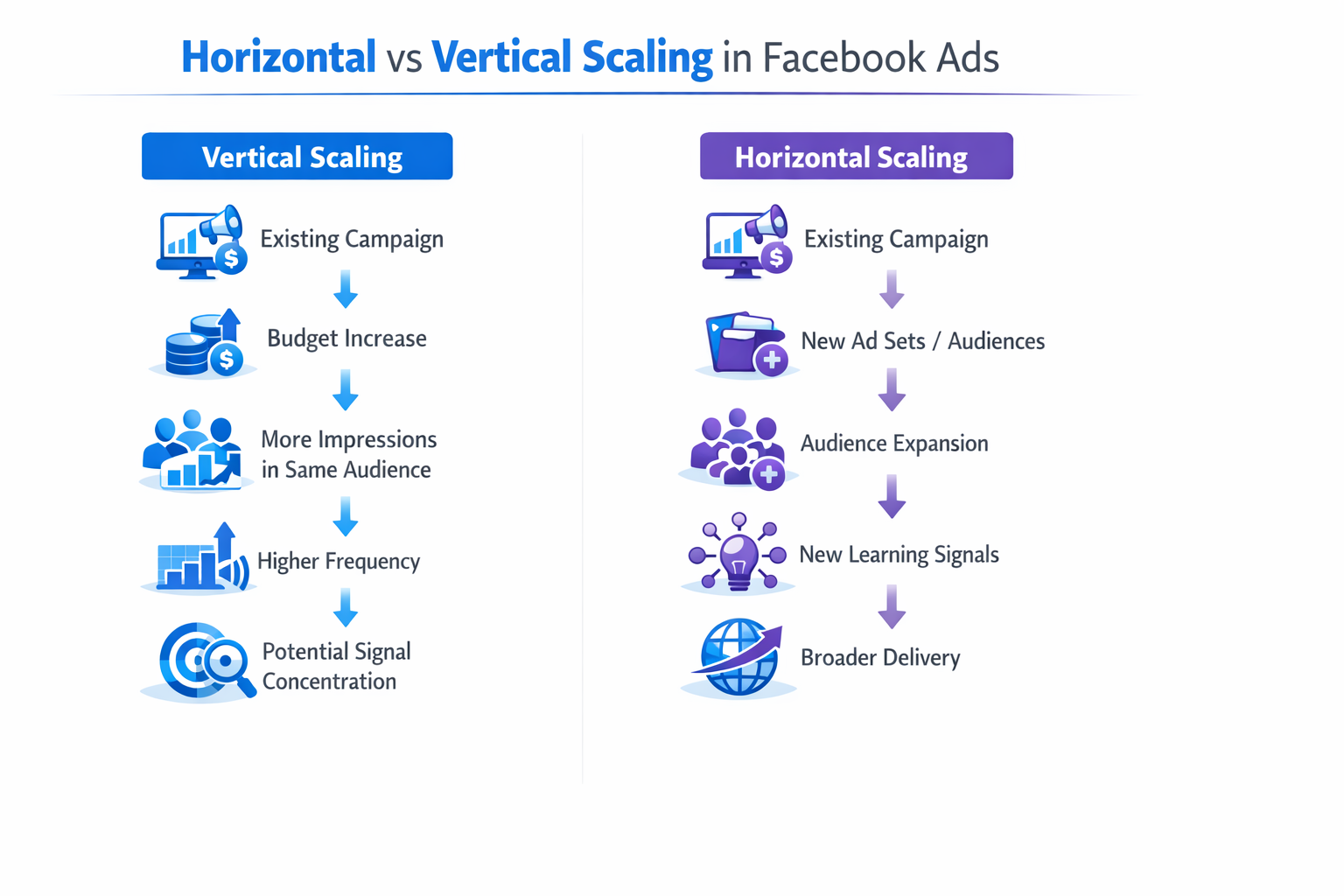
Vertical scaling increases the budget of an existing campaign or ad set without changing its targeting configuration. It is the simplest way to grow spend because it preserves the learning signals the algorithm has already collected.
Common vertical scaling actions include:
-
Increasing an ad set budget gradually.
Many advertisers increase budgets by 20–30 percent at a time so that Meta’s learning phase remains stable and performance volatility stays limited. -
Raising the campaign budget in CBO structures.
In campaign budget optimization, Meta reallocates the additional spend toward ad sets that already generate conversions. -
Relaxing cost controls such as cost caps or bid limits.
This allows the campaign to enter a broader range of auctions, which can increase volume but also introduce higher CPA variance.
In each case, the algorithm continues working with the same audience signals but has more capacity to deliver impressions.
What Happens Inside Meta’s Delivery System
When the budget increases, Meta tries to identify more users who resemble the people already converting. Instead of exploring entirely new audiences immediately, the algorithm first deepens delivery inside the existing behavioral cluster.
This produces several predictable effects:
-
Delivery expands within familiar user segments.
The algorithm prioritizes users who already resemble previous converters, which can increase frequency before reach grows significantly. -
The campaign enters more competitive auctions.
As spend increases, the system must participate in auctions it previously avoided, which can raise costs even if targeting remains unchanged. -
Existing signals become stronger but narrower.
Conversion patterns become more concentrated around specific user behaviors, which can reduce exploration.
Because of this dynamic, vertical scaling works best when the campaign already has strong behavioral diversity in its audience signals.
The Hidden Risk of Vertical Scaling
The most common limitation of vertical scaling is signal over-concentration.
When budgets increase repeatedly within the same campaign structure, the algorithm reinforces a narrow set of behavioral signals. Over time, this reduces the variety of users Meta considers ideal.
Several operational symptoms typically appear:
-
Frequency rises quickly, even when the estimated audience size is large.
-
CTR remains stable but conversion rates decline, suggesting the ads still attract attention but reach less qualified users.
-
Performance drops after creative refreshes, indicating the problem lies in audience exposure rather than creative fatigue.
At this stage, increasing budget further rarely improves results. The campaign needs new behavioral environments in which the algorithm can learn.
Horizontal Scaling: Expanding the Campaign Structure
Horizontal scaling introduces new campaign structures rather than simply increasing budgets. The goal is to create additional environments where Meta can discover new converting patterns.
Typical horizontal scaling actions include:
-
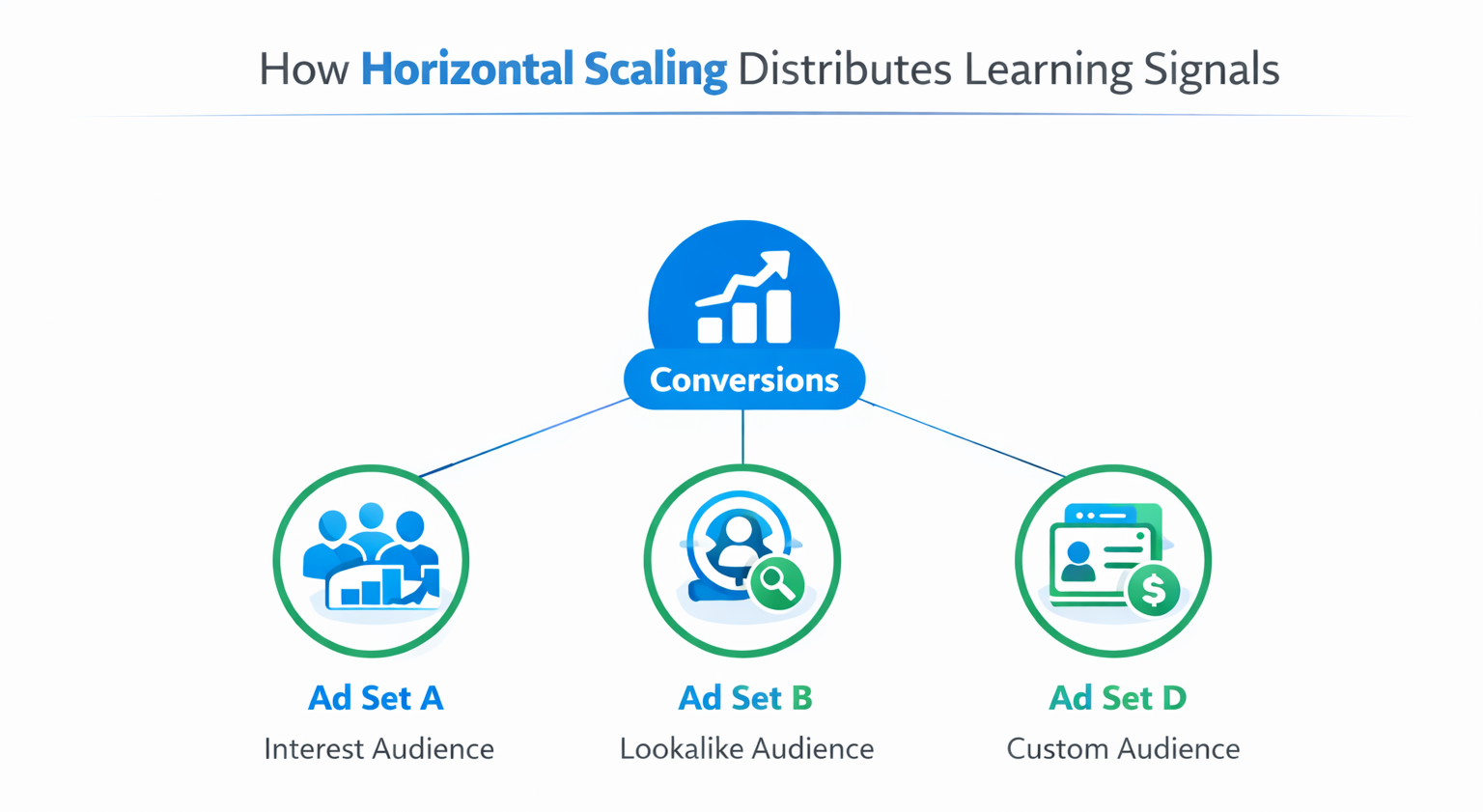
Duplicating high-performing ad sets into adjacent audiences.
For example, a winning interest-based ad set can be duplicated into related interest clusters or broader targeting segments. -
Creating additional lookalike audience tiers.
Expanding from a 1 percent lookalike to 2–5 percent audiences allows the algorithm to test broader similarity groups derived from the same seed. -
Launching parallel campaign structures.
Advertisers sometimes run a broad targeting campaign alongside interest-based targeting or stacked audiences to test which environment generates stronger signals.
This approach increases the number of learning environments available to Meta’s optimization system.
For advertisers relying on lookalike expansion, understanding how seed data influences performance is critical. The mechanics of this process are explained in Lookalike Audiences: How to Seed, Train, and Scale.
The Tradeoff: Signal Fragmentation
Horizontal scaling solves signal concentration, but it introduces another challenge: signal fragmentation.
When too many ad sets run simultaneously, each one receives fewer conversions. Meta’s algorithm then struggles to identify reliable patterns.
This situation often arises when advertisers create many small audiences, such as:
-
Running 15–20 narrowly defined interest ad sets with similar targeting logic.
-
Launching multiple lookalike audiences that compete for the same users.
-
Splitting traffic across several campaigns that share identical creatives.
The consequences typically include:
-
Frequent learning phase resets, because ad sets fail to accumulate enough conversions.
-
Large performance differences between similar audiences, caused by limited signal data rather than true audience quality differences.
-
Higher CPA volatility, especially in the first days of delivery.
In these cases, the issue is not targeting quality but insufficient signal density per ad set.
When Vertical Scaling Works Best
Vertical scaling tends to work well under several conditions:
-
The campaign generates consistent conversion volume.
For example, ad sets that produce 50–100 conversions per week usually provide enough data for stable optimization. -
Audience size is large relative to spend.
Broad targeting campaigns can often absorb budget increases without quickly saturating their user pool. -
Creative diversity remains high.
Multiple creatives help maintain engagement while delivery expands.
These campaigns usually rely on well-built audience foundations. If your targeting structure is still evolving, reviewing the mechanics of How to Create High-Converting Facebook Custom Audiences can help strengthen that base before aggressive scaling.
When Horizontal Scaling Becomes Necessary
Horizontal scaling becomes useful when a campaign shows signs of structural saturation.
Several signals indicate that expansion beyond the current structure may be necessary:
-
Frequency rises rapidly despite moderate budgets.
This often means the algorithm repeatedly reaches the same behavioral segment. -
Creative performance improves briefly after refreshes but declines again quickly.
The audience pool may be limited rather than the creative itself. -
Lookalike audiences plateau in performance.
The algorithm may need new seed sources or broader audience environments.
At this point, introducing new audience clusters—such as different custom audiences or interest layers—can reopen exploration. Many advertisers also use alternative audience sources such as community-based targeting or external data enrichment. One example of this approach is explained in Smarter Audience Building: Beyond Meta’s Built-In Targeting Tools.
A Practical Scaling Framework
Most high-performing Facebook Ads accounts combine both scaling methods instead of relying exclusively on one.
A practical workflow often looks like this:
-
Start with horizontal exploration.
Launch several audience structures to identify which environments generate consistent conversions. -
Allow winning ad sets to accumulate strong signals.
Once an ad set exits the learning phase and stabilizes, it becomes a candidate for budget expansion. -
Scale vertically within the strongest structures.
Increase budgets gradually to amplify the audiences already producing reliable results. -
Introduce new horizontal tests periodically.
Additional audience experiments prevent the algorithm from overfitting a narrow behavioral segment.
This balance maintains both signal density and audience exploration, which are the two forces that ultimately determine how far a campaign can scale.
The Structural Takeaway
Horizontal and vertical scaling are not simply budget strategies. They reshape how Meta’s algorithm interprets user behavior and distributes impressions.
Vertical scaling strengthens existing signals but risks concentrating delivery around a narrow audience segment.
Horizontal scaling expands exploration but can dilute learning signals if the campaign structure becomes too fragmented.
The most scalable Facebook Ads accounts manage both forces carefully. They allow proven structures to scale vertically while continuously introducing new audience environments that keep the algorithm learning and adapting.