Advertisers often expect that a fixed daily budget should produce stable delivery. When impressions or spend start jumping up and down, the first reaction is usually that something is broken in the campaign.
In most cases nothing is broken.
Meta’s delivery system does not try to distribute budget evenly. It constantly reallocates spend toward auctions where it predicts a higher probability of conversion. As those opportunities appear and disappear throughout the day, delivery patterns naturally move with them.
Understanding why this happens makes it easier to separate normal algorithm behavior from actual campaign constraints. If you're still refining how audiences are structured inside your campaigns, reviewing Facebook Custom Audiences Guide: Everything You Need to Know can help clarify how targeting layers influence delivery stability.
The Budget Is Stable, But Auction Opportunities Are Not
A campaign can keep the exact same budget for weeks while impressions still fluctuate day to day. The reason is simple: the number of attractive auction opportunities changes constantly.
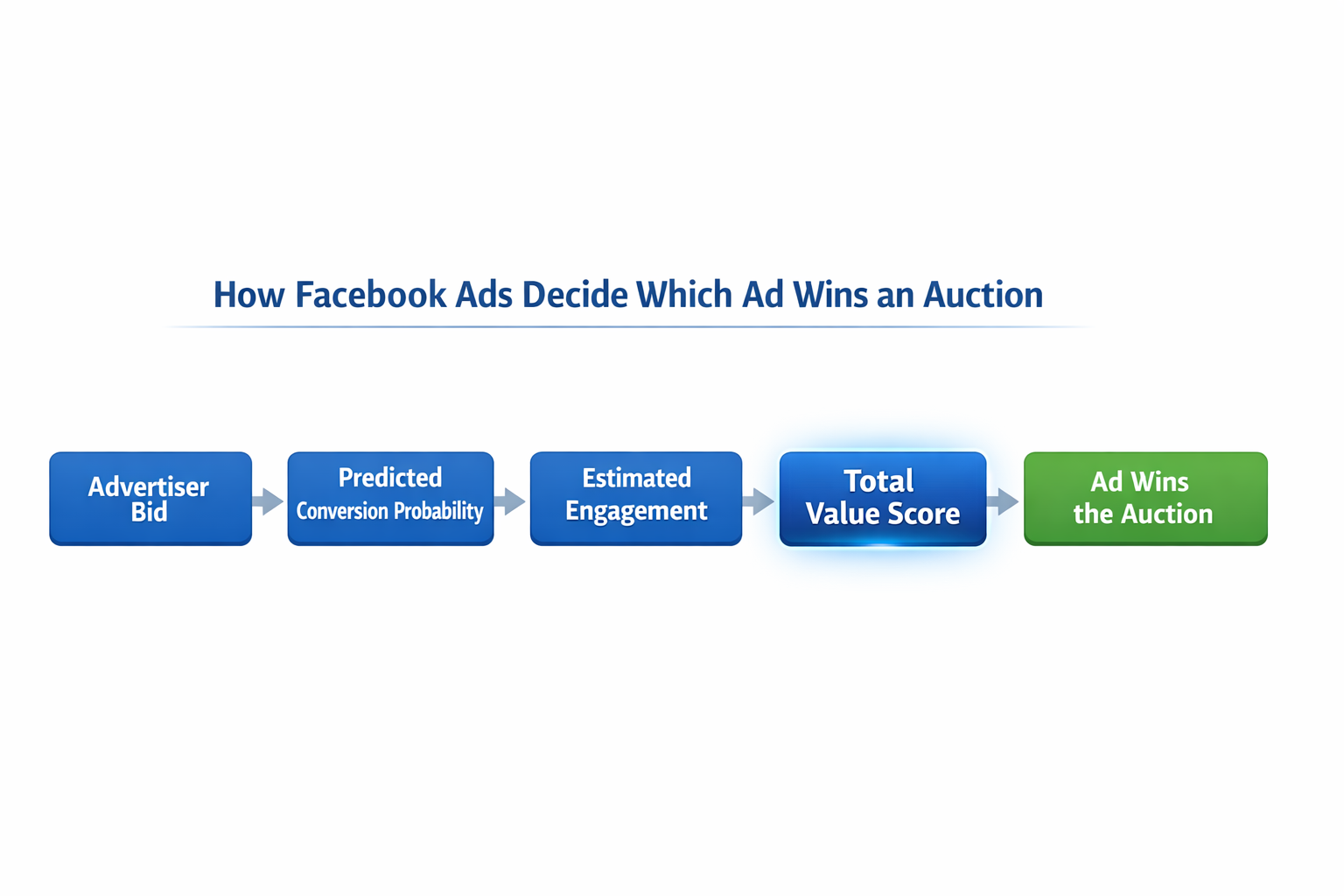
Every time your ad enters an auction, Meta evaluates three variables:
-
predicted conversion probability;
-
expected engagement;
-
bid competitiveness relative to other advertisers.
The platform then combines these into the total value score that determines which ad wins the auction.
If more advertisers compete for the same users on a given day, CPM rises and your campaign enters fewer auctions. When competition drops, impressions increase again even though nothing changed in the campaign settings.
You can usually spot this effect in Ads Manager when:
-
CPM rises suddenly;
-
reach declines;
-
CTR and conversion rate stay stable.
The campaign did not become worse. The auction simply became more expensive.
Delivery Often Concentrates During Certain Hours
Look at the hourly breakdown of a campaign that has been running for a while. Spend rarely spreads evenly across the day.
Instead, the algorithm gradually learns when conversions are most likely to happen. It then shifts budget toward those hours.
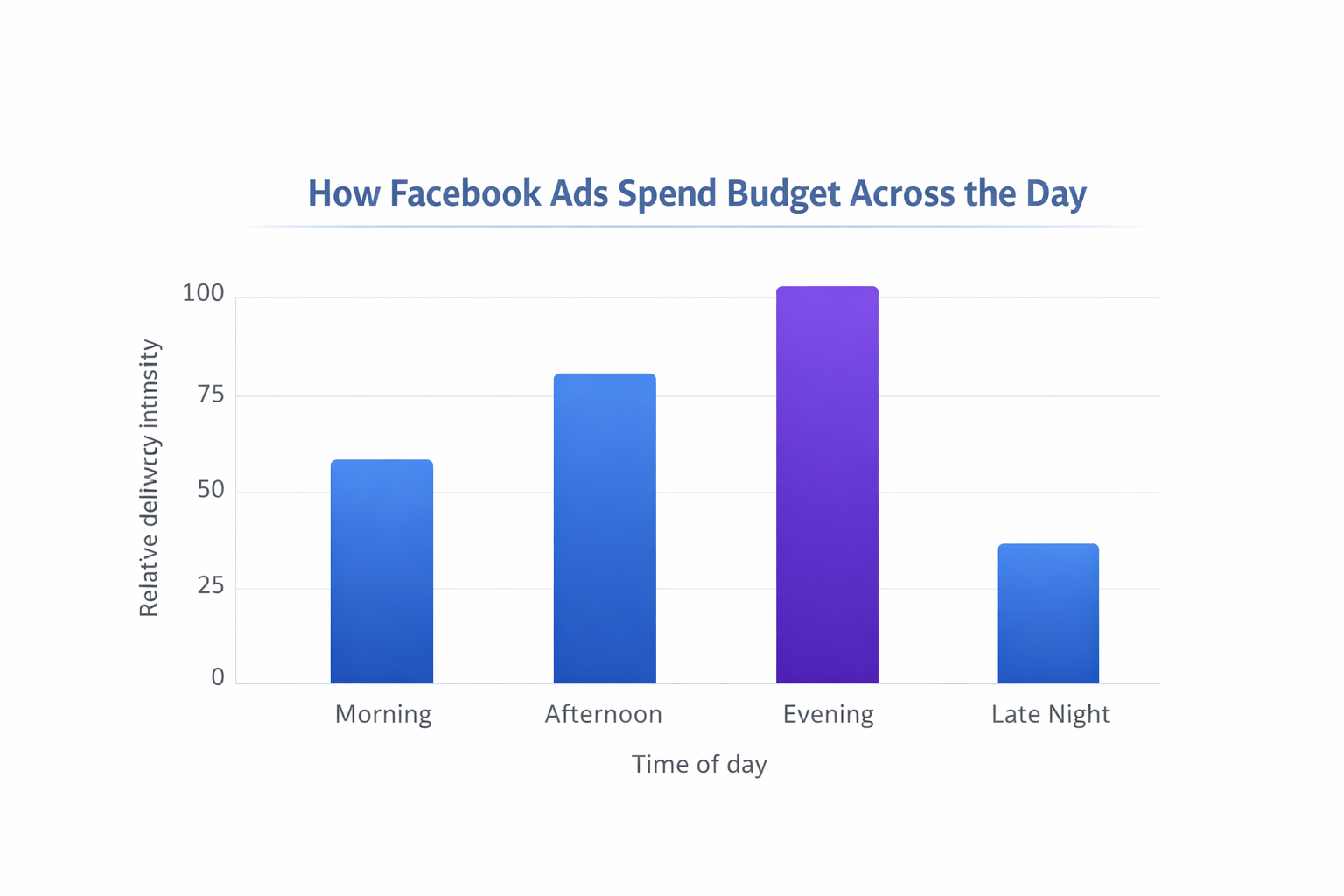
A common example in ecommerce campaigns:
-
delivery stays relatively light during the morning;
-
spend accelerates after work hours;
-
the campaign may spend 30 – 40% of its budget in the evening window.
From the outside this looks like inconsistent pacing. In reality the system is doing the opposite — it is concentrating delivery where historical conversion probability is higher.
If the campaign continues receiving conversions in that time window, the pattern becomes even stronger.
Conversion Clusters Can Temporarily Accelerate Delivery
Spend spikes often appear after a small cluster of conversions.
Suppose a campaign receives three purchases within a short time frame. The algorithm immediately tries to identify patterns among those buyers: device type, browsing behavior, activity time, and hundreds of other signals.
Once it detects a cluster, the system begins bidding more aggressively in auctions containing similar users.
For a few hours this can produce:
-
a noticeable jump in impressions;
-
faster budget consumption;
-
slightly higher frequency inside that segment.
When the cluster stops converting, delivery settles back to normal levels. These cycles can repeat multiple times throughout the day.
Advertisers sometimes interpret this as unstable delivery, but it is simply the algorithm reacting to new signals.
If you're building seed audiences that drive these signals, understanding How to Create High-Converting Facebook Custom Audiences can significantly influence how quickly campaigns stabilize.
Learning Phase Campaigns Show Larger Swings
Fluctuations become much more visible when a campaign does not yet have enough conversion data.
During the learning phase the algorithm actively experiments with different parts of the audience. Instead of concentrating delivery in one segment, it tests multiple pockets of users to see where conversions occur.
This experimentation often produces patterns like:
-
sudden spikes in CPM;
-
several hours of slow delivery followed by a burst of impressions;
-
uneven spend pacing across the day.
Once the campaign accumulates enough conversions — usually around fifty within the optimization window — the algorithm reduces experimentation and delivery tends to stabilize.
Until then, some volatility is unavoidable.
Strong audience segmentation can reduce the time campaigns spend in learning. The framework explained in Maximizing ROI through Facebook Audience Segmentation provides a useful way to structure campaigns around different intent levels.
Audience Saturation Can Quietly Slow Delivery
Sometimes delivery drops even though CPM remains stable. When that happens, the problem is often audience exhaustion rather than auction competition.
In smaller audiences the algorithm quickly reaches the most responsive users. As frequency increases, the probability of additional conversions begins to decline.

When this happens, the system may deliberately slow delivery while it searches for new responsive users inside the targeting pool.
You can usually confirm this pattern when Ads Manager shows:
-
rising frequency;
-
declining CTR;
-
stable or slightly rising CPM.
In other words, the platform still finds auctions, but the expected response rate inside the audience is dropping.
External Competition Changes the Auction Without Warning
Delivery fluctuations also appear when other advertisers enter the same auctions.
This happens frequently during:
-
seasonal promotions;
-
major ecommerce sales periods;
-
product launches in competitive industries.
A campaign that ran smoothly for weeks can suddenly see CPM increase by 30 – 50% when large advertisers start bidding aggressively for the same audience.
From the campaign’s perspective nothing changed. From the auction’s perspective, however, the competitive landscape shifted overnight.
When those advertisers reduce spending again, delivery typically returns to previous levels.
Signals That Indicate a Real Delivery Constraint
Short-term fluctuations are normal. Persistent instability usually points to a structural limitation inside the campaign.
Watch for patterns such as:
Large daily spend swings
If a campaign spends $300 one day and $120 the next with identical settings, the algorithm may be struggling to find enough qualified auctions within the audience.
Rapid frequency growth
When frequency climbs quickly while impressions stagnate, the audience may simply be too small for the budget level.
Repeated learning phase resets
Frequent budget changes, creative swaps, or targeting edits can push the campaign back into learning. Each reset temporarily destabilizes delivery.
These signals usually point to targeting structure, audience size, or creative rotation rather than a platform issue.
Practical Takeaway
Facebook Ads delivery is shaped by auction conditions, conversion signals, and audience response patterns. Because those factors constantly change, even well-structured campaigns rarely deliver impressions at a perfectly steady pace.
Stable budgets simply define the maximum amount the system can spend. The algorithm still decides when and where that budget is most likely to produce conversions.
If performance metrics remain consistent over several days, short-term delivery swings are usually just the system reallocating spend toward better opportunities.