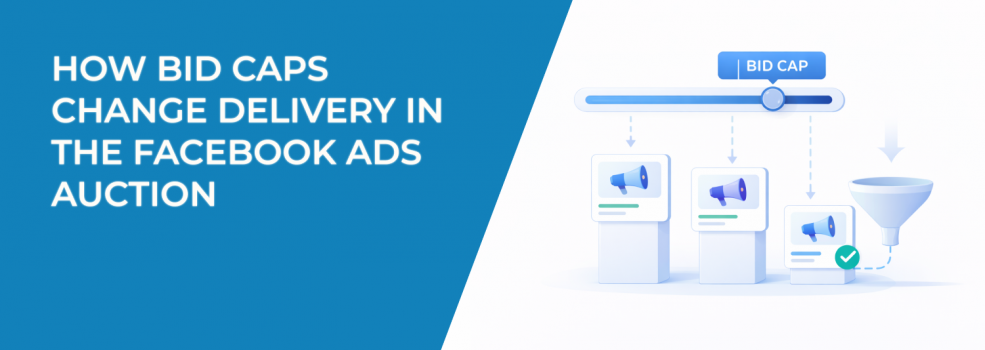
Most advertisers think of bid caps as a cost-control tool. In reality, they change how your campaign participates in the ad auction.
A bid cap does not simply limit cost — it restricts which auctions your ads can enter and how aggressively the system can compete. That shift affects delivery volume, learning speed, and how many conversions the campaign can generate.
If you want to understand the mechanics of the auction itself first, read Crack the Code: What You Need to Know About the Facebook Ad Auction.
How the Auction Normally Works
In a standard campaign with lowest-cost bidding, Meta dynamically adjusts bids for every impression.
The system evaluates three signals:
-
Predicted conversion probability.
Meta estimates how likely a user is to complete the optimization event — for example a purchase or lead. -
Estimated value of the conversion.
In purchase campaigns the algorithm may prioritize users expected to generate higher order value. -
Competition in the auction.
When many advertisers target the same user segment, bids increase to remain competitive.
Because bids are flexible, the system can pursue conversions across a wide range of auction prices.
Bid caps remove that flexibility.
What a Bid Cap Actually Does
A bid cap introduces a hard ceiling on how much the system can bid for any impression.
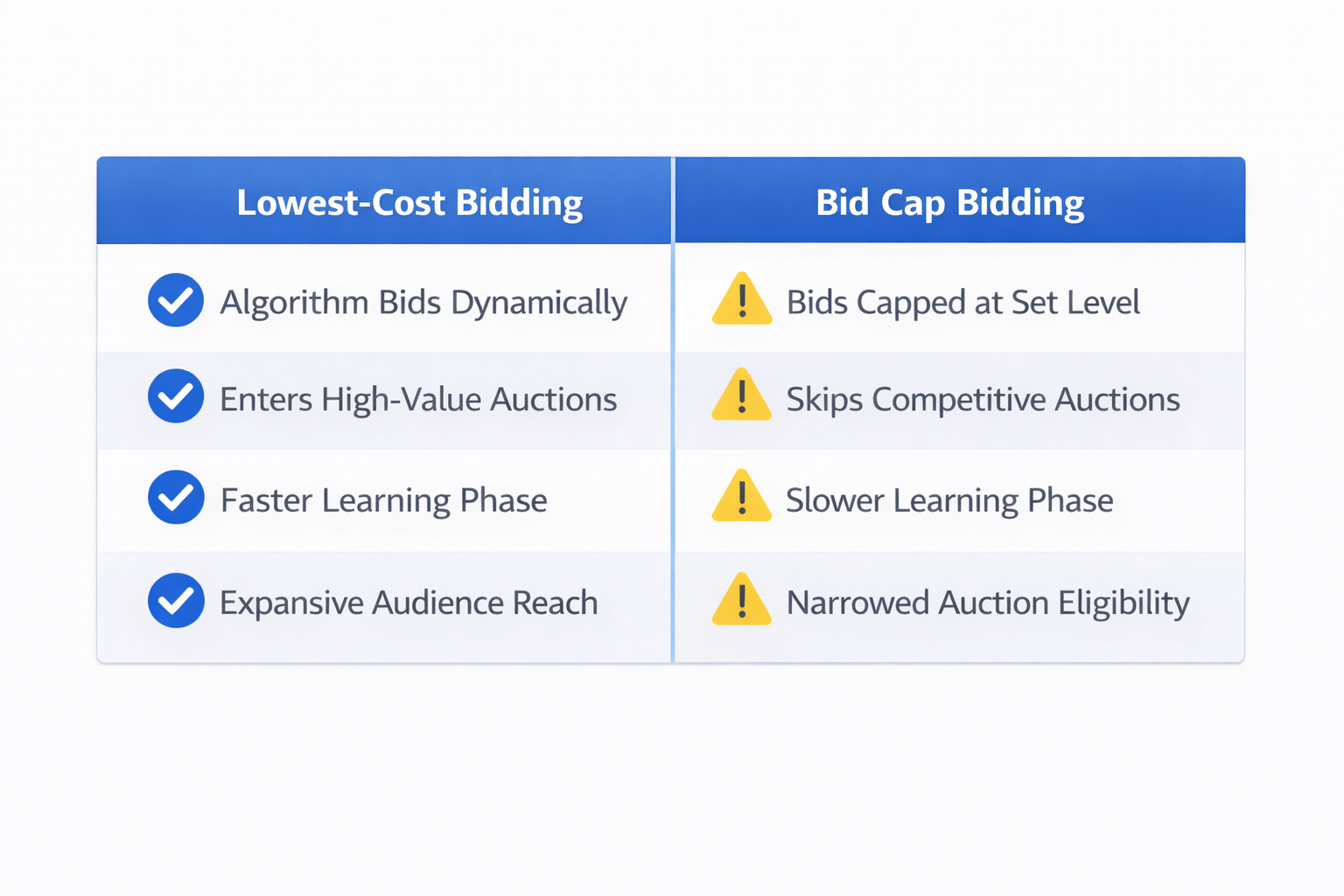
Two delivery changes happen immediately:
-
The campaign skips expensive auctions.
If the estimated winning price is above your cap, the system does not participate. -
The algorithm cannot raise bids for high-intent users.
Even when strong purchase signals appear, the system cannot exceed the cap to win the auction.
In practice, your campaign now competes in a smaller portion of available auctions.
Why Delivery Often Drops
High-intent audiences often trigger expensive auctions.
Several patterns explain the drop in delivery:
-
Competitive audiences increase auction prices.
When multiple advertisers pursue the same buyer segment, the clearing price can exceed your cap. -
High-intent signals require stronger bids.
If a user recently visited your pricing page, Meta may want to bid higher to secure that impression. -
Daily competition fluctuates.
CPMs rise during peak hours or promotional periods, temporarily excluding capped campaigns.
Inside Ads Manager this often appears as consistent underspending.
A similar situation is explained in Why You See “Ad Set May Get Zero” on Facebook and How to Fix It.
How Bid Caps Affect Learning
Meta’s optimization system improves by observing conversions across many auctions. When a campaign participates in fewer auctions, the algorithm receives less feedback.
Two patterns usually appear.
Slower learning.
Fewer impressions and clicks mean fewer conversion signals, which can prolong the learning phase.
Limited audience exploration.
The system normally tests adjacent behavioral clusters. Bid caps restrict this exploration because many auctions become inaccessible.
When Bid Caps Make Sense
Bid caps work best when the campaign already has stable performance data.
Typical scenarios include:
-
Protecting profit margins.
If conversions above a certain CPA become unprofitable, a cap prevents the algorithm from entering overly expensive auctions. -
Stabilizing volatile CPAs.
When competition spikes during promotions or seasonal demand, caps help control cost swings. -
Controlling aggressive bidding.
If the system occasionally overbids due to optimistic predictions, caps create a safety constraint.
This strategy is often applied when advertisers start How to Scale Facebook Ads Without Losing Profit Margin.
How to Set a Practical Bid Cap
Use real campaign data instead of guessing.
A practical approach:
-
Review recent conversion costs.
Analyze at least 50–100 conversions to determine the median CPA. -
Set the cap slightly above that level.
Many advertisers place it roughly 10–30% higher than the median. -
Watch delivery signals for several days.
If impressions and spend collapse, the cap is likely too low.
Learning behavior is also affected by delivery volume, which is discussed in How to Finish the Facebook Learning Phase Quickly.
The Real Tradeoff
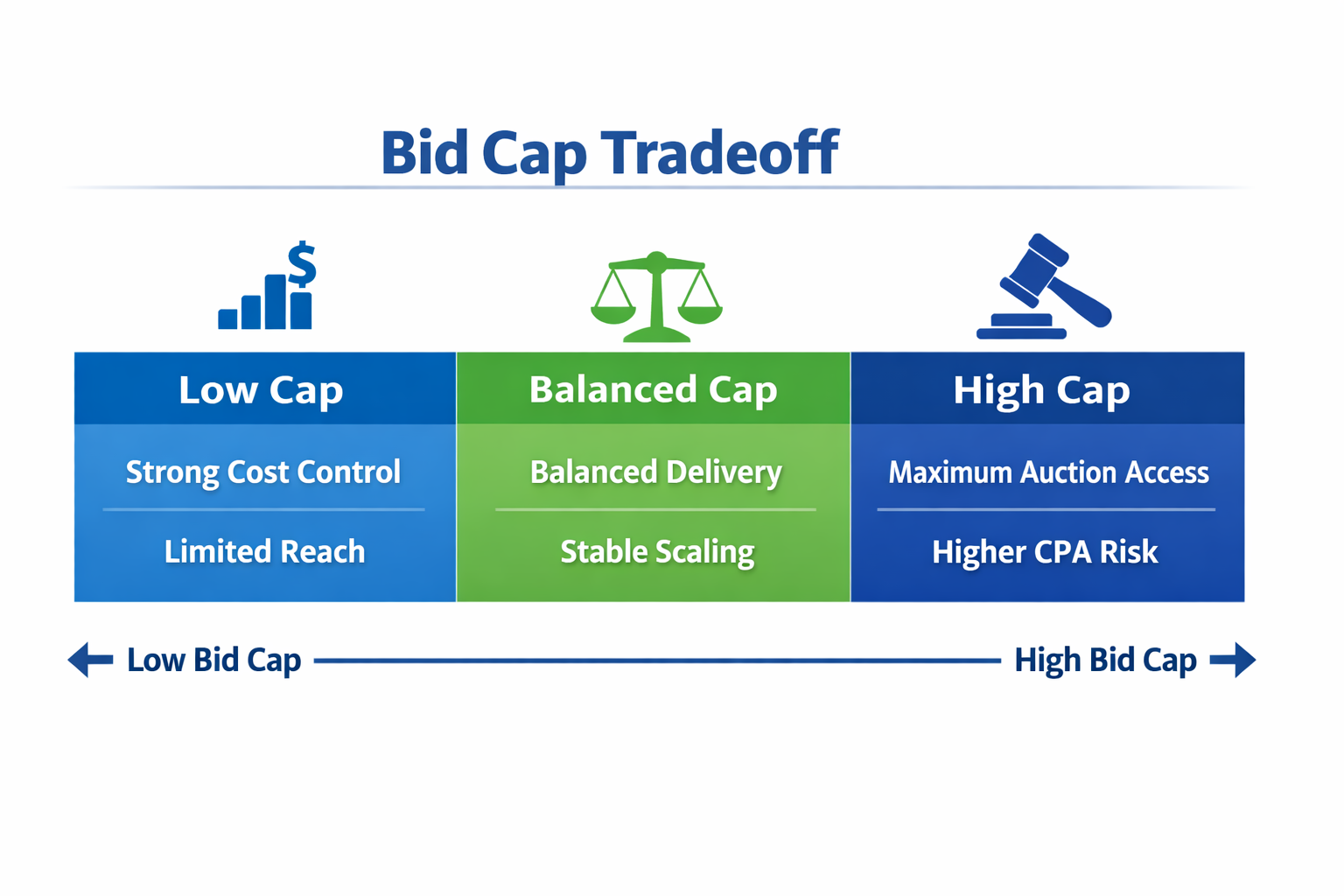
Bid caps create a direct tradeoff — cost control versus auction access.
Lower caps protect margins but reduce delivery opportunities. Higher caps allow the algorithm to compete in more auctions but increase exposure to expensive impressions.
For early-stage campaigns, lowest-cost bidding usually allows the algorithm to learn faster. Bid caps become useful later — when advertisers want tighter cost control without completely sacrificing scale.