Broad targeting can work when Meta has strong purchase data. It gives the system room to find buyers.
But in Messenger campaigns, broad targeting can also create a problem. The action is very easy, so Meta may find people who are willing to chat but not ready to buy.
The result is more messages, more sales-team work, and weaker revenue.
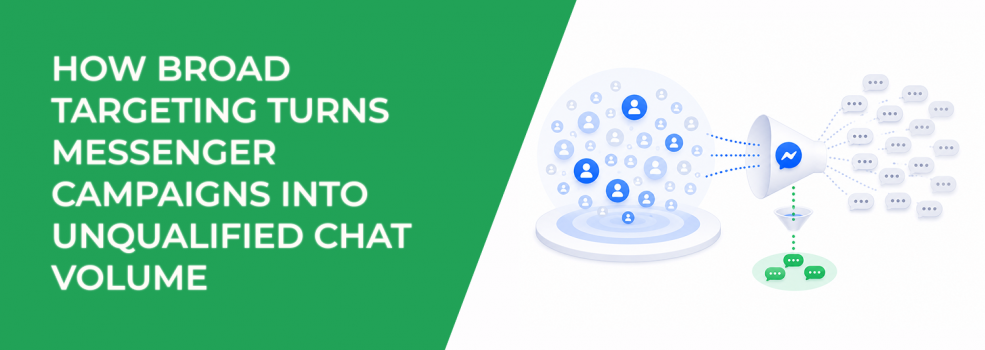
Core problem: broad audiences contain too many casual responders
A broad audience includes many types of people. Some are buyers. Others are browsers, students, competitors, low-budget users, or people who often interact with ads.
If the campaign optimizes for replies, Meta has plenty of low-intent responders to choose from. That can make the campaign look active while sales quality drops.
This is one reason broad targeting kills your ROAS for some advertisers. The campaign reaches enough people to spend, but too many of those people are poor-fit prospects.
Why Messenger makes broad targeting riskier
Messenger lowers friction. A user can reply without reading a long landing page, filling out a form, or entering payment details.
That is useful when the user already has intent. It is risky when the audience is too loose.
For example, a broad campaign for a local remodeling company may attract homeowners, renters, design students, DIY hobbyists, and people outside the service area. Many of them may ask questions, but only a smaller group can actually buy.
The wider the audience, the more important the qualification layer becomes.
Solution: improve the audience before scaling Messenger ads
The fix is not always to make the audience tiny. Very small audiences can limit delivery and raise costs.
The better move is to build a cleaner starting audience. The audience should reflect the type of person who is likely to have the problem your offer solves.
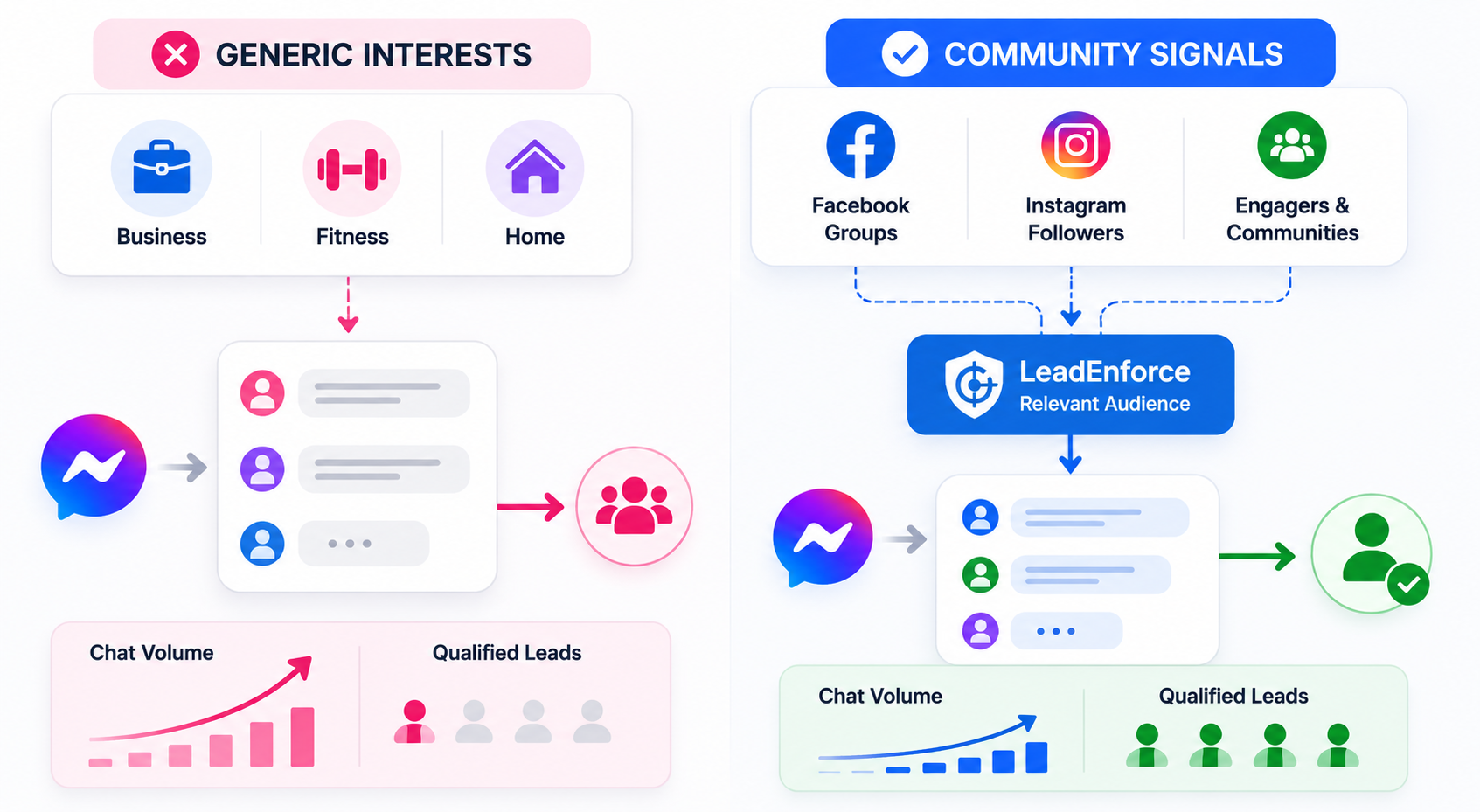
For example, a B2B software campaign should not rely only on broad business interests. It should reach people connected to relevant roles, communities, or niche topics. A local service business should focus on users with stronger local and category relevance.
This is where LeadEnforce can make sense. Advertisers can use it to build audiences from Facebook groups, Instagram followers, engagers, and social profile data. That gives Meta a better starting pool than generic broad targeting.
Use social behavior to find stronger intent
Public social behavior can show useful buying context. People follow niche Instagram accounts, join specific Facebook groups, and engage with content related to their needs.
That does not prove they are ready to buy today. But it can create a more relevant audience than broad interests alone.
For example, a renovation company could build an audience from local homeowner groups and interior design accounts. A SaaS company could build from startup founder communities. A fitness studio could build from local wellness and training audiences.
This approach helps advertisers find high-intent audiences using public social data before launching Messenger campaigns.
Check if broad targeting is creating chat noise
The problem will often show up inside Messenger before it shows up clearly in Ads Manager.
Review the conversations. Look for repeated signs of poor fit:
- Users ask very basic questions. They need too much education before they can understand the offer.
- Many users are outside your service area. This is common for local businesses using broad locations.
- People ask about price and disappear. The offer may be reaching users without enough budget or urgency.
- Close rate drops after budget increases. Scaling may be expanding into weaker audience pockets.
If these patterns appear, the problem is not only the chat script. The audience may be too loose.
Build targeting around communities, not generic interests
Facebook groups can be useful because they often form around real problems. A person in a niche group may have stronger context than someone matched to a broad interest.
For example, targeting “business owners” is very broad. Building an audience from groups about bookkeeping, agency operations, Shopify growth, or local real estate investing gives the campaign more context.
Advertisers can build a target audience from a Facebook group when group membership reflects a clear need or buying situation. This does not remove the need for good copy, qualification, or tracking. It simply improves the input before Meta starts optimizing.
Keep the audience focused, but not too small
Precision does not mean over-segmentation. If the audience is too small, delivery can become unstable and CPM can rise.
A strong Messenger audience should be focused enough to protect quality, but large enough for Meta to learn. Combine several relevant sources instead of relying on one tiny group.
For example, a local business could combine local Facebook groups, related Instagram accounts, and past engagers. A B2B advertiser could combine niche communities, competitor-adjacent profiles, and warm website traffic.
That gives the campaign enough room to deliver while keeping the audience closer to real buyer intent.
Final takeaway
Broad targeting can bring scale, but Messenger ads need quality control. When the campaign optimizes for replies inside a loose audience, it can produce many low-value chats.
The solution is to tighten the starting audience, use stronger social intent signals, and judge performance by qualified conversations and sales. Broad reach is useful only when it reaches people worth talking to.