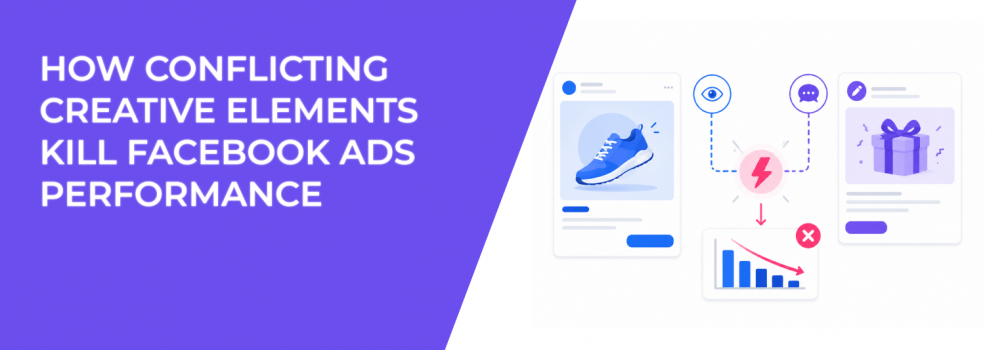
Some Facebook ads fail because the targeting is weak. Others fail because the offer is not strong enough. But many campaigns lose performance for a different reason: the ad itself feels inconsistent.
The image pushes one message, the headline pushes another, and the CTA introduces a different direction again. Users may still click because the ad catches attention, but attention alone does not create buying intent. When the message feels unclear, conversion rates usually drop while CPA starts rising.
The main problem is simple. The ad does not communicate one clear idea from beginning to end.
The fix is also simple. Every major element inside the ad should support the same message, emotional angle, and next step.
Why Conflicting Ad Elements Create Lower Conversion Rates
Facebook users move fast.
Most people do not carefully study an ad before clicking. They scan the image, notice part of the headline, and make a quick decision. If the creative feels easy to understand, the user keeps going. If the message feels mixed, the user hesitates.
That hesitation matters more than most advertisers realize.
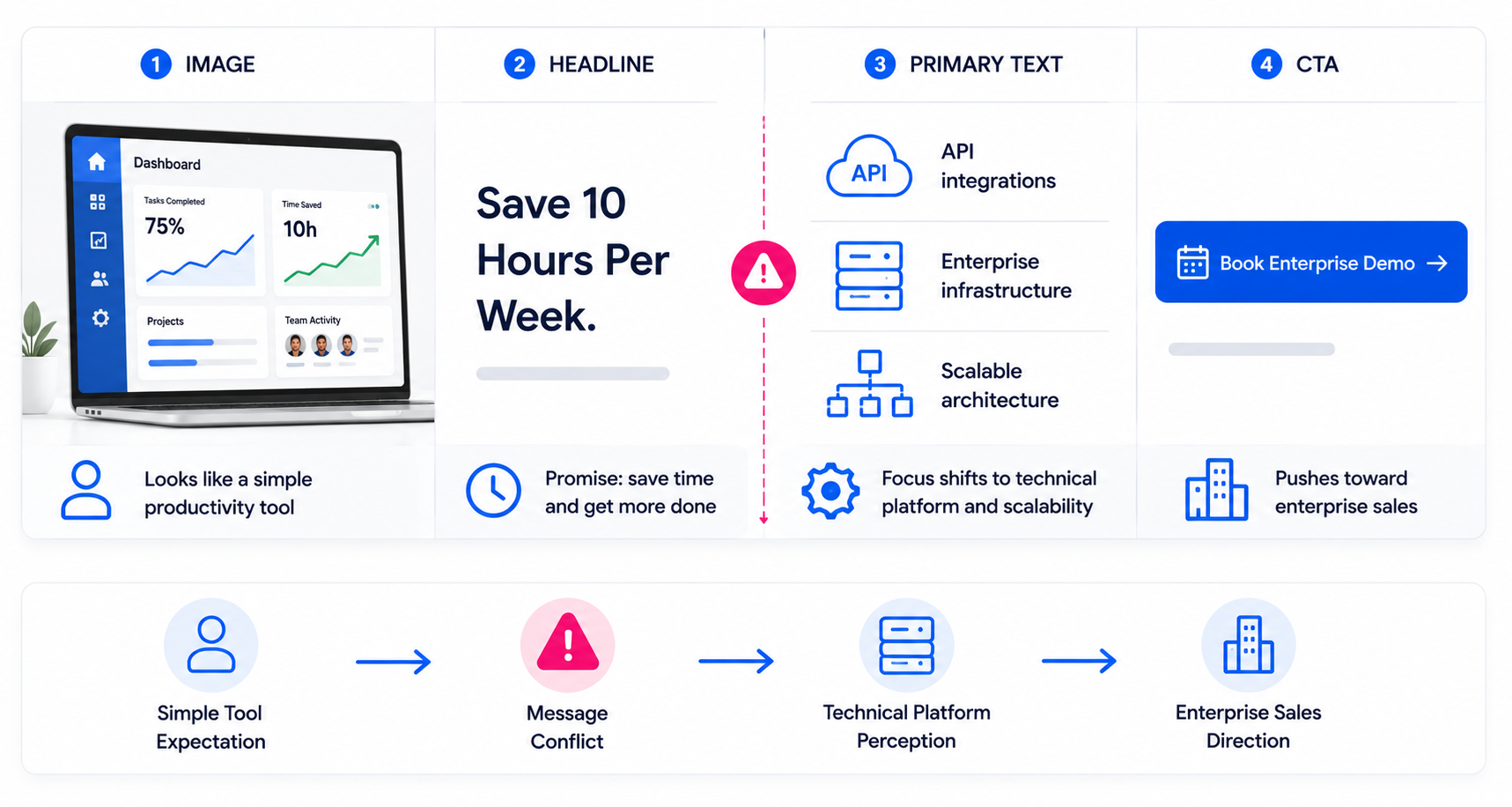
For example, a SaaS company may run an ad with a clean dashboard image and a headline about saving time. But the primary text suddenly focuses on technical integrations and enterprise infrastructure.
The user clicked expecting a simple productivity tool. The copy changed the positioning halfway through the ad.
That usually leads to weaker intent after the click. Users bounce faster, spend less time on the landing page, and convert less often.
What This Problem Looks Like in Real Campaigns
Creative conflict is usually subtle. Most ads with this issue still look polished.
The problem is that the parts do not work together.
Here are several common examples:
- A luxury ecommerce brand uses premium product photography but adds aggressive discount messaging like “70% OFF TODAY.” The visuals attract high-value buyers while the copy attracts bargain hunters.
- A B2B ad shows a complicated analytics dashboard while the headline promises an easy beginner-friendly solution. Experienced buyers think the tool looks too basic. Beginners think it looks too technical.
- A fitness brand uses dramatic transformation imagery while the CTA promotes a free educational guide. The ad attracts curiosity clicks instead of users ready to buy.
- A local service business uses calm trust-focused visuals but combines them with urgent “limited spots left” messaging. The emotional direction changes inside the same ad.
These campaigns often produce misleading metrics early on. CTR may look acceptable because the creative creates interruption in the feed. But deeper performance metrics usually weaken quickly.
Common signals include:
- strong CTR with weak conversion rate;
- higher bounce rates after the click;
- unstable CPL during scaling;
- lower lead quality;
- rising CPM despite stable targeting.
Many advertisers react by changing audiences or budgets when the real problem is message inconsistency.
Why Meta’s Algorithm Struggles With Mixed Messaging
Meta’s system learns from user behavior.
When users click an ad and behave inconsistently afterward, the platform receives weaker optimization signals. Some users click because of the visual. Others respond to the headline. Many leave because the landing page feels different from what they expected.
That creates noisy data.
Over time, Meta starts expanding delivery into weaker audience groups because it cannot clearly identify who actually wants the offer. This is one reason campaigns often become more expensive during scaling even when the targeting stays the same.
You can often identify this issue inside Ads Manager when:
- CTR stays stable but conversion rate falls;
- lead quality drops after audience expansion;
- CPC remains low but CPA rises;
- engagement looks strong while revenue stays weak.
Advertisers dealing with this problem should also review visual hierarchy in Facebook ads because poor attention flow often causes users to misunderstand the ad before reading the full message.
How to Fix Conflicting Creative Elements
The best Facebook ads usually focus on one dominant idea.
The image introduces the idea. The copy strengthens it. The CTA continues the same direction. Nothing forces the user to reinterpret the offer midway through the ad.
One useful way to review creatives is using a quick clarity test.
After looking at the ad for a few seconds, ask:
- What is the offer?
- Who is this for?
- What problem does it solve?
- What should happen next?
If those answers are not obvious immediately, the creative probably contains conflicting signals.
Another useful method is checking whether the same emotional angle appears across all major parts of the ad:
- image;
- headline;
- primary text;
- CTA;
- landing page headline.
For example, if the visual focuses on simplicity, the copy should continue that same idea instead of shifting into technical complexity.
This is why advertisers often improve performance after they structure Facebook ads with a clearer hook and CTA instead of endlessly testing new audiences.
Why Audience Quality Still Matters
Even strong creatives struggle when shown to the wrong people.
Message clarity works best when the audience already has some level of interest in the problem or offer. This is where precision targeting becomes important.
LeadEnforce helps advertisers build audiences using Facebook groups, Instagram followers, and social engagement data. That allows campaigns to reach users who already share stronger intent signals around a topic or niche.
For example, a B2B software company can target audiences connected to industry-specific communities instead of relying entirely on broad interest targeting. That makes it easier to keep the creative specific without confusing colder traffic.
Better audience alignment usually improves both lead quality and campaign efficiency.
Why Creative Testing Often Makes This Worse
Many teams accidentally create message conflict during testing.
The designer focuses on visual engagement. The copywriter focuses on persuasion. The media buyer focuses on CTR. Eventually the campaign becomes a combination of individually optimized parts that no longer support the same conversion path.
This problem becomes worse when advertisers test too many emotional angles at once.
A campaign may combine urgency-based visuals, educational copy, and trust-focused CTAs inside the same ad set. The result is unclear positioning.
That often leads directly to the issue explained in why Facebook ads get clicks but no conversions because users click based on one expectation and encounter a different message after entering the funnel.
Final Takeaway
Conflicting creative elements reduce Facebook ad performance because they weaken clarity.
When the image, headline, copy, and CTA communicate different ideas, users hesitate. That hesitation lowers conversion intent, creates weaker optimization signals, and increases wasted ad spend.
The strongest Facebook ads feel consistent from the first impression to the final action. The user understands the offer quickly, knows who it is for, and immediately understands what should happen next.
That level of clarity usually improves more than CTR. It improves CPA, ROAS, lead quality, and campaign stability over time.