A lot of Facebook ads fail even when the targeting looks solid and the creative gets attention.
The problem is not always the click. Sometimes the problem starts immediately after the click because the user does not know what to do next.
The ad creates interest, but it does not create direction.
This usually happens when advertisers focus too much on getting attention and not enough on guiding user behavior. The creative may look polished, the headline may generate curiosity, and the CTR may even look healthy. But if the next step feels unclear, performance drops quickly.
That confusion often shows up as:
- high CTR with weak conversion rate;
- low-quality leads;
- rising CPA after scaling;
- strong engagement with weak revenue results.
The core issue is simple: the ad creates motion without creating decision clarity.
Why “Next-Step Clarity” Matters in Facebook Ads
Facebook users move through ads quickly.
Most people are not actively trying to buy something while scrolling. Your ad interrupts their attention for a few seconds, and during that short window the user needs to understand three things:
- What is this?
- Why should I care?
- What should I do next?
Many ads answer the first two questions but fail on the third.
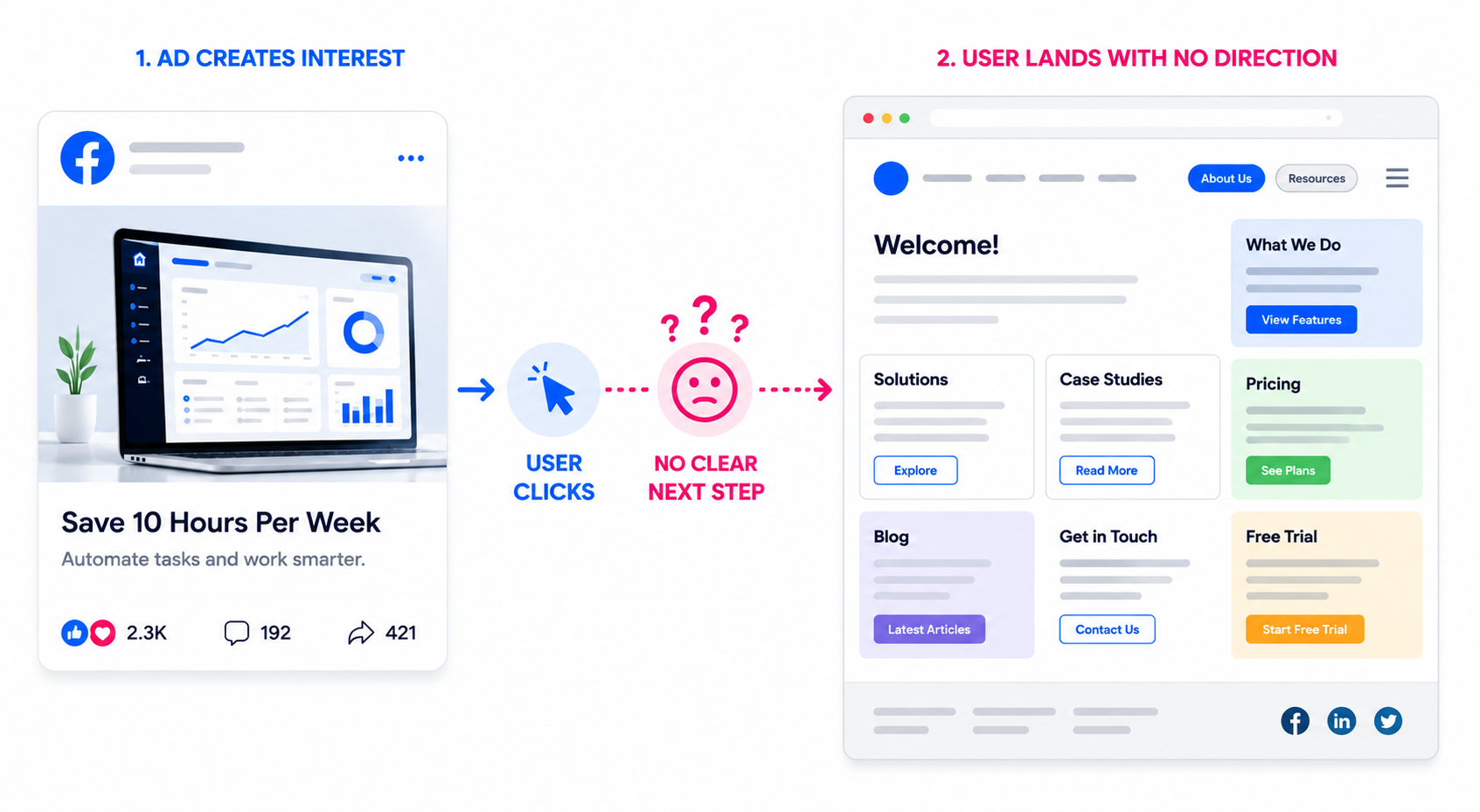
For example, a SaaS company may run an ad about saving time with automation. The image looks clean, the headline promises efficiency, and the copy explains the product well. But the CTA simply says “Learn More.”
Learn more about what? A demo? A pricing page? A case study? A free tool?
The user hesitates because the next action feels vague. That hesitation matters because Facebook traffic usually converts best when the path feels easy and predictable.
What Weak Direction Looks Like Inside Real Campaigns
Most underperforming ads do not look “bad.” The problem is usually hidden inside the user journey.
Here are several common examples:
- An ecommerce ad promotes a product benefit clearly but sends users to a busy category page with too many choices.
- A B2B lead generation ad offers a useful solution but never explains whether the next step is a demo, a consultation, or a free trial.
- A local service ad creates urgency in the creative but links to a generic homepage without a booking flow.
- A lead magnet ad promises a guide or checklist but lands users on a page asking for too much information upfront.
In all these situations, the ad creates enough interest for the click but fails to maintain momentum afterward.
Users start asking themselves questions they should not have to think about:
- Where do I click?
- What happens next?
- How long will this take?
- Am I about to get sold to?
Every extra layer of uncertainty reduces conversion intent.
Why This Problem Increases CPA Over Time
Meta’s algorithm depends on consistent user behavior.
When users click but fail to complete the next step consistently, the platform receives weaker optimization signals. Some users bounce immediately. Others browse without converting. Some hesitate and leave before finishing the process.
That inconsistency hurts delivery quality over time.
The campaign may still generate traffic, but Meta starts struggling to identify which users actually want the offer. This usually causes:
- less stable performance;
- higher cost per result;
- weaker audience matching;
- lower-quality conversions.
This is one reason many campaigns look good early on but become inefficient after scaling. The algorithm can optimize attention faster than it can optimize confused behavior.
How Strong Ads Create Clear Momentum
The best Facebook ads reduce uncertainty.
The user should immediately understand what happens after the click and why taking that step feels worthwhile.
Strong ads usually create momentum in three connected stages:
- The creative introduces the problem or opportunity.
- The copy explains the value clearly.
- The CTA leads naturally into the next action.
Nothing feels disconnected.
For example, if the ad promotes a free audit, the CTA should clearly continue that direction:
- “Get Your Free Audit”
- “See Your Results”
- “Book Your Strategy Call”
The landing page should then immediately continue the same promise without changing tone or forcing users to reorient themselves.
This is why advertisers often improve performance when they match ad copy to the right funnel stage instead of constantly changing audiences or budgets.
Why Landing Pages Often Break the Flow
Many advertisers think the ad’s job ends at the click.
In reality, Facebook ads perform best when the transition between the ad and landing page feels seamless.
A common problem appears when the ad creates one expectation but the landing page introduces friction immediately.
For example:
- the ad feels simple but the page looks crowded;
- the ad promotes speed but the form feels long;
- the ad creates urgency but the page feels generic;
- the ad targets beginners but the landing page uses technical language.
The user suddenly has to stop and rethink the decision.
That usually kills conversion momentum.
Advertisers struggling with this should review how to optimize the post-click experience because many “Facebook ad problems” are actually transition problems between the ad and the landing page.
How to Audit Whether Your Ad Has a Clear Next Step
One of the easiest ways to audit a Facebook ad is checking whether the CTA creates a predictable continuation of the message.
Ask these questions:
- Does the CTA feel connected to the headline?
- Does the landing page continue the same promise?
- Would a cold user understand exactly what happens next?
- Is the action easy to complete quickly?
If the answer to any of those questions is unclear, the campaign probably contains directional friction.
Many advertisers improve results dramatically after simplifying the journey instead of redesigning the creative itself.
This is also why understanding what makes a landing page convert matters so much in paid social campaigns. A strong ad can still fail if the next step feels confusing or disconnected.
Final Takeaway
Facebook ads underperform when they create attention without creating direction.
Users should never have to stop and figure out what the next step means. The strongest campaigns guide people smoothly from the first impression to the final action without changing tone, message, or expectation.
When the ad, CTA, and landing page all support the same path, conversion rates usually improve naturally. That leads to lower CPA, better ROAS, and more stable campaign performance over time.