Every Facebook and Instagram ad impression goes through an auction.
Not sometimes. Every single time.
When a user opens Instagram Stories, scrolls Facebook Feed, or watches a Reel, Meta instantly evaluates which advertiser wins that placement opportunity. Billions of these auctions happen daily across Meta technologies.
Most advertisers assume the highest bidder wins.
That is not how the system actually works.
Meta’s auction rewards ads that combine strong bids, high engagement probability, and positive user experience signals. That is why some advertisers consistently generate lower CPMs and stronger ROAS while spending less than competitors targeting the same audience.
The Meta Ad Auction Is Designed to Maximize Total Value
Meta does not simply prioritize the advertiser willing to spend the most money.
The platform wants users to keep engaging with Facebook and Instagram long term. Showing low-quality or irrelevant ads hurts that experience.
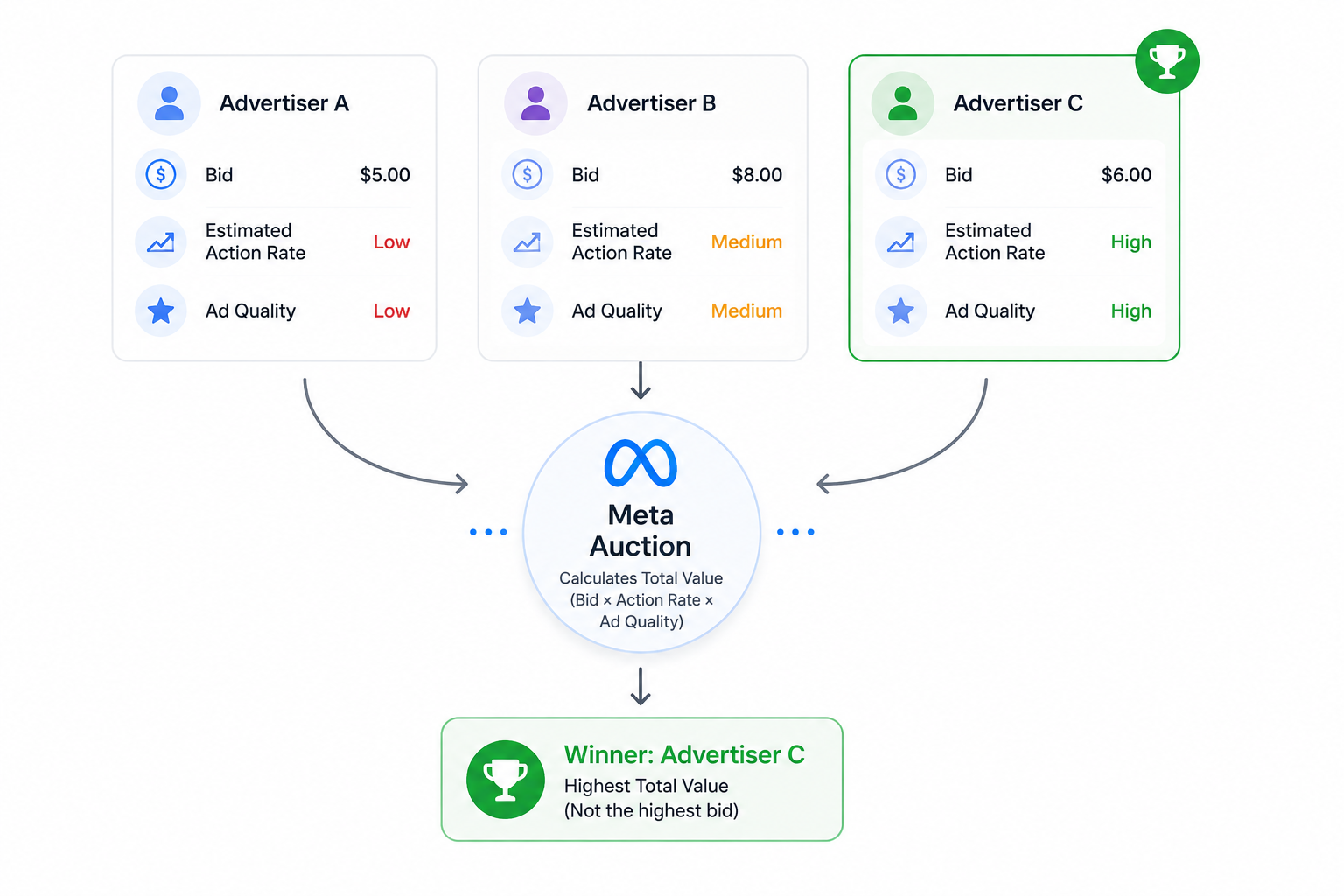
To prevent that, Meta calculates “total value” before choosing a winner. That value combines three major elements:
- Bid. The amount an advertiser is willing to pay for a desired result, such as a click, lead, or purchase.
- Estimated action rate. Meta’s prediction of whether a user will engage or convert after seeing the ad.
- Ad quality and relevance. Signals tied to user feedback, engagement patterns, landing-page quality, and low-quality creative behavior.
This explains why a smaller advertiser with strong creative and precise targeting can outperform a large brand with weak audience relevance.
Inside Ads Manager, these differences become visible through CPM, CTR, conversion rate, frequency, and quality ranking movement.
Why Higher Bids Alone Rarely Fix Poor Performance
One of the most common scaling mistakes is raising bids without fixing relevance problems.
That usually increases costs faster than conversions.
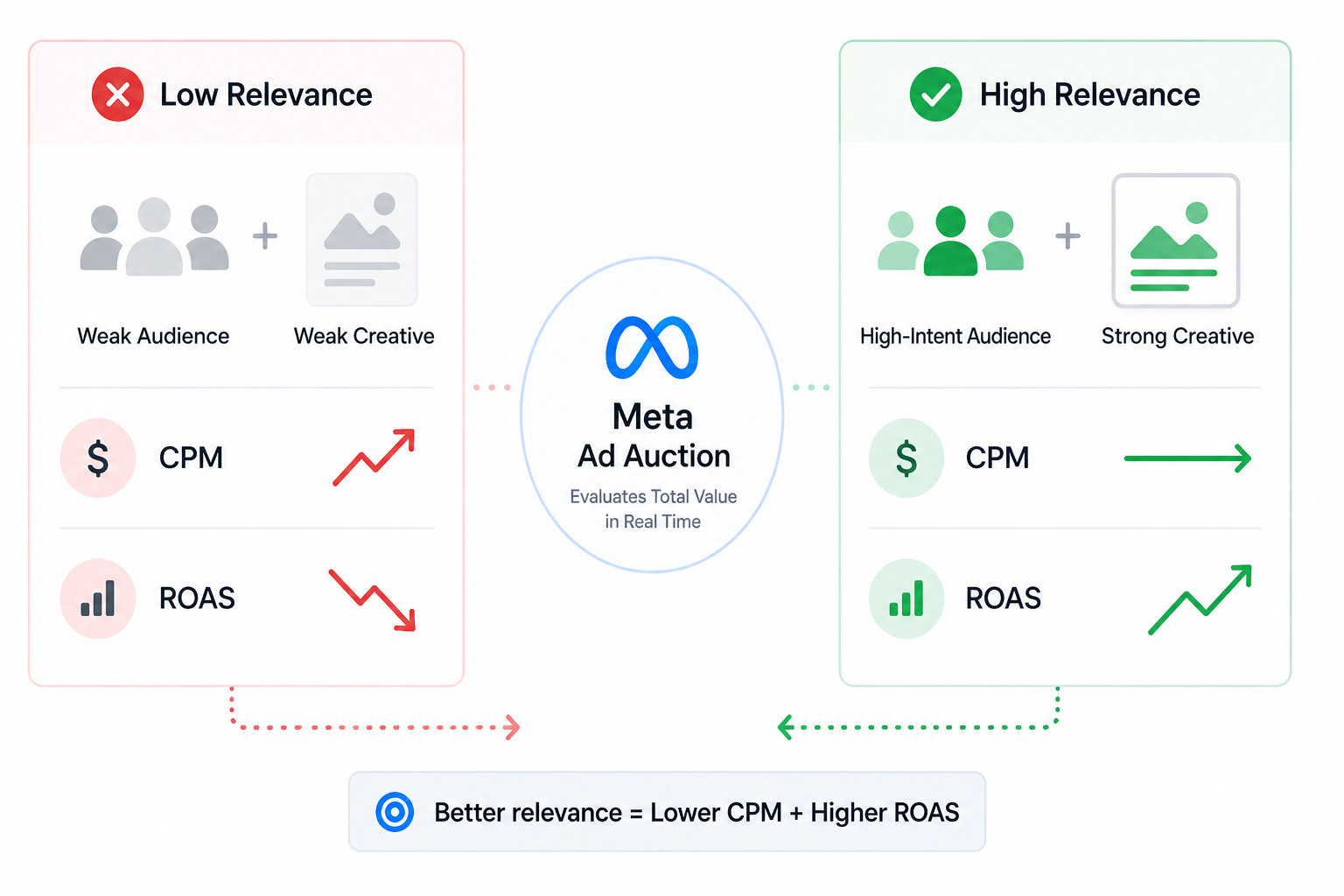
If Meta predicts weak engagement or poor conversion probability, the platform becomes less willing to prioritize your ad in competitive auctions. You may still win impressions, but often at a higher CPM and weaker efficiency.
Advertisers usually notice this pattern when:
- CPC rises while CTR declines;
- CPM spikes during scaling;
- conversion rates weaken despite higher spend;
- frequency climbs but purchases flatten;
- spend increases without additional reach.
In these cases, the auction is signaling weak expected value.
The solution is rarely “spend more.” It is usually better audience quality, stronger creatives, cleaner offers, or better conversion signals.
Estimated Action Rates Quietly Control Delivery
Estimated action rates are one of the most important parts of the auction system.
Meta constantly predicts whether a user is likely to click, watch, purchase, submit a lead form, or complete another desired action. Those predictions influence auction competitiveness heavily.
Strong advertisers improve estimated action rates by aligning four things tightly:
- audience intent;
- creative messaging;
- campaign objective;
- landing-page experience.
When those signals match, Meta gains confidence that showing the ad creates value for both the user and advertiser.
This is one reason broad targeting often becomes expensive over time. Meta initially finds cheap impressions, but estimated conversion quality may decline rapidly.
That is exactly why advertisers should understand why broad interest targeting wastes ad budgets.
The auction rewards predicted outcomes, not just cheap reach.
Ad Quality Influences CPM More Than Most Advertisers Realize
Meta explicitly uses ad quality as part of auction calculations.
That includes user feedback signals such as:
- hiding ads;
- low engagement;
- poor landing-page experience;
- clickbait language;
- misleading claims;
- engagement bait.
Advertisers often underestimate how aggressively Meta filters weak experiences.
Inside Ads Manager, low-quality ads frequently show these patterns:
- rising CPM despite stable targeting;
- weak outbound click quality;
- declining reach over time;
- poor quality ranking diagnostics;
- unstable delivery during scaling.
This becomes especially noticeable in competitive industries where many advertisers target similar audiences.
A high-quality ad can beat a higher bidder simply because Meta predicts users will respond better to it.
Audience Quality Changes Auction Performance
Not every audience competes equally inside the auction.
Some audiences generate stronger conversion signals naturally because the users already show intent, familiarity, or behavioral alignment with the offer.
This is why audience quality affects more than CTR.
It affects Meta’s confidence.
For example, an advertiser targeting highly engaged Facebook group members or Instagram followers connected to a niche interest often sees stronger estimated action rates than advertisers using massive broad-interest stacks.
That stronger signal can reduce wasted impressions and improve auction efficiency.
This is where LeadEnforce fits naturally into the process. Instead of relying only on Meta’s built-in interests, advertisers can build higher-intent audiences from Facebook groups, Instagram engagers, followers, and social-profile behavior tied to real community signals.
In many cases, that improves relevance before the auction even begins.
Why CPM Rises Even When Campaigns Look Healthy
Many advertisers panic when CPM increases.
Sometimes the campaign is actually performing normally.
Meta auctions constantly shift because advertisers enter and leave the system every second. Seasonal competition, audience saturation, creative fatigue, and conversion demand all affect pricing.
CPM increases often happen because:
- more advertisers target the same audience;
- your audience becomes saturated;
- creatives lose engagement momentum;
- conversion signals weaken;
- users stop responding to the offer at the same rate.
That is why advertisers should monitor more than CPM alone.
A higher CPM paired with rising conversion rate may still improve profitability. A lower CPM with collapsing purchase quality can destroy ROAS.
Understanding what influences CPM on Facebook ads helps advertisers separate healthy auction pressure from real delivery problems.
Bid Strategy Matters Less Than Most Advertisers Think
Meta offers multiple bidding strategies, including automatic bidding, cost caps, bid caps, and minimum ROAS controls.
Advertisers often obsess over bid settings while ignoring relevance problems.
In reality, bid strategy usually amplifies existing performance conditions rather than fixing them.
A weak audience with poor creative rarely improves because of aggressive bid caps. More often, delivery becomes unstable and learning slows down.
Strong campaigns typically scale because:
- estimated action rates stay healthy;
- conversion signals remain stable;
- creatives maintain engagement;
- audiences retain intent quality;
- landing pages convert consistently.
The auction rewards overall efficiency, not isolated settings.
The Auction Rewards Relevance More Than Aggression
Many advertisers approach Meta ads like a bidding war.
The system works more like a prediction engine.
Meta wants the ad most likely to create positive engagement, valuable actions, and long-term platform satisfaction. That is why relevance can outperform raw spend.
Advertisers who consistently win auctions usually focus on:
- cleaner targeting;
- stronger audience signals;
- better creative-to-audience fit;
- stable conversion behavior;
- positive user interaction patterns.
The auction is not just deciding who pays more.
It is deciding which advertiser Meta trusts most with user attention.
That is why understanding what you need to know about the Facebook ad auction becomes essential once campaigns start scaling seriously.