Applying for monthly invoicing sounds like a finance task.
For advertisers, it is also a campaign operations task.
If the application process creates access confusion, legal-entity mismatches, missing documentation, or unclear ad account assignments, the impact can reach campaign launch timelines and testing plans.
Meta’s indexed help result says eligible businesses see a notification in Meta Business Suite and can apply for monthly invoicing from there.
The goal is not only to submit the application.
The goal is to apply without slowing down the campaigns that depend on clean billing.
What the Application Process Is Really About
Monthly invoicing is tied to business eligibility and billing structure.
That means the application process is not just about entering payment details. It is about confirming that Meta can connect your business, billing entity, and ad accounts in a way that supports invoiced ad spend.
Meta’s indexed application source mentions reviewing terms and conditions, submitting the application, and uploading a legal document if the selected legal entity has not been approved.
Another indexed Meta result says that once approved, the line of credit appears in Credit lines inside Billing & payments, and it can then be assigned to ad accounts to pay for ads.
For marketers, that last step is critical.
A line of credit that is approved but not assigned to the right ad accounts does not help the campaigns that need it.
Why This Matters for Performance Teams
Campaign teams often discover billing dependencies too late.
Creative is ready. Audiences are prepared. Landing pages are approved. Then the billing setup becomes the blocker.
That delay can hurt performance in several ways.
Testing windows get missed.
Campaigns launch with smaller budgets than planned.
Media buyers use workaround accounts that fragment data.
Agencies spend time chasing finance access instead of optimizing campaigns.
High-intent audiences sit unused while billing access is resolved.
The application process has 4 common blockers: eligibility banner missing, legal entity mismatch, finance permissions unclear, and documentation gaps.
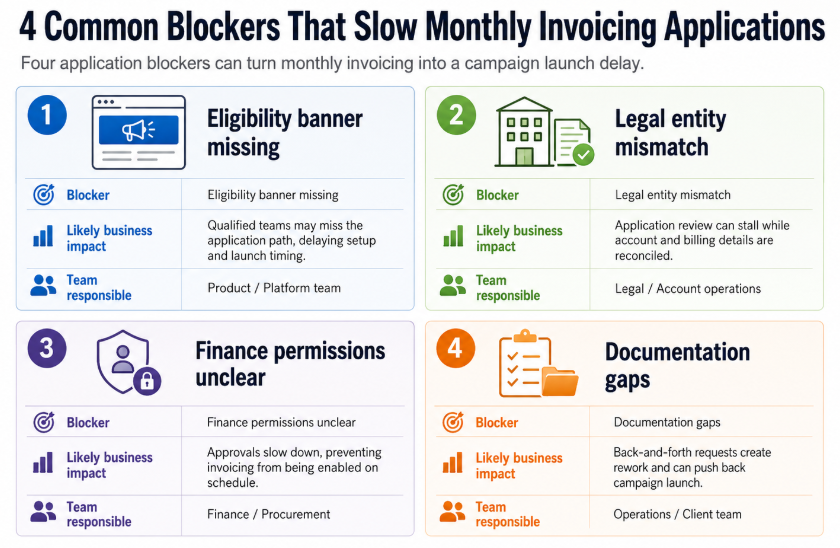
Four application blockers can turn monthly invoicing into a campaign launch delay
Each blocker can slow campaign testing if it is discovered during launch week.
Business Impact on CPC, CPA, CAC, ROAS, and Budget Efficiency
A monthly invoicing application does not directly improve CPC or ROAS.
But a failed or delayed application can hurt the systems that support those metrics.
When campaigns are delayed, teams lose momentum. When ad accounts are changed at the last minute, historical learning and audience structure may become less useful. When finance and media teams are misaligned, budget decisions become reactive instead of strategic.
The business impact is especially visible in:
- Higher CAC when campaigns must restart or relearn after billing delays.
- Weaker ROAS when budget is pushed into rushed tests.
- Lower lead quality when teams abandon planned audience segments and use broader backup targeting.
- Slower optimization cycles when billing setup interrupts the testing calendar.
- More wasted spend when campaigns launch in accounts that were not designed for the test.
Billing setup is not the same as performance strategy.
But bad billing setup can undermine performance strategy.
Typical Scenarios Where This Applies
Agencies onboarding larger clients
The client may be eligible for monthly invoicing, but the agency still needs clarity on who owns the credit line, which ad accounts are assigned, and who can manage billing.
Businesses consolidating ad spend
A company moving from scattered payment methods to invoicing needs a clean map of ad accounts, business entities, and internal owners.
B2B teams preparing major lead-gen campaigns
If the campaign depends on a fixed launch date, invoicing delays can disrupt the entire test plan.
Ecommerce brands entering seasonal peaks
Peak-season campaigns should not rely on an invoicing setup that has not been approved, assigned, and checked.
Startups preparing to scale paid acquisition
A startup may be ready to increase budget, but if business details, verification, and finance roles are incomplete, invoicing can become the first scaling bottleneck.
Risks and Considerations
Do not treat monthly invoicing approval as guaranteed.
Eligibility, documentation, legal-entity data, and business access can all affect the process.
Advertisers should avoid several mistakes.
Do not apply with inconsistent legal business information.
Do not assume the person who runs campaigns has the finance permissions needed to manage billing.
Do not wait until launch week to check whether the credit line is assigned to the right ad accounts.
Do not create new ad accounts as a workaround unless there is a clear strategic reason.
Do not move budget into broad campaigns simply because the planned high-intent audience test is blocked by billing setup.
Most importantly, do not confuse “approved” with “operationally ready.”
The line of credit must support the campaigns that actually need to spend.
Prerequisites and Dependencies
Before applying, confirm:
- The business is eligible or has the application notification.
- The legal entity is correct.
- Business information matches official records.
- Someone with the right finance permissions can complete the process.
- Required legal documents are available if requested.
- The ad accounts that need the credit line are identified.
- Internal finance and marketing teams agree on who owns invoice review.
- The campaign team has a backup plan if approval or assignment takes longer than expected.
While the application is pending, prepare 3 campaign-readiness items: audience hypotheses, test budgets, and approval workflow.
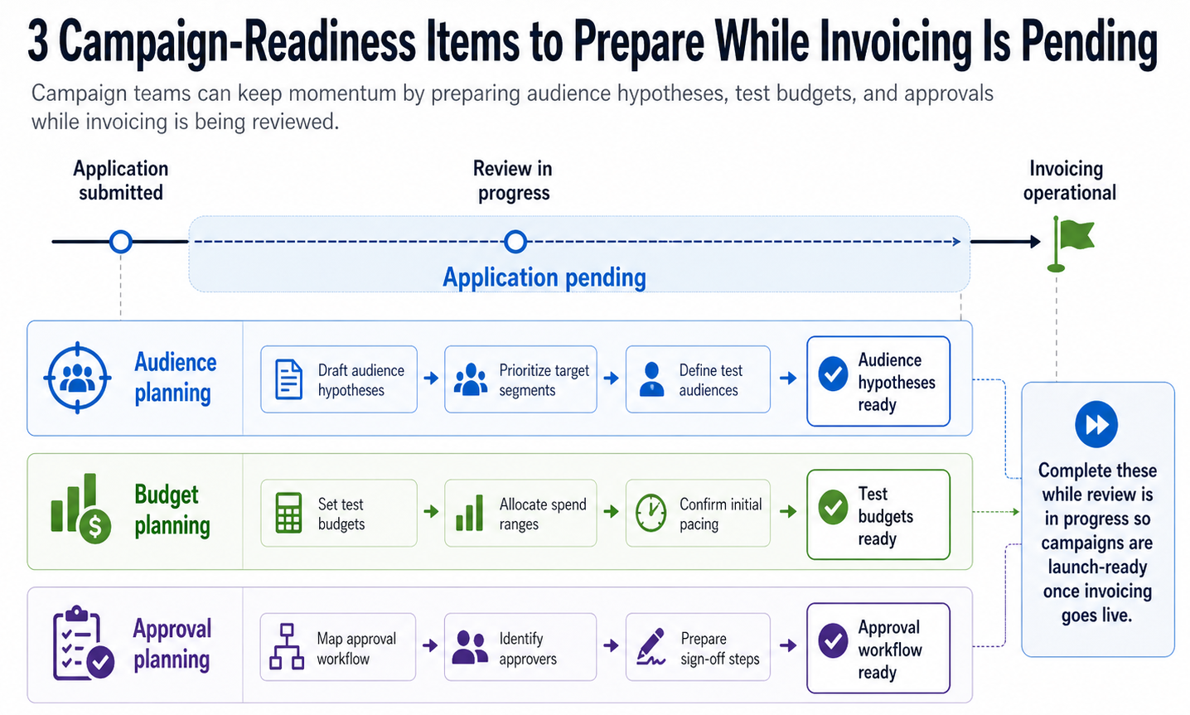
Campaign teams can keep momentum by preparing audience hypotheses, test budgets, and approvals while invoicing is being reviewed
That way, the marketing team keeps moving even if finance setup is still in progress.
How LeadEnforce Helps
LeadEnforce helps advertisers use the application period productively.
While finance or operations teams handle monthly invoicing, the performance team can prepare higher-intent audience tests.
With LeadEnforce, advertisers can identify and build audiences from Facebook groups, Instagram profiles, followers, engagers, LinkedIn professional data, and custom social-profile data.
That is useful because billing approval only creates the ability to spend.
LeadEnforce helps improve the quality of where that spend goes.
For example, a B2B advertiser waiting for monthly invoicing can prepare audience segments around job roles, professional communities, LinkedIn-derived criteria, and niche Facebook groups.
An ecommerce brand can prepare segments from Instagram followers of relevant niche accounts or competitor-adjacent communities.
An agency can prepare audience options before the client’s invoicing setup is complete, then activate the strongest tests once billing access is ready.
This reduces dead time and keeps the launch focused on relevance, not just budget availability.
Practical Recommendations
Start the monthly invoicing application before major campaign launches, not during them.
Assign one finance owner and one marketing owner for the process.
Confirm the exact ad accounts that need to use the line of credit.
Document the legal entity, billing address, finance permissions, and required documents.
Keep campaign tests ready, but do not depend on unapproved billing for urgent launches.
Use LeadEnforce to prepare high-intent audience segments during the application period.
After approval, run a structured campaign test before pushing larger budgets through the new billing setup.
Review performance and billing together after the first invoice cycle.
Final Takeaway
Applying for Meta monthly invoicing is not just a payment workflow.
It is part of campaign readiness.
Eligible advertisers should treat the application as a structured operating project: confirm access, align legal information, assign the right ad accounts, and prepare higher-quality audience tests before budget expands.
That is how monthly invoicing supports performance instead of delaying it.
Related LeadEnforce Articles
- How to Verify Your Business in Meta Business Suite (Step-by-Step Guide) — Relevant because verification, business details, and trust signals often overlap with advanced billing readiness.
- Fix Meta Business Verification Issues and Restore Ad Performance — Helps advertisers troubleshoot the business-identity problems that can slow scaling and billing workflows.
- No Full Control of Your Meta Business Portfolio? Fix Access Before Campaigns Stall — Useful when finance access or portfolio control blocks invoicing and campaign execution.
- Why Your Meta Business Portfolio Setup Affects Paid Social Performance — Explains why portfolio structure matters before advertisers scale spend or assign billing.
- How to Give an Agency Partner Access to Meta Assets Without Losing Campaign Control — Helpful for agencies and clients coordinating billing, asset access, and campaign management.