Running Facebook and Instagram campaigns manually is no longer sustainable at scale. As advertising platforms grow more complex, automation is now a necessity — not a luxury. But most advertisers fear the tradeoff: faster execution often comes with less precision, fewer creative controls, and unclear attribution.
If you want to stay competitive, you need a framework that lets you automate for efficiency — without compromising on quality, brand integrity, or results.
This guide is written for experienced advertisers, media buyers, and marketing strategists who want to streamline operations while maintaining control where it counts most.
Why You Must Embrace Automation (Strategically)
Meta’s automation ecosystem — particularly through its Advantage suite — now governs a majority of performance-driven delivery. In fact, Facebook’s algorithm can now outperform most manual setups in both scale and speed.
But automation without structure leads to chaos. It can easily result in poor creative delivery, misaligned funnel flows, and wasted budget.
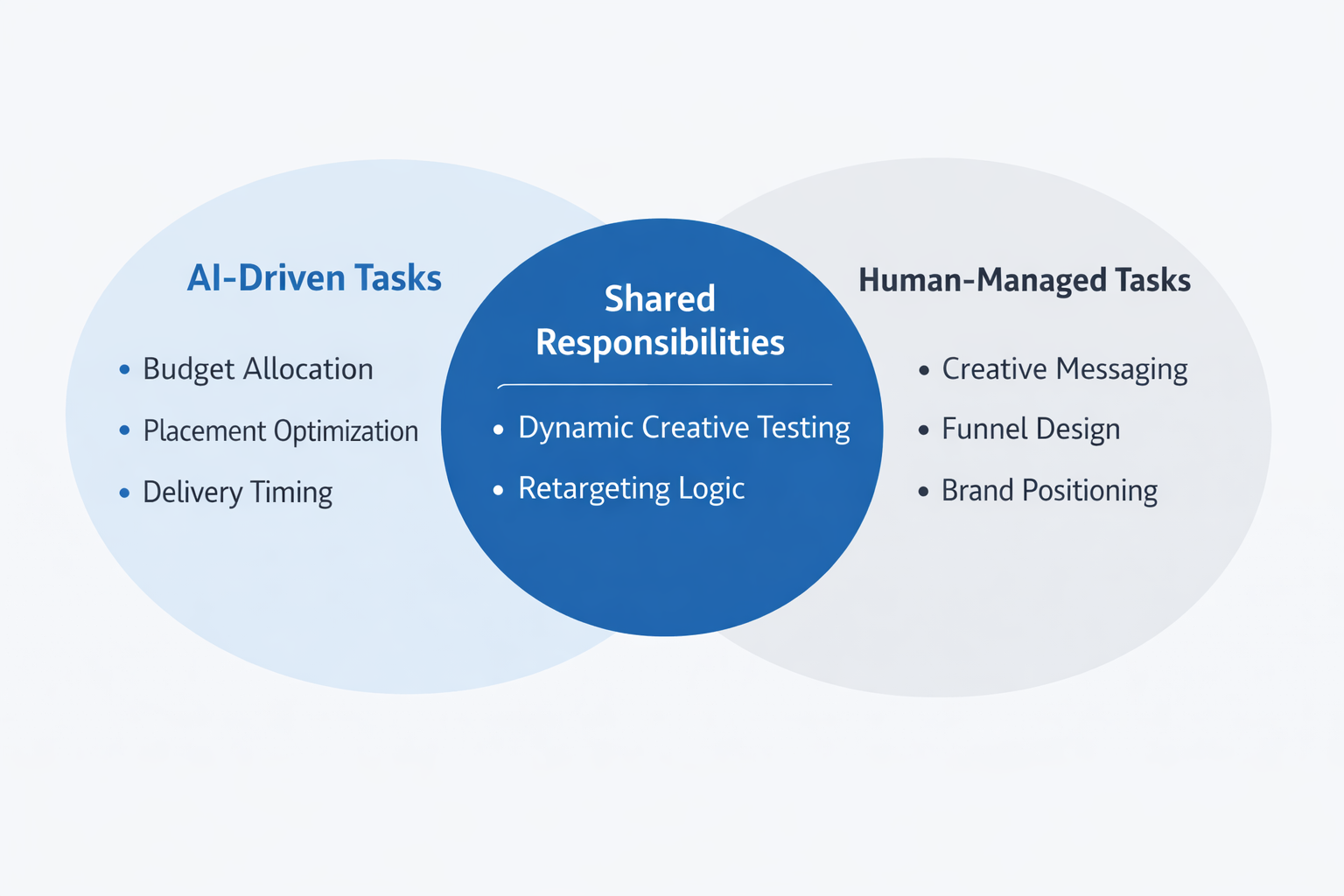
The solution isn’t to reject automation — it’s to direct it with expert-level systems. That means:
-
Automating tactical tasks that AI handles better than humans — like budget distribution, placement optimization, and delivery pacing;
-
Retaining control over strategic areas — such as messaging architecture, creative frameworks, and full-funnel sequencing.
Think of automation not as autopilot, but as augmented execution — where you program the system to follow high-quality strategic inputs.
For a real-world breakdown of how Advantage+ tools help achieve that balance, read Efficient Scaling Made Easy with Advantage+ Campaign Automation.
What to Automate — For Performance at Scale
Campaign Structure and Budget Allocation
Meta’s newer campaign models — like Advantage+ Shopping and App Campaigns — allow advertisers to consolidate ad sets, reduce fragmentation, and focus on creative inputs. These campaigns dynamically allocate spend based on real-time performance across audiences, placements, and even devices.
If you're running manual ABO setups across several micro-audiences, you’re likely over-segmented. Not only are you slowing learning, you're also diluting creative insights.
Advanced implementation tip:
-
Set up consolidated Advantage+ campaigns with broad targeting;
-
Include 4–6 distinct creatives per product, each aligned with a different angle (social proof, pain point, emotional benefit, scarcity);
-
Limit campaign budget initially to avoid uncontrolled early spend. Scale gradually based on stable learning and creative winners.
This structure lets Meta’s delivery system do what it does best — optimize for conversions at scale.
Audience Targeting and Signal Engineering
Manual audience layering is quickly becoming obsolete. Meta’s platform now favors signal density over hyper-specific interests.
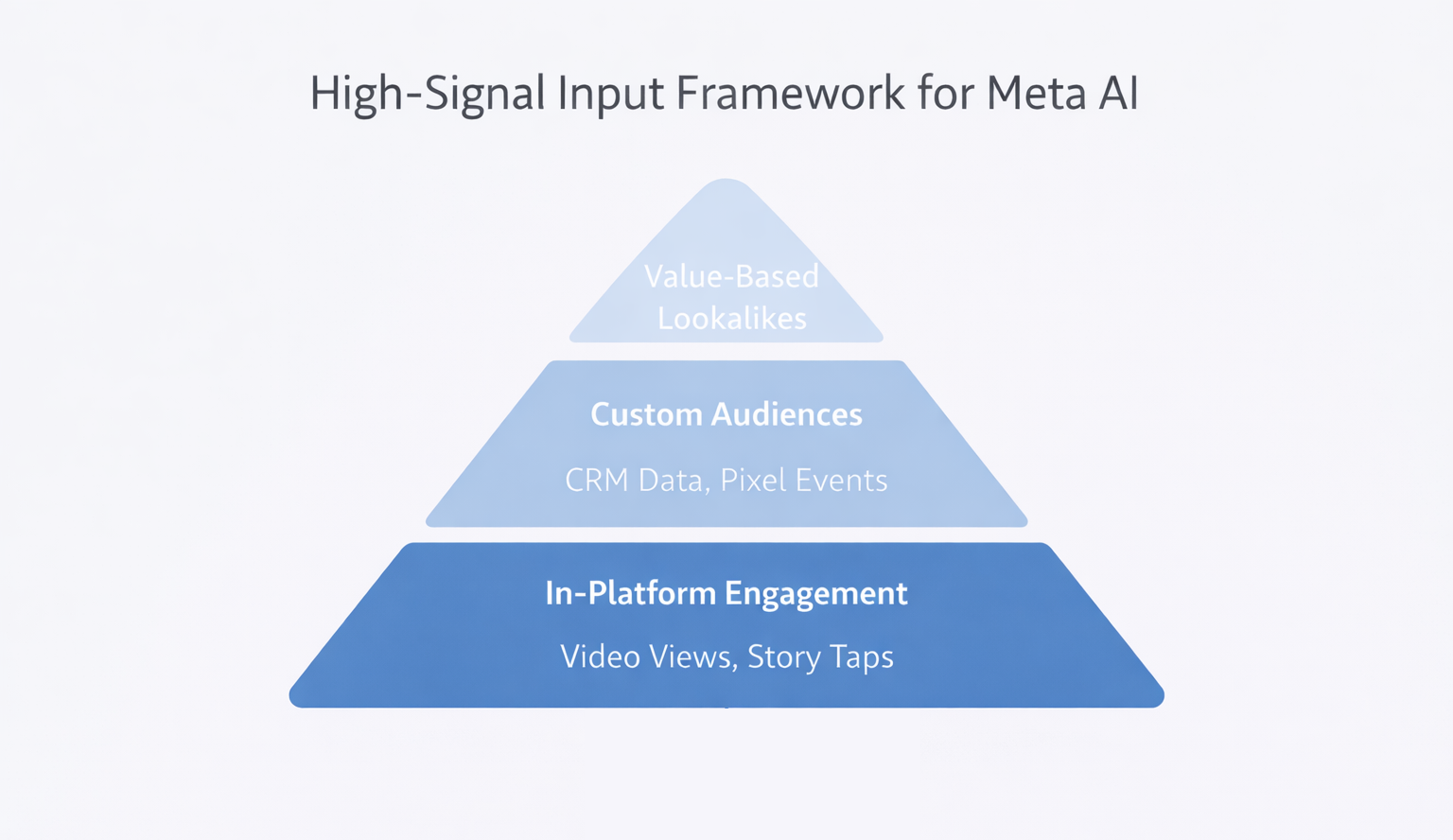
Instead of stitching together stacks of behaviors and demographics, feed the system high-quality inputs:
-
Value-based lookalike audiences (e.g., top 10% by LTV);
-
Custom audiences from CRM, product usage, or lead quality data;
-
In-platform behavior signals — video views, post saves, and high dwell time interactions.
Important: Exclusions matter as much as inclusions. Always suppress:
-
Recent converters (1–7 days);
-
Low-quality leads (via CRM backfeeds);
-
High-frequency users who haven’t converted.
Use automation to broaden reach, but use signals to guide intent. That’s how you build intelligent prospecting systems.
What to Keep Manual — Strategic Leverage Zones
Creative Architecture and Brand Control
Automation can't tell your story. It can’t understand nuance, emotional triggers, or category-specific insight. That’s why creative is the last place to give up control.
Before plugging into dynamic creative testing, map your creative angles:
-
Emotional hooks — e.g., relief from pain, transformation, belonging;
-
Rational proofs — e.g., data points, expert quotes, product specs;
-
Offer structures — e.g., bundles, urgency, money-back guarantees.
Then build creative clusters around those frameworks. Each cluster should include:
-
A static image or video;
-
A matching primary text and headline;
-
Variants of CTAs tailored to the user intent.
Pro tip: Use naming conventions in ad libraries (e.g., "Benefit_Proof_V1") to track which angles scale and which fail.
Funnel Mapping and Lifecycle Sequencing
Meta can’t manage user journey logic. That’s your job.
You still need to structure campaigns across funnel stages — otherwise, automation flattens everything into a single conversion event.
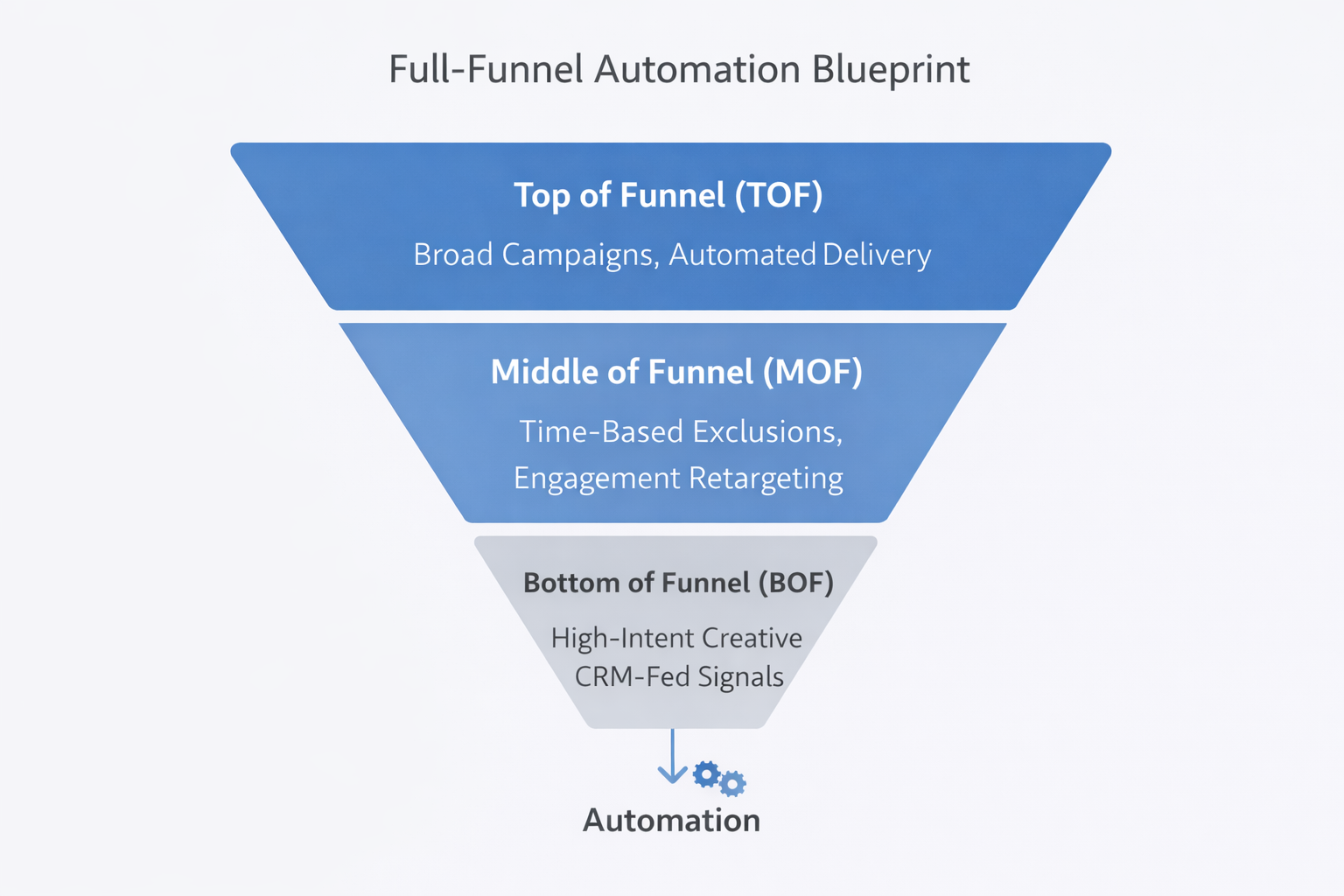
Recommended funnel architecture:
-
Top of Funnel (TOF): Broad Advantage+ campaigns, no exclusions, focused on attention and engagement;
-
Middle of Funnel (MOF): Retargeting via 7–30 day engagement windows — video views, page views, IG engagers;
-
Bottom of Funnel (BOF): Dynamic product ads, testimonials, offer-focused messages, cart abandoners.
Each stage requires different creative, messaging, and delivery logic. Use time-based exclusions to guide users from awareness to action.
Advanced tactic: Feed conversion events back into Meta from your CRM or backend — segmented by quality, not just quantity. That allows smarter optimization and tighter sequencing.
If you want a deeper look at why automation sometimes fails — and how to prevent it — don’t miss The Dark Side of Facebook Ads Automation: Hidden Trade-Offs.
Tools That Support Automation With Control
Meta's Native Tools — Use Them Correctly
These are the native Meta tools most performance advertisers should be using — selectively:
-
Advantage+ Shopping Campaigns: Ideal for eCommerce brands with deep SKU catalogs and diversified creatives. Avoid if you have only one ad variation;
-
Dynamic Creative Optimization (DCO): Useful for testing permutations within a theme — not for running random mixes. Disable asset customization if brand consistency matters;
-
Advantage+ Creative Enhancements: Use selectively. Brightness and text animation can increase engagement, but may lower perceived brand quality.
Avoid: Automated music, auto-cropping, and auto-CTA options unless you're working with casual UGC creatives.
Third-Party Automation Platforms
When native tools aren't enough, third-party platforms can fill the gap by adding logic, scaling rules, and better creative testing infrastructure.
Top platforms for professionals:
-
Revealbot — Build automated rules (e.g., kill ad sets after 3 hours above CPA threshold);
-
Madgicx — Combines creative testing, audience exploration, and budget scaling under one dashboard;
-
Leadenforce — Built for Advantage+ optimization, creative feeds, multilingual testing, and automated campaign rebuilds.
Pro tip: Use third-party tools to build pre-scaling conditions — only increase budget after X ROAS over Y impressions for Z time. This protects against volatile learning phase errors.
How to Maintain Quality as You Scale
Build Constraints Into Your Automation
Automation works best when you give it boundaries. Set thresholds that prevent overspending, audience fatigue, or brand erosion.
Set up:
-
Cost caps (not bid caps) to maintain CPA targets;
-
Frequency caps per audience segment — 2/day for MOF, 1/day for BOF;
-
Budget limits per country or language for geo-specific control.
Think of automation like a self-driving car — you still need lanes, speed limits, and road signs.
Create a Creative Supply Chain
No amount of automation can fix creative fatigue. If your CTRs drop and CPMs rise, your audience is burned out.
Build a content pipeline with:
-
Weekly or biweekly creative launches;
-
Templates for each ad type (UGC, testimonial, carousel, static);
-
A/B testing schedules and win/loss criteria.
Advanced tip: Use asset-level breakdowns to identify fatigue velocity — how fast each creative deteriorates over spend. Use this to forecast refresh cycles.
Audit, Iterate, Improve
Automation ≠ autopilot. Set a recurring audit process.
Weekly or biweekly audits should include:
-
CPA, ROAS, CTR by campaign and audience source;
-
Spend efficiency during learning vs. stable phases;
-
Creative performance mapped against user behavior (e.g., click depth, scroll depth, bounce rate).
Overlay your data with performance trends — not just campaign-level, but creative-level and audience-intent level.
Final Thoughts: Automate What You Can, Own What You Must
Meta’s algorithm has never been stronger. But it still can’t think. It doesn’t know your brand, your audience, or your funnel strategy.
The best advertisers will be those who combine strategic inputs with AI execution — who automate repeatable tasks but retain ownership of positioning, creative intent, and conversion paths.
Use automation not to simplify your work — but to multiply your impact.
To understand where this is all going, check out The Future of Meta Advertising: What’s Next After AI Automation. It’s a deep dive into what's coming — and how to prepare.