Many Facebook and Instagram ad campaigns waste budget because they are built without a clear understanding of how the platform optimizes delivery.
In most cases, poor performance is not caused by the algorithm itself but by unclear goals, unstable setups, or constant changes that prevent learning.
When advertisers focus on fixing fundamentals instead of reacting emotionally to short-term data, performance becomes more predictable and efficient.
This article explains where ad spend is commonly wasted and how to prevent it using simple, practical adjustments.
Why Facebook Ads Often Underperform
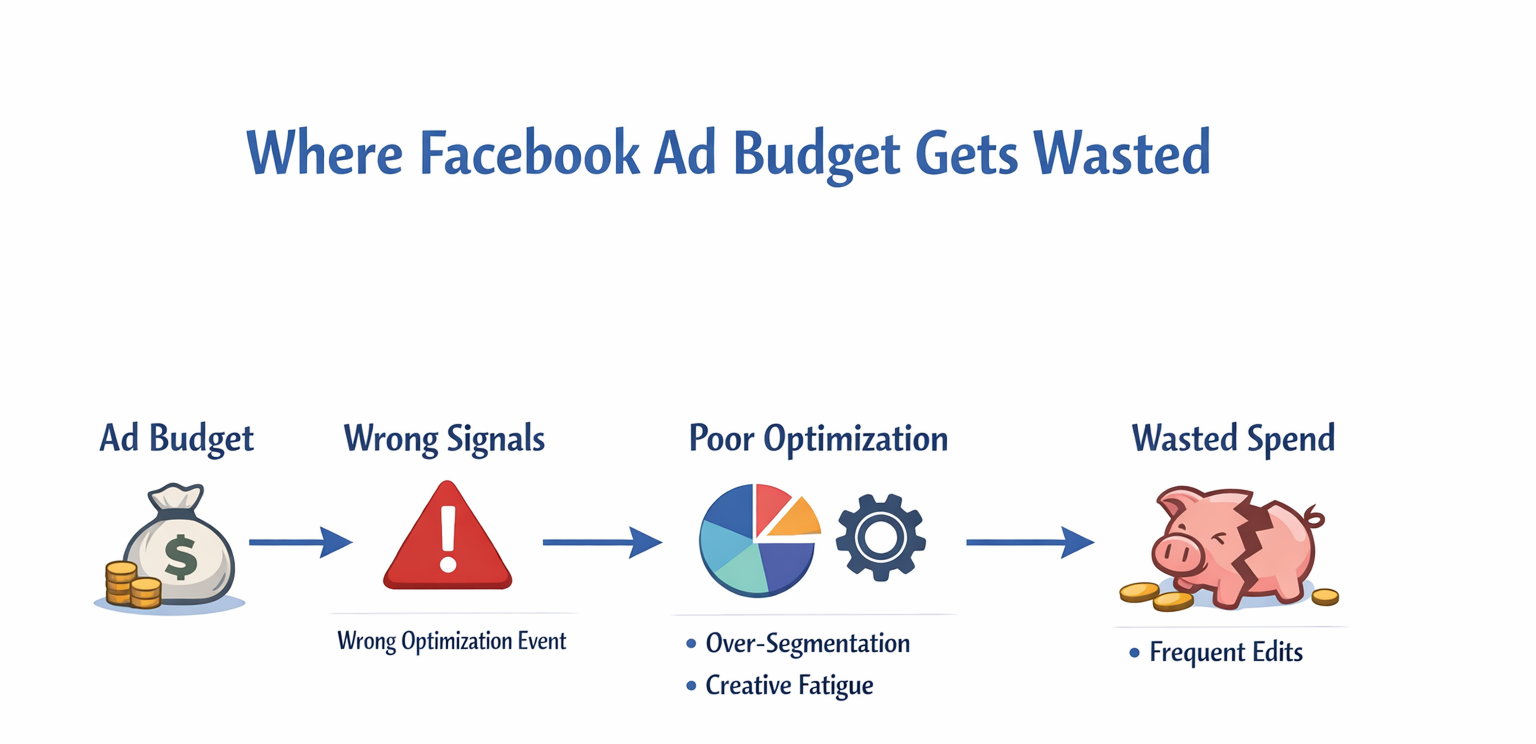
Underperforming Facebook ads rarely fail for one dramatic reason, but instead suffer from several small issues that slowly drain budget.
Facebook relies on consistent data signals to learn who is most likely to take action, and weak inputs make that process inefficient. When campaigns lack clarity or stability, the system delivers ads broadly without finding high-quality users.
| Issue | What It Looks Like in Ads Manager | Why It Wastes Budget | How to Fix It |
|---|---|---|---|
| Wrong optimization event | High spend, low conversions | Optimizes for low-intent users | Switch to a higher-intent event |
| Over-segmentation | Many ad sets with small budgets | Learning never stabilizes | Consolidate ad sets |
| Creative fatigue | Rising CPMs and frequency | Engagement signals decline | Refresh creatives |
| Frequent campaign edits | Learning keeps resetting | Optimization never matures | Reduce changes and wait |
| Weak post-click experience | Clicks without conversions | Message breaks after the click | Align landing page with ad |
A common example is excessive or poorly defined interest targeting, which often looks precise but actually limits delivery and increases costs, as explained in Why Broad Interest Targeting Wastes Ad Budgets.
Clear Signs Your Budget Is Being Wasted
Most campaigns show early warning signs that advertisers often ignore until spend increases.
-
High spend with few conversions, which usually means the campaign is optimizing for the wrong behavior or low-intent users.
-
Healthy click numbers with weak results, often caused by attractive ads that do not match the landing page or offer.
-
Gradually increasing costs, which often indicate learning instability, creative fatigue, or inefficient audience structure.
Identifying these patterns early helps stop inefficient spending before it scales.
Set Clear Goals Before You Spend More
Facebook can only optimize toward the objective and conversion event you give it. If those signals are vague or poorly chosen, the system will deliver impressions that look active but produce little value.
Clear goals reduce waste by aligning budget with outcomes that actually matter to the business.
Choose Conversion Events That Match Intent
Selecting the wrong primary event often leads to fast spend and weak returns.
-
Optimizing for clicks instead of conversions attracts users who are curious but unlikely to buy or submit forms.
-
Using very rare events too early, such as purchases on cold traffic, limits data and slows learning.
-
Mismatch between funnel stage and event, which confuses delivery and weakens optimization.
The best event is one that balances user intent with enough volume for learning.
Simplify Campaign Structure to Improve Efficiency
Complex campaign structures often look strategic but usually scatter budget across too many variables.
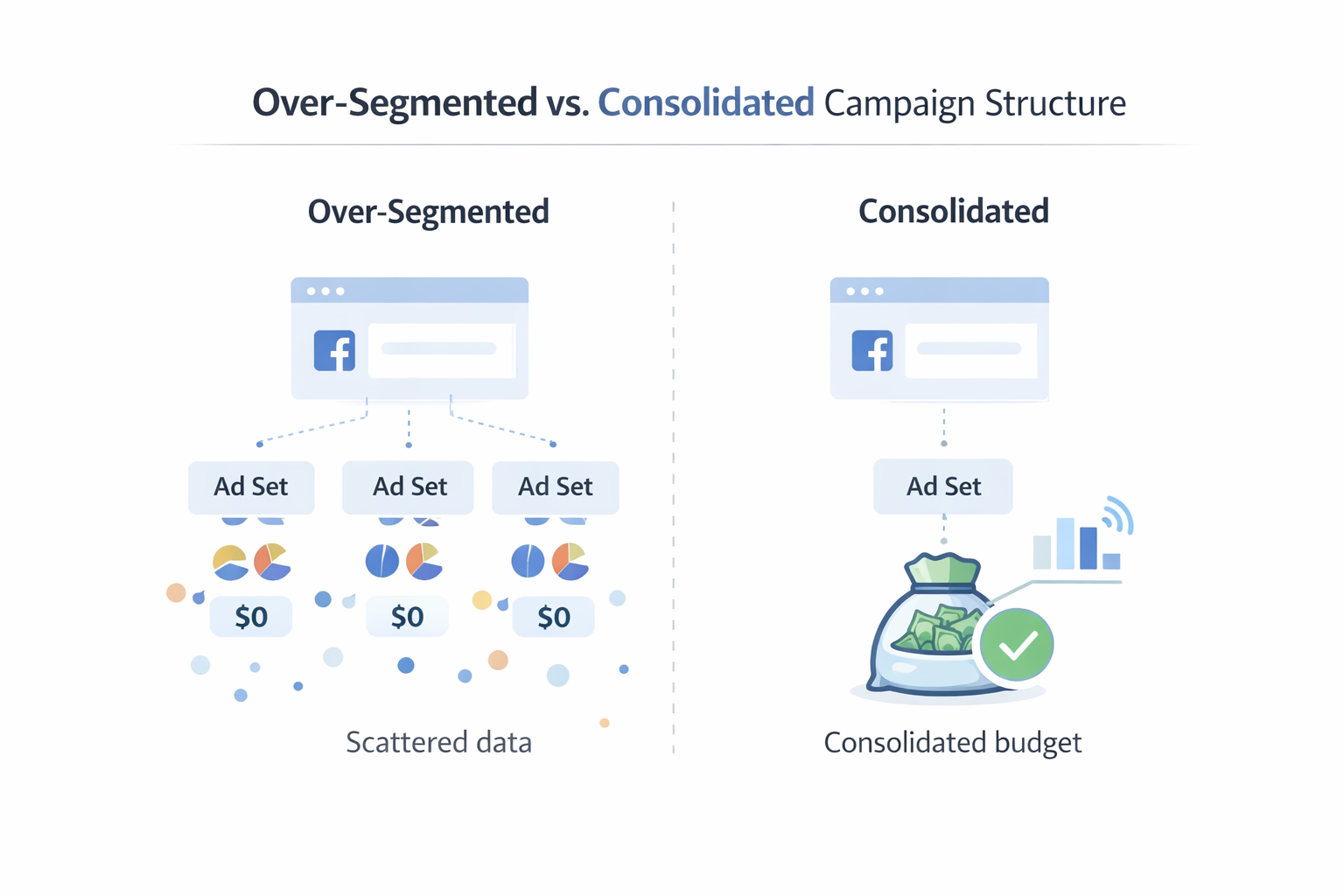
Facebook performs better when it can concentrate data and learn faster from fewer signals. Simplifying structure often improves performance without increasing spend.
Many wasted budgets are uncovered during professional audits because inefficient structures hide problems at scale, as outlined in How Agencies Audit Facebook Ads to Uncover Hidden Wasted Spend.
Avoid Over-Segmentation
Breaking campaigns into too many small ad sets restricts optimization and raises costs.
-
Small budgets per ad set prevent stable delivery and meaningful performance trends.
-
Overlapping audiences force ad sets to compete against each other in the auction.
-
Heavy targeting restrictions reduce reach and limit Facebook’s ability to find converters.
These issues often come from flawed audience design, which is covered in 5 Audience Segmentation Mistakes That Waste Ad Budget.
Use Automated Rules to Protect Your Budget
Automated rules help prevent budget waste by reacting faster than manual monitoring allows. When configured correctly, they remove emotional decision-making and enforce consistent performance standards.
| Rule Type | Trigger Condition | Action Taken | Benefit |
|---|---|---|---|
| Spend-based pause | No conversions after a set spend | Pause ad set | Stops early losses |
| Cost control | CPA exceeds defined threshold | Reduce budget | Limits overspending |
| Frequency alert | Frequency rises above set limit | Send notification | Prevents creative fatigue |
| Performance drop alert | Sudden CTR or conversion decline | Send notification | Enables faster intervention |
| Scaling guardrail | Rapid spend increase detected | Freeze budget changes | Protects learning stability |
Rules are especially useful for stopping loss-making spend before it compounds.
Practical Ways to Use Automated Rules
Simple rules can significantly reduce unnecessary spend without harming learning.
-
Pause ads with no conversions after a defined spend, which prevents early-stage underperformers from draining budget.
-
Reduce budgets when costs exceed thresholds, allowing campaigns to stabilize instead of overspending.
-
Notify when frequency or costs spike, so issues are addressed before performance collapses.
A structured approach to automation is explained in The Smart Way to Automate Budget Allocation Using Automated Rules.
Watch Creative Performance Closely
Even well-structured campaigns lose efficiency when creatives stop resonating with the audience.
Facebook heavily weights engagement signals when deciding how often and to whom ads are shown. Ignoring creative performance leads to rising costs and declining results.
Signs Creative Is Hurting Performance
Creative issues usually appear before conversions drop sharply.
-
Declining click-through rates, which suggest users no longer find the message relevant.
-
Rising costs with steady impressions, often caused by weaker engagement signals.
-
Good engagement but poor conversions, which usually indicates message misalignment after the click.
Refreshing messaging is often more effective than adjusting targeting.
Reduce Unnecessary Changes That Reset Learning
Frequent campaign edits are one of the most common causes of wasted Facebook ad budget.
Every major change forces the system to relearn who responds best to the ad. This restarts optimization and temporarily increases costs.
Changes That Commonly Hurt Performance
Some adjustments are more disruptive than advertisers expect.
-
Large budget increases or decreases, which destabilize delivery patterns.
-
Audience changes during learning, which remove historical performance data.
-
Replacing creatives too quickly, which erases engagement signals.
Allowing campaigns time to stabilize usually improves efficiency.
Focus on Metrics That Reveal Real Problems
Surface-level metrics can make underperforming campaigns appear healthy. Looking deeper helps identify where budget is actually being wasted.
Better analysis leads to better decisions.
| Metric | What a Problem Looks Like | Likely Cause | Recommended Action |
|---|---|---|---|
| Frequency | Above 3.0 and still rising | Audience saturation | Expand or refresh audiences |
| CTR | Declining over time | Creative fatigue | Update messaging or formats |
| Conversion rate | Low after the click | Landing page mismatch | Improve page clarity or offer |
| CPM | Increasing without reach growth | Weak engagement signals | Refresh creatives or simplify targeting |
| Time to conversion | Long delays before converting | Misaligned expectations | Adjust messaging or funnel stage |
Metrics That Matter More Than Clicks
These indicators provide clearer insight into performance quality.
-
Frequency trends, which reveal audience fatigue or overserving.
-
Post-click conversion rates, which highlight landing page or offer issues.
-
Time to conversion, which shows whether expectations align with user intent.
Understanding these signals prevents unnecessary structural or targeting changes.
Final Thoughts
Avoiding wasted spend on Facebook ads comes from discipline, clarity, and consistency rather than constant optimization tactics.
Most underperforming campaigns fail because they send mixed or unstable signals to the platform.
Advertisers who simplify setups, avoid segmentation mistakes, and use automated safeguards usually achieve stronger and more stable results.